

The Bible’s composition spans approximately 1,500 years, beginning with Old Covenant portions around 1500-1400 BC during the formation of the Pentateuch and concluding with New Covenant writings by 100 AD. Key periods include the Davidic era around 1030 BC when earliest Psalms emerged, the prophetic writings from 760-430 BC, and the Greek Septuagint translation in 250-200 BC. New Testament books were written between 45-100 AD, with Paul’s letters and James’s epistle among the earliest. This extensive timeline reveals the gradual development of biblical literature across diverse historical contexts.
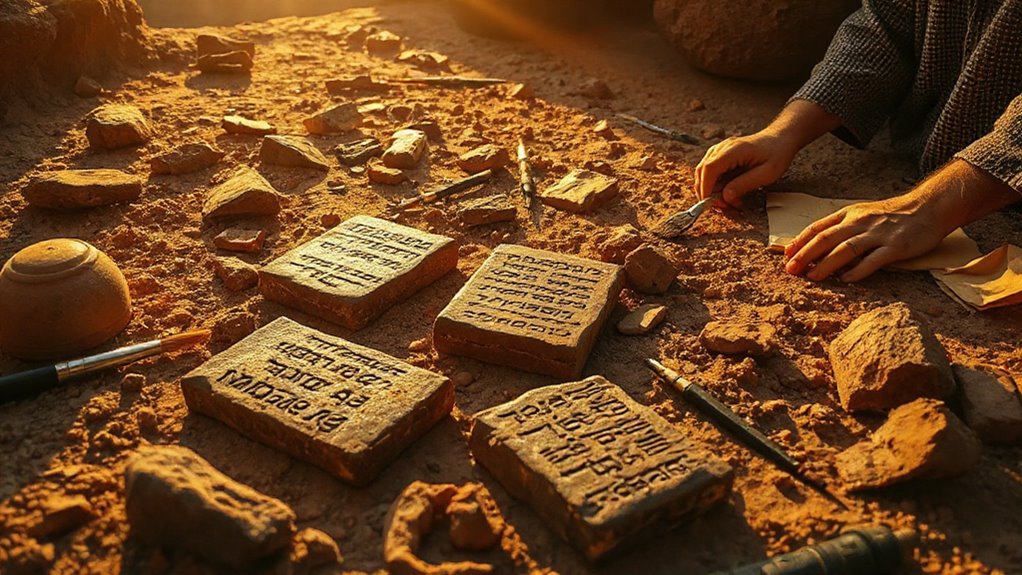
The Bible’s composition spans over a millennium, representing one of history’s most extensive and influential literary projects that emerged from ancient civilizations across the Near East. Modern scholarship highlights composite authorship and editorial shaping in the Bible’s formation. The earliest portions of the Old Testament began taking shape around 1500-1400 BC, with foundational elements of the Pentateuch emerging during this period. The Exodus narrative, traditionally dated to 1446 BC, marks vital early roots of biblical storytelling, while the Book of Joshua reflects events from approximately 1405-1385 BC according to biblical chronology.
During the period of Judges and early monarchy, biblical literature continued developing. The Psalms originated across a vast timespan from 1410 BC to 450 BC, with the earliest compositions attributed to the Davidic period around 1030 BC. Books like Samuel and Kings were primarily composed between 930-540 BC, though much earlier content likely existed in oral tradition before being committed to writing.
Biblical literature evolved continuously during the Judges period and early monarchy, with the Psalms spanning nearly a millennium of composition.
The era of divided kingdoms produced significant prophetic literature. Amos wrote between 760-750 BC, followed by Hosea from 750-715 BC and Micah from 735-700 BC. Isaiah’s prophecies emerged around 700-681 BC, while later prophets including Nahum, Zephaniah, and Habakkuk wrote leading up to Jerusalem’s fall in 586 BC. This catastrophic event inspired Lamentations and Ezekiel‘s prophecies from 593-571 BC.
The post-exilic period brought additional writings as Jewish communities rebuilt. Daniel began around 530 BC, while Ezra, Nehemiah, and Esther were composed between 440-400 BC. Prophets like Haggai and Zechariah wrote during temple reconstruction around 520 BC, with Malachi representing one of the final Old Testament voices around 440-430 BC.
The Greek Septuagint translation emerged between 250-200 BC, making Hebrew scriptures accessible to broader audiences. Several centuries later, New Testament writings began with Paul’s letters around 50-51 AD. The Gospels followed, with Mark written circa 70 AD and John completing the collection around 90-100 AD. James wrote his epistle between 45-50 A.D., making it potentially the earliest New Testament book.
Frequently Asked Questions
Who Decided Which Books Would Be Included in the Bible?
The Bible’s canon was determined through a gradual process involving Jewish authorities, early Christian leaders, and church councils. Jewish scholars established the Hebrew Scripture canon by the second century BC.
Early Christians like Athanasius identified the twenty-seven New Testament books by 367 CE. The Council of Rome in 382 CE and subsequent councils at Hippo and Carthage formally affirmed the complete biblical testament that remains widely accepted today.
How Accurate Are the Earliest Surviving Bible Manuscripts?
The earliest surviving biblical manuscripts demonstrate remarkable accuracy despite being copies made centuries after the originals. The Dead Sea Scrolls show striking fidelity to later texts.
While early New Testament papyri like P75 align closely with fourth-century manuscripts. Though textual variants exist due to manual copying, scholars can reconstruct reliable original texts through careful comparison of these ancient witnesses.
What Languages Was the Bible Originally Written In?
The Bible was originally written in three languages. The Old Covenant was primarily composed in Biblical Hebrew, with some sections in Aramaic, particularly parts of Ezra, Daniel, and one verse in Jeremiah.
The entire New Covenant was written in Koine Greek, the common language of the Eastern Mediterranean from 300 BC to 300 AD, which enabled the Christian message to spread throughout the Graeco-Roman world.
Why Are There Different Versions of the Bible Today?
Different Bible versions exist today due to varying translation philosophies and manuscript sources. Some translations prioritize word-for-word accuracy like the ESV, while others emphasize readability like the NIV.
Modern versions utilize broader manuscript evidence than older translations such as the King James Version. Denominational preferences, updating archaic language, and balancing scholarly precision with accessibility have created multiple versions serving diverse reader needs and theological traditions.
How Do We Know the Bible Wasn’t Changed Over Time?
Scholars point to extensive manuscript evidence supporting the Bible’s faithful transmission. Over 5,800 Greek New Testament manuscripts exist, many within a century of originals.
The Dead Sea Scrolls show Hebrew scriptures remained virtually unchanged across centuries. Ancient scribes like the Masoretes used meticulous copying procedures, counting letters to prevent errors.
Archaeological discoveries consistently validate biblical accounts, while textual criticism methods effectively identify and correct minor variations.