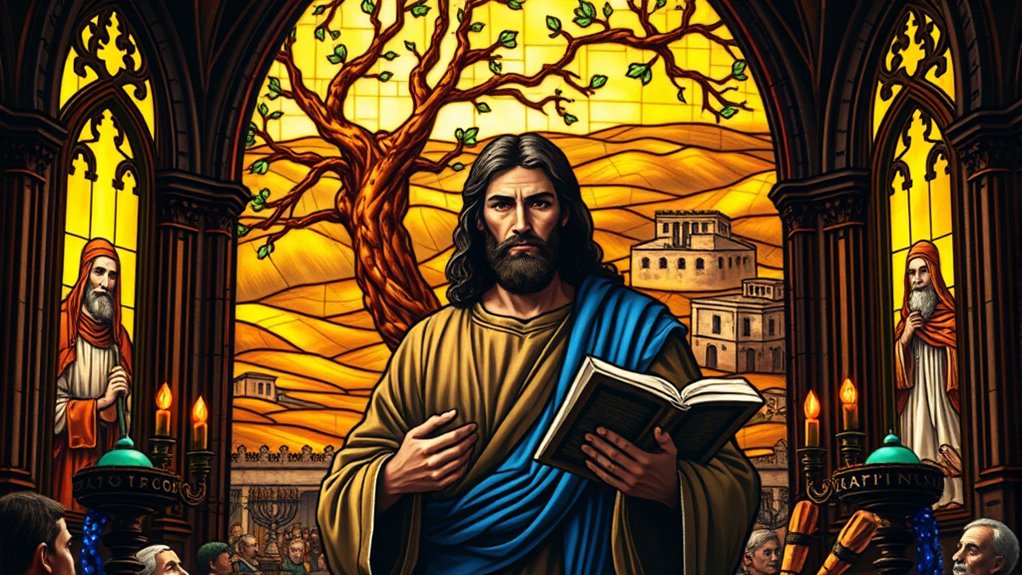
Historical evidence confirms Jesus of Nazareth was ethnically and religiously Jewish, born into first-century Palestinian society. He spoke Aramaic, participated in synagogue services, followed Mosaic Law including circumcision, and drew teachings from Jewish scripture. Genealogies in Matthew and Luke trace his lineage to Abraham and King David, establishing his Jewish heritage. Archaeological findings and historian Josephus document the mainly Jewish environment of his time. His identity reflects the diverse ethnic landscape of ancient Palestine, where his ministry unfolded within established Jewish traditions and customs that shaped his entire life.

The historical Jesus of Nazareth was ethnically Jewish, born and raised within the rich cultural and religious traditions of first-century Palestine. His language was Aramaic, commonly spoken by Jews in that region, and the genealogies recorded in Matthew and Luke trace his lineage directly to Abraham and King David, affirming his heritage from the tribe of Judah. These ancestral connections established his legitimacy within Jewish messianic expectations. Scholars have debated the precise locations tied to his life, including sites like Golgotha/Calvary, based on historical and archaeological evidence.
Jesus participated regularly in Jewish religious customs throughout his life. He attended synagogue services on the Sabbath, observed Mosaic Law, and followed traditional practices such as circumcision and Temple presentation as an infant. His teachings drew extensively from Jewish scripture and prophetic traditions, operating fully within the religious framework of his time rather than attempting to establish a new faith.
Jesus lived as a devout Jew, faithfully observing Sabbath, Mosaic Law, and traditional customs while teaching from Jewish scripture and prophetic traditions.
The New Testament texts never question Jesus’ Jewish identity, presenting it as an established fact. He lived in Judea, part of Roman Palestine, where archaeological findings like ritual baths reflect the Jewish purity practices that shaped daily life. First-century historian Josephus documented this chiefly Jewish environment, confirming the cultural context surrounding Jesus’ ministry.
Jesus’ genealogy reveals multi-ethnic ancestry, including Moabite heritage through Ruth and Canaanite lineage through Rahab, demonstrating the diverse backgrounds within Jewish family lines. This genealogical complexity emphasizes both his Jewish identity and the broader ethnic tapestry of the region.
Regarding physical appearance, scholars agree Jesus likely resembled modern Middle Eastern Levantine peoples rather than the European features often depicted in later Christian art. No contemporary descriptions of his appearance exist, and the image of a “white Jesus” emerged through cultural interpretation rather than historical accuracy. His physical traits would probably mirror those of modern Syrians, Lebanese, or Israelis. Biohistorical analysis suggests Jesus likely had brown eyes, olive skin, short black hair, and was about 5’5″ tall, with a bearded appearance typical of Palestinian Jews. Modern science considers race an invalid biological category, with little evidence for biological racial distinctions among humans.
Jesus and his followers belonged to a marginalized ethnic group under Roman colonial rule, experiencing the social and political pressures of occupation. His ministry challenged existing Jewish authorities while remaining within Judaism’s boundaries, fulfilling prophecies such as birth in Bethlehem, David’s city.
Different cultures have since portrayed Jesus reflecting their own ethnicity, illustrating Christianity’s global reach while maintaining his historical Jewish roots.
Frequently Asked Questions
Did Jesus Follow Jewish Dietary Laws and Kosher Practices?
Jesus followed basic Jewish dietary laws as standard practice for first-century Jews. Historical evidence indicates he observed Torah-mandated kosher restrictions, including avoiding pork and other forbidden animals, while consuming ritually acceptable foods like Passover lamb.
However, Jesus rejected additional Pharisaic traditions such as ritual handwashing before meals, viewing these as human-made extensions beyond biblical requirements rather than divine commands.
What Language Did Jesus Speak in His Daily Life?
Jesus spoke Aramaic in his daily life, the common language of first-century Galilee where he grew up in Nazareth. The Gospels preserve several of his Aramaic phrases, including “Talitha koum” during healing miracles.
He also understood Hebrew for synagogue readings and religious practices, and likely knew some Greek for interactions with Roman officials and trade contexts, reflecting the multilingual environment of his time.
Was Jesus Circumcised According to Jewish Tradition?
Yes, Jesus was circumcised according to Jewish tradition on the eighth day after his birth, as recorded in Luke 2:21. This practice followed the covenant established with Abraham in Genesis and was mandated by Mosaic Law.
Paul’s letters confirm Jesus was “born under the Law,” indicating full observance of Jewish customs.
Historical sources like Josephus document eighth-day circumcision as standard Jewish practice in first-century Palestine.
Did Jesus Celebrate Jewish Holidays Like Passover and Yom Kippur?
Jesus participated in major Jewish holidays throughout his life. The Gospels document his Passover observance from childhood, including the Last Supper as a Passover meal.
John’s Gospel records his attendance at Hanukkah and the Feast of Tabernacles in Jerusalem.
While direct evidence of Yom Kippur celebration isn’t documented, Jesus maintained consistent engagement with Jewish religious festivals, reflecting his upbringing within traditional Jewish religious practice.
How Did Jesus’ Jewish Identity Influence Early Christian Beliefs?
Jesus’ Jewish identity fundamentally shaped early Christian beliefs by providing the theological framework through which his followers understood his role as Messiah. Early Christians interpreted Jesus’ death and resurrection within Jewish covenant theology.
They maintained Jewish Scriptures as authoritative texts, and initially viewed Christianity as a Jewish sect rather than a separate religion. This Jewish foundation influenced liturgical practices, messianic expectations, and scriptural interpretation methods that defined nascent Christian theology.