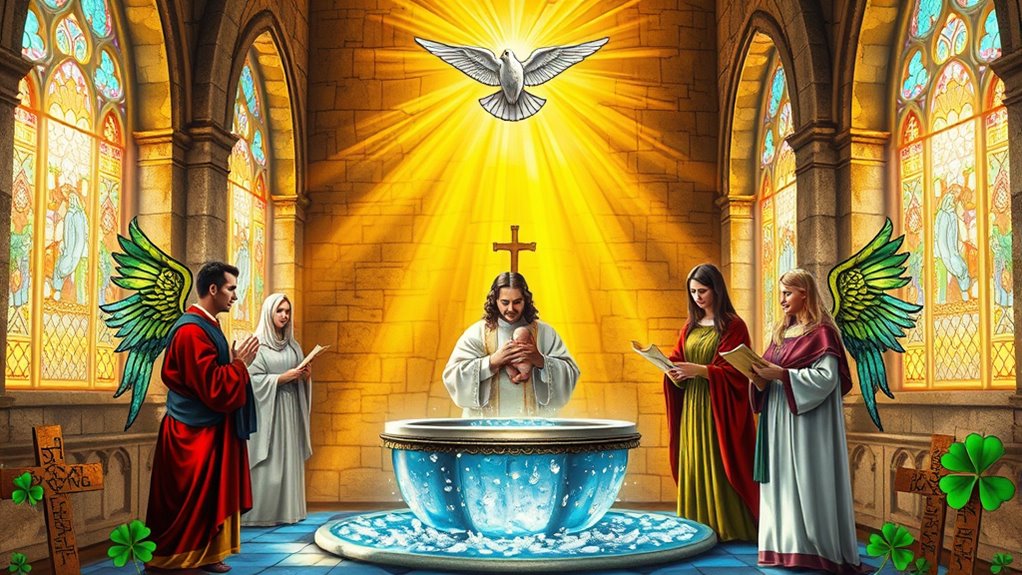
Irish Catholics strongly rejected former President Mary McAleese‘s January 11, 2026 Irish Times op-ed claiming infant baptism violates children’s rights by coercing them into lifelong obligations. Clergy including Fr. Brendan Kilcoyne countered on January 21 that baptism represents a gift of grace rather than legal compulsion, noting parents remain free to stop practicing the faith. Defenders emphasized that human rights frameworks do not properly evaluate Catholic theology, describing baptism as an act of love granting membership in Christ’s body. The controversy sparked broader discussion about sacramental meaning and the relationship between individual rights and religious tradition.
In the wake of renewed criticism from former Irish President Mary McAleese, who argues that infant baptism violates children’s human rights, Irish Catholics have responded with firm defenses of the ancient sacrament. McAleese, who served as Ireland’s president from 1997 to 2011, published an op-ed in the Irish Times on January 11, 2026, claiming that baptism coerces infants into lifelong obligations and restricts rights under the Universal Declaration of Human Rights and the UN Convention on the Rights of the Child.
The former president describes baptized infants as conscripts held to obedience, arguing that baptismal promises renewed at confirmation are fictitious. Her remarks stem from her doctoral work in canon law at Rome’s Gregorian University, where she earned her degree in 2018 despite holding views at odds with Catholic teaching. McAleese has previously advocated for ending abortion restrictions and supporting same-sex marriage, earning her a reputation among critics as Ireland’s leading dissenting Catholic voice. She has also spoken at the Voices of Faith women’s conference in Rome, which was held outside the Vatican in 2018.
Irish clergy and laity have rejected McAleese’s characterization as a fundamental misunderstanding of baptism. Fr. Brendan Kilcoyne addressed her claims in a January 21 podcast, joining other Catholics who emphasize that the sacrament offers benefits that should not be postponed.
According to Church teaching found in the Catechism, baptism immerses a child in Christ and grants life in His body, an act of love rather than power or control. Bishop Alphonsus Cullinan described infant baptism as commonplace across Christian denominations and practiced since the first century.
Defenders note that no legal compulsion exists to pursue holiness after baptism, and parents can stop practicing their faith without church interference. They argue that human rights frameworks are not the proper standard for evaluating Catholic moral theology, and that baptism represents a gift of grace rather than an imposition.
While baptism grants lifelong church membership with rights and obligations, the voluntary nature of ongoing faith commitment remains central to Catholic understanding. Many defenders also point out that baptism, according to Scripture and tradition, signifies identification with Christ and the reception of grace rather than a loss of personal autonomy.
The controversy has given Irish Catholics an opportunity to explain baptism’s true meaning to a broader audience. McAleese’s criticisms, though generating outrage, have prompted renewed discussion about the sacrament’s significance in Catholic tradition and family life.