Catholic bishops’ criticism of U.S. presidents carries weight because Catholic voters form a pivotal swing constituency in Midwestern battleground states, making episcopal statements politically significant. The 2019 Baltimore vote, where bishops condemned the Trump administration’s deportation policies 216-5, represented the strongest collective denunciation of a sitting president in American Catholic history. This unprecedented rebuke, which prompted standing applause, demonstrated that certain moral boundaries compel unified religious response despite the bishops’ traditional preference for private dialogue over public confrontation. The shifting dynamics between religious authority and executive power reveal deeper patterns about institutional conscience and political accountability.
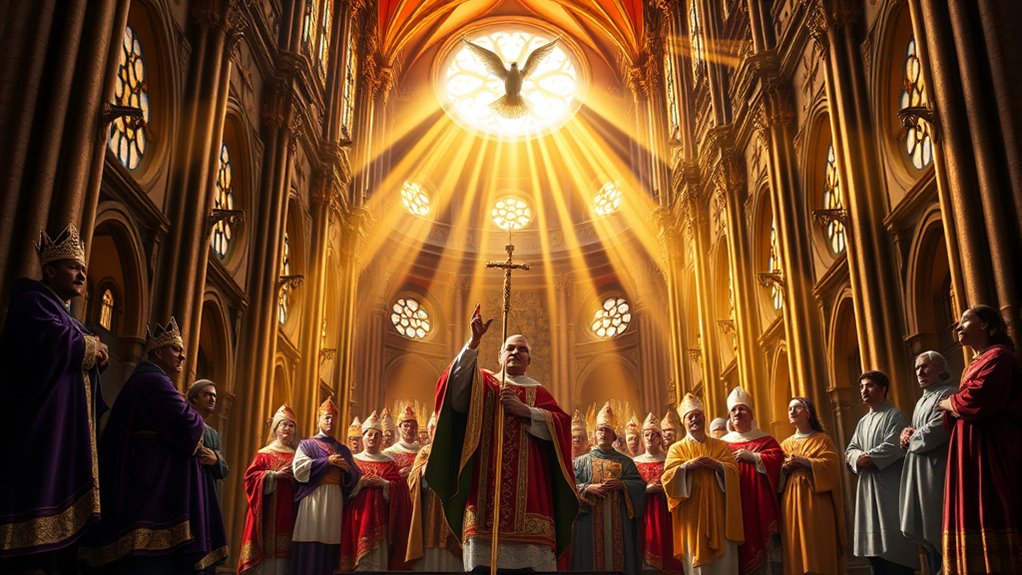
The relationship between America’s Catholic bishops and the nation’s presidents has rarely been simple, but the Trump administration pushed this tension to unprecedented levels. When nearly all U.S. Catholic bishops gathered in Baltimore and voted 216-5 to denounce the administration’s “inhumane” deportation campaign, they issued what observers called the strongest collective denunciation of a U.S. president by Catholic hierarchy in American history. The “Special Message” on immigration, the first in twelve years, opposed indiscriminate mass deportation and described a “climate of fear” among immigrant families afraid to take children to school or church. After the vote, the assembly stood and applauded, marking the significance of this historic moment.
This rebuke represents a shift in how bishops engage with presidential power. Historically, Catholic leaders balanced private dialogue with public criticism. John F. Kennedy, America’s first Catholic president, distanced himself from the Church’s polarizing stances and rarely consulted bishops publicly. Bishops backed Kennedy and Johnson against Soviet atheism from 1960 to 1973, particularly protecting South Vietnamese Catholics. When George H.W. Bush ordered Persian Gulf War troops, Pope John Paul II and Archbishop Daniel Pilarczyk raised concerns about proportionality, but the administration proceeded anyway.
The Trump era intensified these tensions. Responses to the January 6th Capitol attack divided bishops, with San Diego Bishop Robert McElroy identifying it as the logical trajectory of Trump’s divisive leadership, while others remained silent. New York Cardinal Timothy Dolan condemned Trump for stoking flames, and Chicago Cardinal Blase Cupich criticized Archbishop Gomez’s election letter as “ill-considered.” USCCB press releases from 2019-2020 rarely criticized Trump by name, referencing “administration” instead. Catholic voters function as a key swing constituency concentrated in midwestern swing states, making episcopal statements on presidential actions electorally significant.
Pope Leo reportedly urged bishops to issue their historic immigration rebuke. The statement listed concerns including vilification of immigrants in public debate and dehumanizing rhetoric. Bishop Robert Barron deplored violence, retribution, and deep suspicion during this polarized period. The bishops’ willingness to speak collectively, despite their internal divisions, suggests that certain moral lines demand unified responses. Their steering of dialogue and public criticism as complementary strategies demonstrates how religious leaders can engage democratic processes while maintaining prophetic witness, offering guidance to both political leaders and faithful citizens seeking moral clarity.
The bishops’ approach to national leadership echoes the Church’s long-standing emphasis on the covenantal role of faith communities in public life, reflecting how religious institutions have historically shaped notions of communal identity and responsibility through teachings like those rooted in the patriarchal covenant.