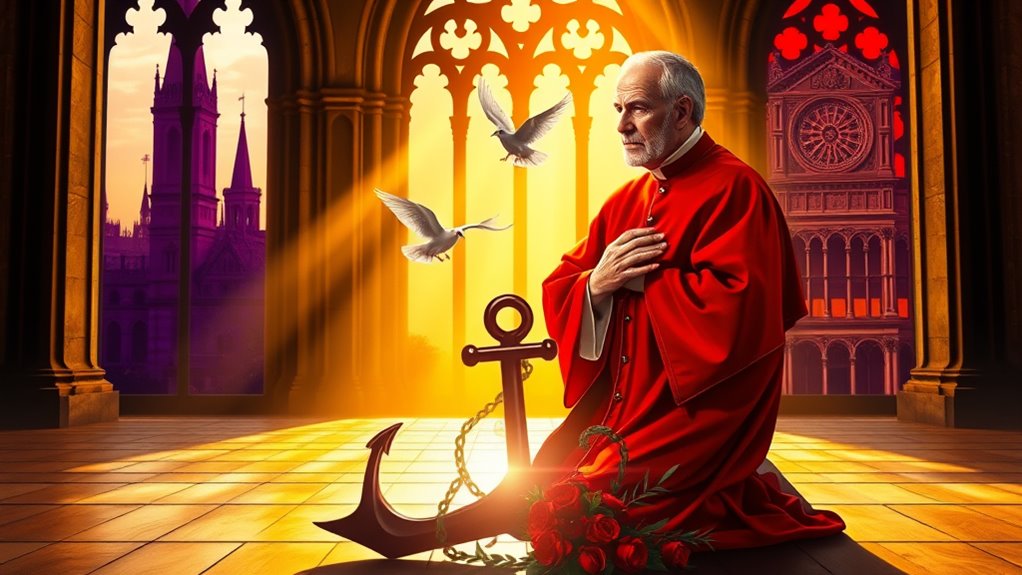
The Catholic Church commemorates St. John Henry Newman on October 9, marking the anniversary of his reception into the Catholic faith in 1845 rather than his death on August 11, 1890. This choice emphasizes conversion as central to his spiritual journey, anchoring his memorial on transformation rather than mortality. The Church of England, by contrast, observes Newman on August 11. Born in London in 1801, Newman led the Oxford Movement before converting to Catholicism and was canonized in 2019. The full arc of his extraordinary life reveals why this date holds such significance.
On October 9 each year, the Catholic Church commemorates St. John Henry Newman on the General Roman Calendar, marking the date he was received into the Catholic Church in 1845. This choice reflects the conversion’s central importance in Newman’s life and ministry, anchoring his memorial in a moment of profound spiritual transformation rather than his death.
The Catholic Church honors Newman on his conversion date rather than his death, recognizing this moment as pivotal to his spiritual journey.
Newman was born February 21, 1801, in London and became an Anglican priest in 1825. He led the Oxford Movement starting in 1833 and served as vicar of St. Mary the Virgin at Oxford University for 17 years. His theological work as an Anglican made him an influential figure, but clashes with bishops eventually led him to leave Anglicanism. On October 9, 1845, he entered the Catholic Church, a decision that reshaped his vocation.
Ordained a Catholic priest in Rome in October 1846, Newman founded the Oratory of St. Philip Neri in Edgbaston in 1849 and served as rector of the Catholic University in Dublin from 1854. Pope Leo XIII named him cardinal in 1879. Newman died August 11, 1890, in Edgbaston, and the Church of England commemorates him on that date.
The Congregation for the Causes of Saints declared Newman venerable in 1991. A miracle involving Deacon Jack Sullivan’s 2001 healing was recognized July 3, 2009, leading Pope Benedict XVI to beatify Newman September 19, 2010, in Birmingham. Pope Francis formally approved canonization February 12, 2019, following recognition of a second miracle involving a pregnant woman in Chicago in 2013.
Newman was canonized October 13, 2019, during a Mass in St. Peter’s Square attended by Prince Charles and tens of thousands of pilgrims. The ceremony coincided with the Pan-Amazonian Synod and an ad limina visit by Indian bishops. Both Catholics and Anglicans welcomed the canonization of this theologian and poet whose holy life spanned both communions. Cardinal Vincent Nichols described the canonization announcement as a moment of great pride. Four others were canonized during the same Mass, including Blessed Dulce Lopes Pontes, a member of the Missionary Sisters of the Immaculate Conception. On November 1, 2025, he was proclaimed Doctor of the Church. His motto remains “Cor ad cor loquitur”—Heart speaks to heart. A significant aspect of his legacy is his influence on Catholic intellectual life, which continues to shape theological education and pastoral practice.