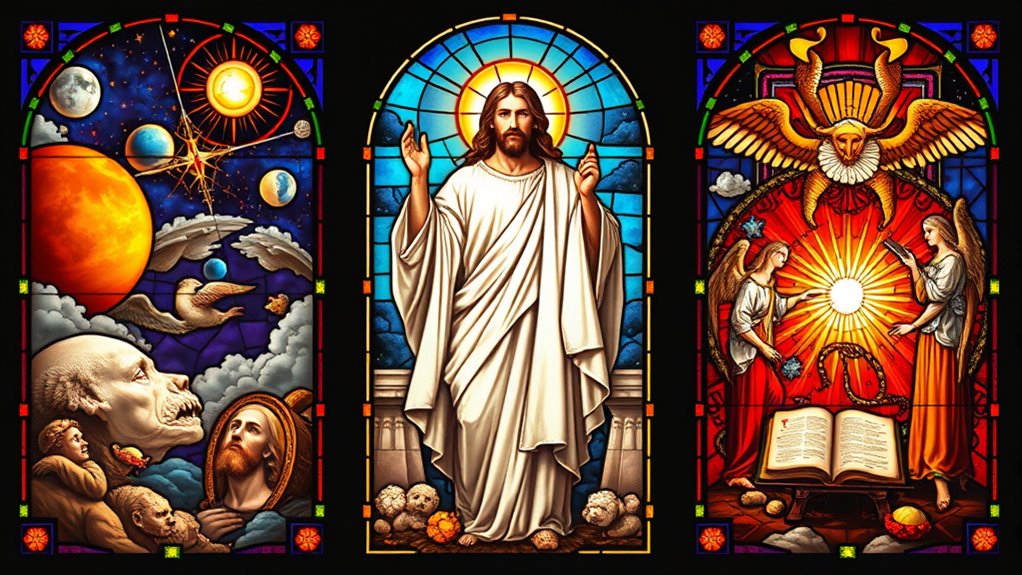
Christians recognize two ways God reveals himself: general revelation through nature and special revelation through Scripture. According to Romans 1:20, creation displays God’s eternal power and divine nature to all people. However, theologians note that nature alone remains insufficient for salvation, requiring Scripture to interpret it accurately. The Bible functions as the authoritative guide, providing essential details about redemption that observation of the natural world cannot supply. While both revelations originate from God and cannot ultimately contradict, Scripture holds interpretive priority, acting like corrective lenses for understanding creation’s testimony. The articles below explore how these complementary revelations work together within the complete gospel narrative.
Throughout history, believers have pondered how God makes Himself known to humanity, arriving at a twofold understanding that distinguishes between what can be seen in the world and what has been specifically revealed through Scripture.
General revelation refers to knowledge of God available through observing creation. According to Romans 1:20, God’s eternal power and divine nature are clearly seen and understood from what has been made, leaving humanity without excuse for denying His existence. This form of revelation operates universally, accessible to all people regardless of their location or background. The heavens declare God’s glory, as described in Psalm 19, communicating His attributes through the natural world and human conscience. However, this revelation carries inherent limitations. Nature discloses the Creator’s power but remains silent on salvific details, the specifics of redemption necessary for salvation. While general revelation can condemn when suppressed, it proves insufficient for salvation. Observing creation can lead to true knowledge of God’s attributes, but it does not replace the need for biblical baptism as a sign of entry into the covenant community.
Special revelation, by contrast, provides God’s written word through Scripture, communicating His purposes in creation, redemption, and restoration. This revelation came through direct mediums including theophanies, dreams, visions, angels, and miracles, with Scripture serving as an enduring witness to God’s work. According to 2 Timothy 3:16, all Scripture is divinely inspired and profitable, guided by God while preserving each author’s individual style. Scripture is irreducibly propositional, with even narratives and poetry making truth claims about reality. The culmination of special revelation appears in Jesus Christ, described in John 1:1 as the Word made flesh, the ultimate expression of God’s self-disclosure.
These two forms of revelation maintain a complementary yet hierarchical relationship. Both proceed from God and cannot ultimately conflict, yet Scripture holds authority over interpretations of nature. General revelation requires special revelation for accurate understanding, functioning like a corrective lens through which observations of nature gain proper focus. Nature cannot be treated as equivalent to a sixty-seventh book of the canon or used to modify biblical teaching. Human interpretations of the natural world remain prone to error, which Romans 1:18 describes as suppressing truth.
The gospel narrative of creation, fall, redemption, and new creation constitutes God’s complete revelation, with Christ as the climactic testimony to Scripture’s divine origin and reliability.