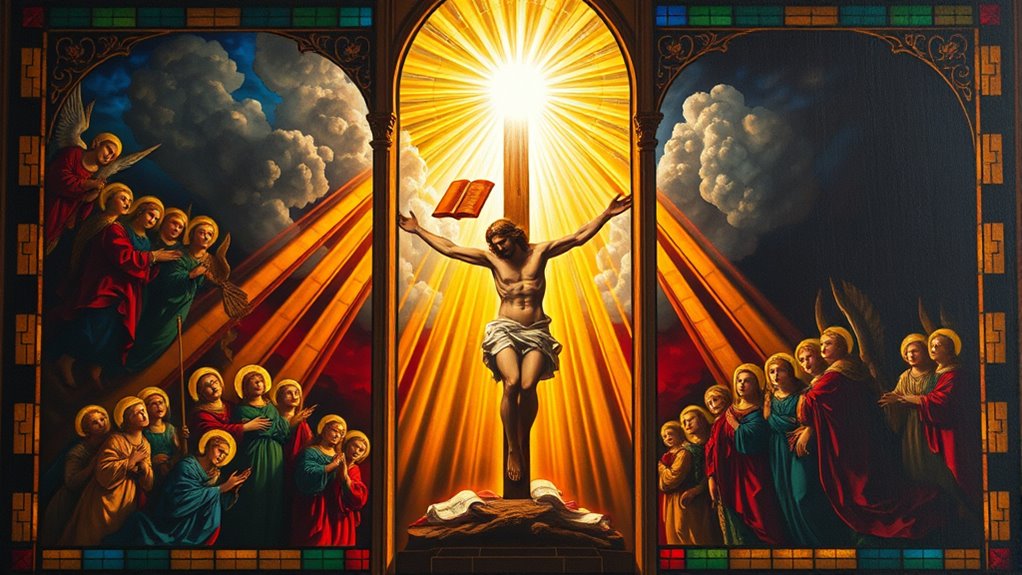
The Bible teaches that death is not the end of conscious existence. The soul continues immediately after the body stops functioning. Believers enter the presence of Christ, as Paul describes in Philippians 1:23 and 2 Corinthians 5:8. Those who reject Christ enter Hades, a state of conscious separation from God. Revelation 20 and John 3:36 connect final eternal outcomes directly to one’s response to Jesus Christ. The full picture goes deeper still.
Key Takeaways
- At death, the soul immediately enters a conscious spiritual state—it does not sleep, dissolve, or pause before God.
- Believers enter Christ’s direct presence immediately upon death, as taught in Philippians 1:23 and 2 Corinthians 5:8.
- Unbelievers enter Hades, a temporary domain of conscious torment and separation from God, awaiting final judgment.
- After Christ returns, physical bodies resurrect and reunite with the soul, transformed into imperishable, glorified form.
- Eternal destiny—heaven or the Lake of Fire—is determined entirely by one’s response to Jesus Christ.
What Happens to the Soul the Moment You Die?

The moment biological life ends, Christian theology holds that the soul does not pause, sleep, or dissolve into unconsciousness. According to Scripture, the soul remains alert and aware as the body ceases functioning. Consciousness continues uninterrupted through the passage, carrying with it the individual’s memory and personality.
Death, in this framework, is not an ending but an immediate crossing. The soul moves deliberately into a spiritual domain beyond the physical world. The body returns to dust, but the soul continues operating in a non-physical state of eternal reality. Regular spiritual practices such as daily Bible reading and prayer are taught to shape how believers live in light of that reality.
Theologians note that death also marks an instant encounter with the Creator. No passage period softens the moment. The soul arrives fully conscious before God, shaped entirely by the choices made during earthly life. Scripture, however, teaches that the soul dies, as stated in Ezekiel 18:4, which declares that the soul who sins shall die. Some answers on eBible present the contrasting view that the bible teaches that when one dies he/she sleeps until Christ returns the second time.
Where Does a Believer’s Soul Go Before the Resurrection?

Christian theology consistently holds that a believer’s soul enters the direct presence of Christ immediately upon death, without delay or interruption. This period, commonly called the intermediate state, begins the moment the body dies and continues until the future resurrection.
Scripture supports this understanding in several places. Paul wrote in Philippians 1:23 that departing to be with Christ is “far better” than remaining alive. In 2 Corinthians 5:8, he described being absent from the body as being present with the Lord. Jesus told the dying thief in Luke 23:43 that he would be in paradise that very day. The location where Jesus was crucified, Golgotha, underscores the significance of his death and the promise of immediate presence with Christ.
Theologians note that this state is temporary, not final. The soul awaits eventual reunion with a glorified, resurrected body at the last day. Some have proposed that souls remain unconscious during this period, citing Scripture’s use of “sleep” as imagery for death, but this applies to the body, not the soul. At that resurrection, body and soul are united permanently, continuing together for eternity in the new heavens and new earth.
Where Do People Who Reject Christ Go When They Die?

While Christian theology offers a reassuring picture for believers, it presents a sobering account of what awaits those who reject Christ at death.
Scripture teaches that the soul enters Hades, a temporary domain of conscious separation from God, characterized by torment and anguish. This understanding aligns with the traditional view of distinct persons within the Trinity, wherein Jesus and the Father are distinct yet unified in divine purpose, as reflected in the doctrine of the Trinity.
Hebrews 9:27 confirms that death ends all opportunity for salvation.
This intermediate state continues until the Great White Throne Judgment, after which the wicked face the Lake of Fire described in Revelation 20:14-15.
Matthew 25:46 contrasts eternal life for believers with eternal punishment for the unrepentant.
Second Thessalonians 1:9 describes this as everlasting destruction, completely shut off from God’s presence.
John 3:36 adds that God’s wrath remains permanently on those who reject His Son. Different Christian traditions, however, disagree on the precise nature of this fate, with some teaching soul-sleep, others purgatory, and others eternal torment in hell.
Romans 3:20 makes clear that no one is declared righteous through works of the law, meaning that good deeds alone cannot spare the unbeliever from condemnation at the final judgment.
What Actually Happens When Your Body Is Resurrected?

For those who reject Christ, Scripture describes a future of permanent separation from God—but for believers, the story moves in a sharply different direction.
The Bible teaches that after Christ returns, the physical body is resurrected and reunited with the soul and spirit.
Paul describes this in 1 Corinthians 15, explaining that the body is “sown perishable” but “raised imperishable.” There are about 7,957 verses in the New Testament that include these teachings.
The transformation is not a replacement but a perfecting—the same body, now glorified.
Sickness, decay, and death no longer apply.
Identity, personality, and memories remain intact.
The resurrected body becomes suited for eternal life in the new creation, free from biological limitations.
Paul draws a parallel to a seed planted in the ground, explaining that what is buried is not the final form—just as God gives each seed a new body suited to what it was meant to become.
This state is described as permanent, beginning at resurrection and continuing without end. Scripture affirms that “death is swallowed up” in victory, marking the complete and final defeat of what sin introduced into the human condition.
What Determines Where You Spend Eternity?

According to Scripture, the single factor that determines where a person spends eternity is their response to Jesus Christ. The Bible presents two eternal destinations: heaven and hell. Every person will occupy one of them permanently, and no intermediate option exists.
John 3:18 states that those who believe in God’s one and only Son are not condemned, while those who do not believe stand condemned already. Revelation 20 describes a Book of Life containing the names of the redeemed. Those absent from that record are cast into the Lake of Fire.
The decision is made before death. No opportunity to change destinations exists afterward. Scripture presents acceptance or rejection of Christ as the defining, irreversible choice that determines where a person spends eternity. Romans 10:9–10 confirms that confessing Jesus as Lord and believing God raised Him from the dead are the terms of salvation.
Salvation rests entirely on faith in Christ and His finished work on the cross, not on human effort or merit. Ancient biblical language and cultural context have led scholars to various interpretations about life after death, but the core scriptural teaching focuses on eternal destiny as determined by one’s response to Christ.