
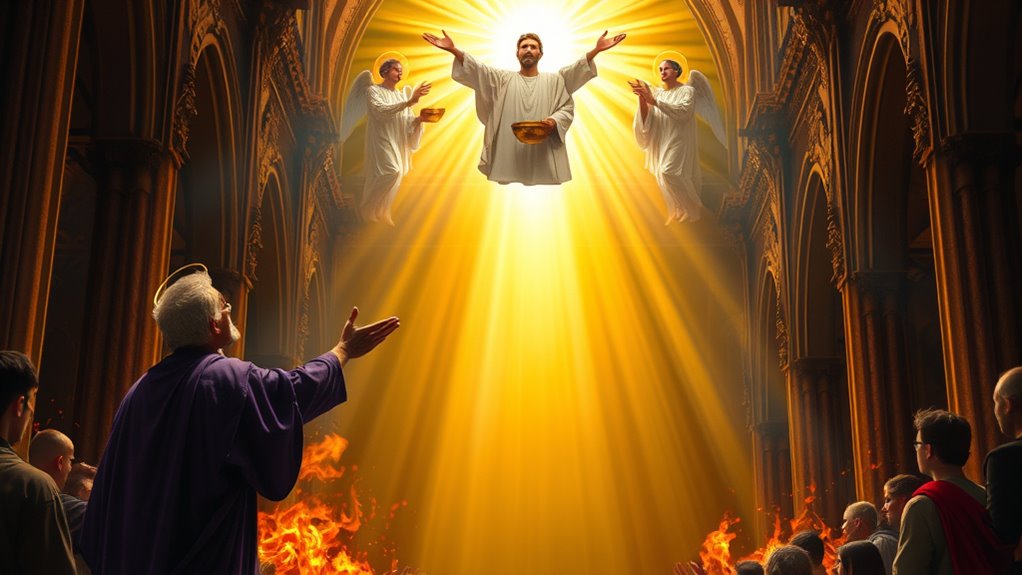
In Luke 16, the rich man in torment addresses Abraham as “Father Abraham” and petitions him for relief, asking that Lazarus dip his finger in water to cool his tongue. Abraham responds with authority from beyond death, declining the request and citing a “fixed chasm” between the two spheres. The narrative presents a deceased saint receiving and responding to petitions without divine rebuke, a detail that supporters of saintly intercession cite alongside Revelation’s imagery of elders presenting prayers to God. The passage’s implications extend into early Christian tradition and contemporary theological discussion.
The debate over whether Christians may ask deceased saints to pray for them often hinges on biblical interpretation, and one passage that warrants close examination is the parable of the rich man and Lazarus in Luke 16. In this account, a rich man in torment addresses Abraham as “Father Abraham, have mercy upon me,” requesting that Lazarus dip his finger in water to cool his tongue. Abraham hears and responds from beyond death, though he declines the request, citing a fixed chasm between them. The rich man persists, begging Abraham to send Lazarus to warn his five brothers, using prayer language such as “I pray thee accordingly, father.” Abraham refuses again, stating the brothers have Moses and the prophets. What stands out is that Abraham never rebukes the rich man for addressing a deceased saint. Instead, Abraham exercises authority to send or withhold aid, demonstrating that dead saints receive and respond to intercessory requests. This challenges the view that praying to anyone but God is forbidden, since the passage depicts such communication without condemnation. Scripture elsewhere supports the principle of intercession. James 5:16 states that believers should “pray one for another” and that the prayer of a righteous person holds great power. Job 42:7-8 records God requiring Job to pray for his friends as a condition of forgiveness. Paul requests prayers for himself in 2 Thessalonians 3:1 and Ephesians 6:18, illustrating mutual intercession among believers. The efficacy of righteous prayer appears throughout biblical narratives. Abraham pleads for Sodom in Genesis 18:22-33, Moses intercedes and causes God to relent from judgment in Exodus 32:9-14, and Job’s prayers restore his three friends in Job 42:8-9. If the living may ask each other to pray, the question becomes whether death ends this practice. Notably, God is not mentioned anywhere in the narrative of Lazarus and the rich man, yet the story depicts communication with the deceased without divine rebuke. The parable also reveals Abraham’s awareness of earthly matters, knowing about Moses and the prophets and their availability to the rich man’s living brothers, which demonstrates the departed possess knowledge of terrestrial realities. Revelation 5:8 depicts elders holding golden bowls described as the prayers of saints, while angels present prayers to God in Revelation 8:3-4. Early church figures such as Ephraim the Syrian and John Chrysostom affirmed this practice. Luke 16 thus provides a foundation for understanding intercession as extending beyond earthly life. A similar concept appears in early Christian writings that discuss prayers for the dead, showing continuity between scripture and later tradition.