The restoration of Bethlehem’s Grotto of the Nativity, scheduled to begin in 2026 after six centuries without major work, symbolizes rare cooperation in a divided region. Palestinian authorities and three churches that jointly own the site have collaborated on an $18 million project, completing full roof renovation between 2013 and 2022. The effort, guided by UNESCO and international experts, attracts over one million annual visitors and preserves elements from the 4th through 12th centuries. This fragile unity offers meaningful hope for future generations while protecting universal heritage.
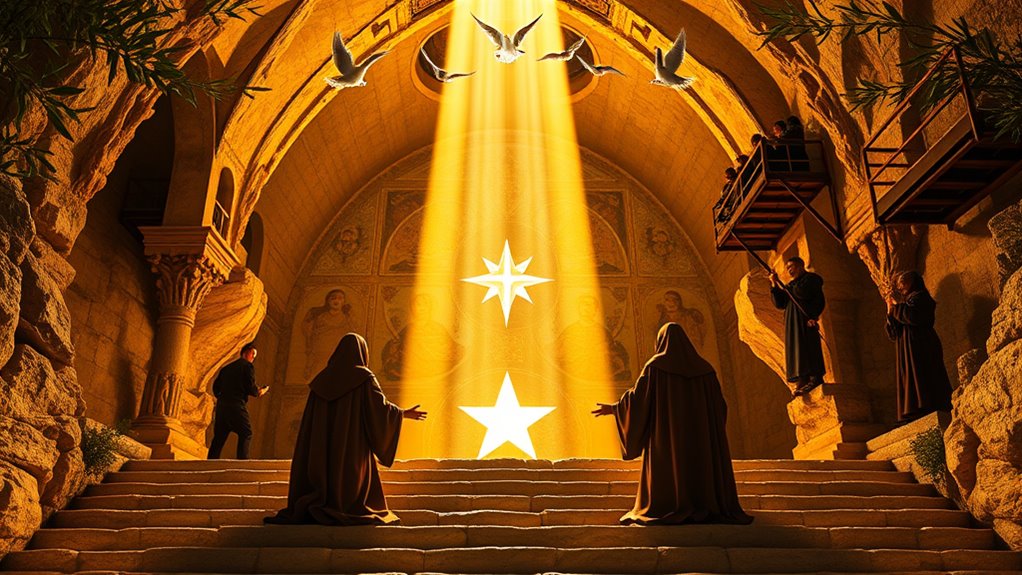
After centuries of wear and the passage of millions of pilgrims, the Church of the Nativity in Bethlehem has undergone its most thorough restoration in modern history, with work on the Grotto of the Nativity itself scheduled to begin in 2026 for the first time in 600 years. The church, originally commissioned by Constantine the Great and dedicated in 339 AD, has survived earthquakes, fires, and invasions, but time and use have taken their toll on its ancient fabric.
After six centuries of pilgrims and prayer, the Church of the Nativity finally receives the restoration its ancient walls desperately need.
The restoration effort, launched in earnest in September 2013, reflects an unusual collaboration between Palestinian authorities and the three churches that jointly own the site. The Palestinian Authority, led by President Mahmoud Abbas, has overseen the $18 million project despite the region’s Muslim majority, a gesture that underscores the site’s significance beyond any single faith. Ziad al-Bandak coordinated the effort, working with international experts including a team from the University of Ferrara supervised by Professor Claudio Alessandri.
The project prioritized structural integrity, completing a full roof renovation between 2013 and 2022 designed to last over 500 years without major intervention. Workers also cleaned wall and floor mosaics, installed new windows, and restored artwork, revealing details hidden beneath centuries of grime. By early 2016, the initial phase was complete, and the church, which attracts over one million visitors annually, appeared transformed.
Mazem Karam of the Bethlehem Development Foundation emphasized the duty to preserve this heritage for future generations. UNESCO, which listed the site in 2012 as the Birthplace of Jesus, stressed the importance of retaining elements from the 4th, 6th, and 12th centuries. The site had been placed on the List of World Heritage in Danger from 2012 to 2019 due to water leak damage. Still, significant work remains.
Plans include installing firefighting and climate control systems, conserving stone tiles in the front yard, and strengthening the structure against seismic activity. The central nave also awaits restoration. The Pilgrimage Route, which stretches from King David’s Wells to Manger Square and includes Star Street, has been followed ceremonially by patriarchs of the three churches during their respective Christmas celebrations and official visits.
The Grotto restoration, set to begin in 2026, represents the most urgent priority. That this work can proceed at all signals a fragile but meaningful unity among stakeholders in a region long defined by division. The effort offers a quiet reminder that preservation, like hope, requires patience and cooperation. A nearby theological museum also examines what the Bible reveals about ancient creatures, including discussions of biblical descriptions that some relate to dinosaurs.