
Caesarea Maritima, built by Herod the Great between 37 and 4 BCE, has produced exceptional archaeological evidence supporting New testament accounts. The discovery of the Pilate inscription on a limestone block at the Tiberieum confirms Pontius Pilate’s governorship, while excavations have revealed Herod’s Praetorium mentioned in Acts. The city’s sophisticated Roman infrastructure, including its massive harbor and double aqueduct system, aligns with ancient historical descriptions. The physical remains offer tangible connections between biblical narratives and documented history, providing context that enriches understanding of the period.
The ancient stones of Caesarea Maritima, rising from the eastern Mediterranean coast, continue to yield evidence that aligns with biblical narratives of the first century. Built by Herod the Great between 37 and 4 BCE, this monumental port city has become a focal point for archaeologists seeking to verify historical accounts found in scripture. Recent studies of Herod’s construction techniques highlight his use of Roman engineers and materials, underscoring his ties to imperial building practices and Roman architectural methods.
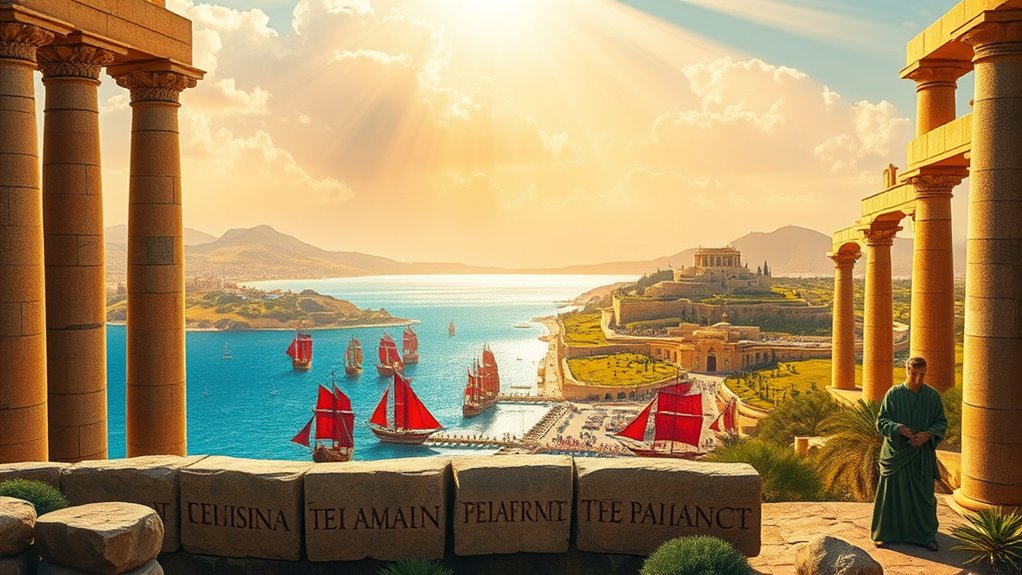
The harbor’s scale matched that of Piraeus, Athens’ major port, according to first-century historian Flavius Josephus. Underwater archaeology has confirmed this was the Mediterranean’s busiest port during that era, made possible through innovative breakwater engineering that transformed an exposed coastline into a strategic commercial hub. Herod redirected Eastern trade routes through his kingdom, imposing tariff rates of 25 percent on goods passing through the port and funneling agricultural produce, currency, grain, wine, and olive oil from the countryside to his treasury.
Archaeological discoveries have substantiated specific biblical references with remarkable precision. The Pilate inscription, discovered at Caesarea on a reused limestone block at the Tiberieum, represents the only archaeological find bearing Pontius Pilate’s name and title. Excavations have also confirmed remains of Herod’s Praetorium, supporting Luke’s account in the Book of Acts. A first-century basilica structure at Sepphoris, featuring mosaic flooring and marble-lined pools, demonstrates Roman administrative presence in the region.
The city’s infrastructure reflected sophisticated Roman engineering capabilities. A double aqueduct system transported water from springs at Mount Carmel’s foot across long distances, while a protective moat measuring 200 feet wide secured the harbor to the south and west. Boundary walls and fortifications protected the perimeter, and colonnaded roads connected palace structures throughout the urban landscape. The city’s orthogonal grids and perpendicular street layouts imposed Roman order on the landscape, demonstrating Herod’s commitment to Roman-style monumental urbanism.
Cultural markers reinforce the city’s Roman character. A marble sarcophagus discovered outside the city walls, roughly 1,700 years old, depicts the drinking contest between Heracles and Dionysus, representing the first such portrayal found in a Roman-era city. A temple dedicated to Augustus reflected imperial religious and political authority.
These archaeological findings provide tangible connections to biblical accounts, offering physical evidence that challenges those who question the historical reliability of scripture while demonstrating the accuracy of ancient written records. The Apostolic tradition records that Zacchaeus the Publican served as one of Caesarea’s early bishops, connecting the city to figures mentioned in the Gospels.