Christmas centers on Jesus Christ’s birth, not commercial gift-giving, though the holiday blends ancient customs with Christian theology. The earliest recorded celebration occurred in AD 336, with Pope Julius I formalizing December 25 between 337-352. Early Christians prioritized Jesus’ resurrection over his birth, but the date eventually merged with Roman festivals like Saturnalia. While gift-giving traditions emerged from these pagan roots, Christian observances—nativity scenes introduced by Francis of Assisi in 1223, midnight masses, and carols—kept Jesus central to the celebration as the “Light of the World.” The holiday’s deeper origins and theological significance reveal much more.
Christmas and Jesus
The celebration of Christmas centers on the birth of Jesus Christ, yet the December 25 date that billions observe each year appears nowhere in the Bible and emerged centuries after his death. The earliest written record linking Jesus’ birth to December 25 appears in the Chronograph of 354, a Roman calendar dated to AD 336, though Donatist Christians in North Africa celebrated on that date even earlier, before 312 CE. Pope Julius I formalized December 25 as the official celebration day between 337 and 352, establishing a tradition that would spread throughout the Christian world. Many Christians find that 12 minutes daily suffices to read the Bible in a year, making personal devotion manageable alongside holiday observances.
The choice of December 25 was not random. The date coincided with Roman festivals including Saturnalia, a week-long celebration of feasting and gift-giving that ran from December 17 to 24, and Sol Invictus, honoring the Unconquered Sun on December 25. Some historians suggest church leaders strategically selected this date to replace popular pagan celebrations, making conversion easier by Christianizing existing customs. Others point to theological reasoning: if Jesus was conceived on March 25, the Annunciation, his birth would fall nine months later on December 25.
December 25’s selection as Christmas merged Roman winter festivals with Christian theology, transforming pagan celebrations into commemoration of Christ’s birth.
Early Christians initially focused more on Jesus’ resurrection than his birth. Eastern churches celebrated his nativity on January 6, Epiphany, before adopting December 25 by the late fourth century. The shift coincided with Christianity’s legalization under Constantine, when the church began formalizing its calendar and practices. The symbolism proved powerful—Jesus as the “Light of the World” aligned with the winter solstice and the return of longer days, representing light overcoming darkness. Early Christian writers saw this coincidence as providential, interpreting it as a divine sign rather than a deliberate calendrical choice.
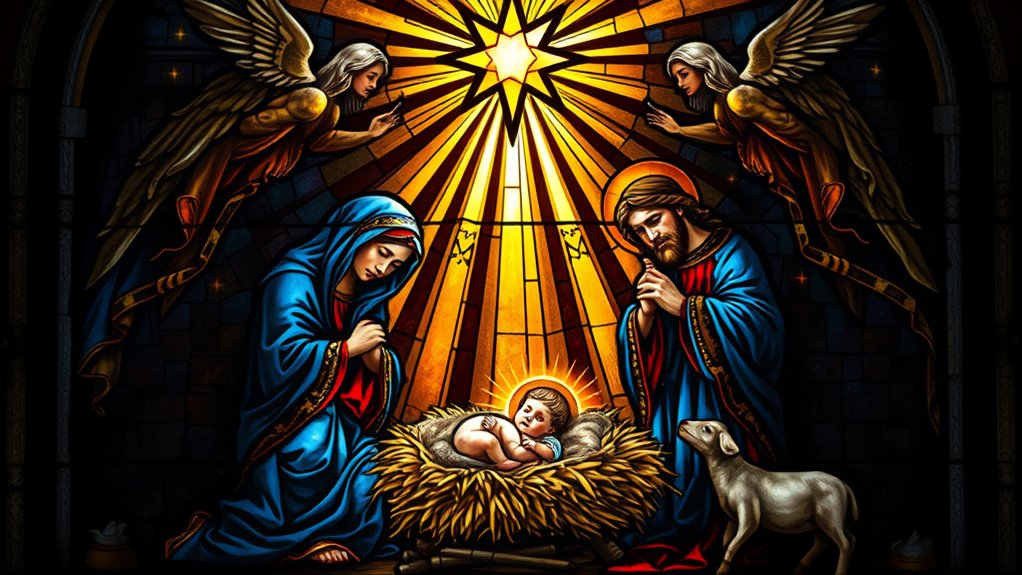
Over centuries, traditions developed to keep Jesus central to Christmas. Francis of Assisi introduced nativity plays in 1223, dramatizing the birth story for worshipers. Christmas carols emerged emphasizing Jesus’ humble arrival in Bethlehem. The nativity scene became an enduring visual reminder of the incarnation. While modern Christmas includes secular elements like gift-giving inherited from ancient festivals, the holiday’s Christian meaning persists through liturgy, scripture readings, and the story of hope and divine love embodied in a child born in a manger. In Roman Catholicism, Christmas is recognized as a holy day of obligation, with the first mass traditionally celebrated at midnight.