
As St. Peter’s Basilica nears its 400th anniversary in November 2026, the Vatican is implementing major upgrades to serve over 20 million annual visitors while preserving the world’s largest church for centuries ahead. The transformation includes expanded terrace access, real-time Mass translations in 60 languages, crowd-monitoring sensors, and advanced digital tools including a complete 3D model. Structural assessments sponsored by Eni confirm the basilica’s health and aim to guarantee usability for 250 more years, combining spiritual programming with technological innovation to enhance both pilgrim experience and long-term preservation.
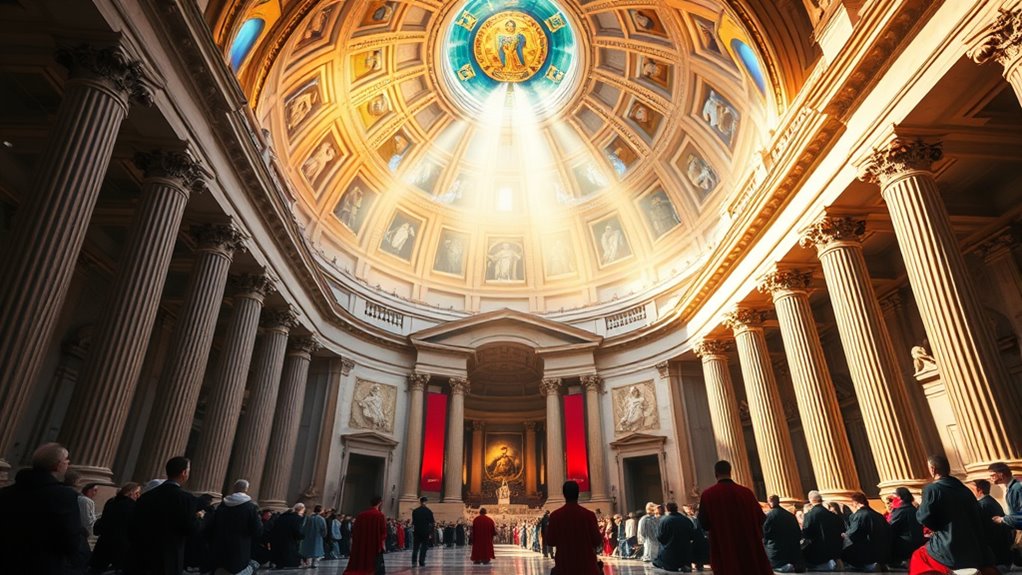
After four centuries of welcoming pilgrims, St. Peter’s Basilica approaches its 400th anniversary with ambitious plans to improve access and understanding for millions of annual visitors. Pope Urban VIII consecrated the church on November 18, 1626, completing a structure designed by Bramante, Michelangelo, Maderno, and Bernini that replaced an earlier basilica. Now the largest church in the world by interior measure, it receives over 20 million visitors each year, with daily counts reaching 20,000. Recent scholarship on the basilica’s evolving role highlights how liturgical and public use has shifted over centuries, reflecting broader changes in church practice.
St. Peter’s Basilica welcomes over 20 million pilgrims annually as it prepares to celebrate four centuries since its 1626 consecration.
The Vatican is expanding the basilica’s terrace to accommodate more guests, opening the full space compared to the current one-third access. The refreshment area will double to 100 square meters, and an expanded snack bar will include bathrooms for pilgrims. Exhibitions on the building’s history, construction, and maintenance will occupy the northern portion of the terrace, providing educational context for visitors. The terrace will also feature dedicated exhibition programming for children.
Digital improvements aim to reduce queues and enhance the visitor experience. A streamlined online reservation system and SmartPass digital entry will manage crowds more efficiently, while sensors inside the basilica monitor visitor numbers in real time. QR codes will provide instant access to translations, and the Beyond the Visible project is creating a detailed 3D digital model of the entire structure.
For the first time, pilgrims will access real-time translations of Mass in 60 languages through AI-assisted technology developed by Rome-based firm Translated. Audio and text versions will be available on smartphones via a dedicated web page, making services accessible during the anniversary year.
Spiritual programming includes weekly Spiritual Elevations every Saturday at 3:30 p.m., featuring prayer and polyphonic singing by the Cappella Giulia at the Altar of the Chair. Swiss artist Manuel Dürr won a competition to design temporary Stations of the Cross for Lent 2026. Michele La Ginestra’s theatrical performance “29 June — Peter and Paul in Rome” is scheduled around the solemnity of Sts. Peter and Paul in June.
Eni’s structural assessment confirms the basilica remains in good health. Real-time monitoring of movements in the building and foundations prevents future damage, using techniques intended to guarantee usability for 250 more years. These initiatives, sponsored by Eni and technology partners, protect artistic treasures while redistributing crowds throughout the historic space.