
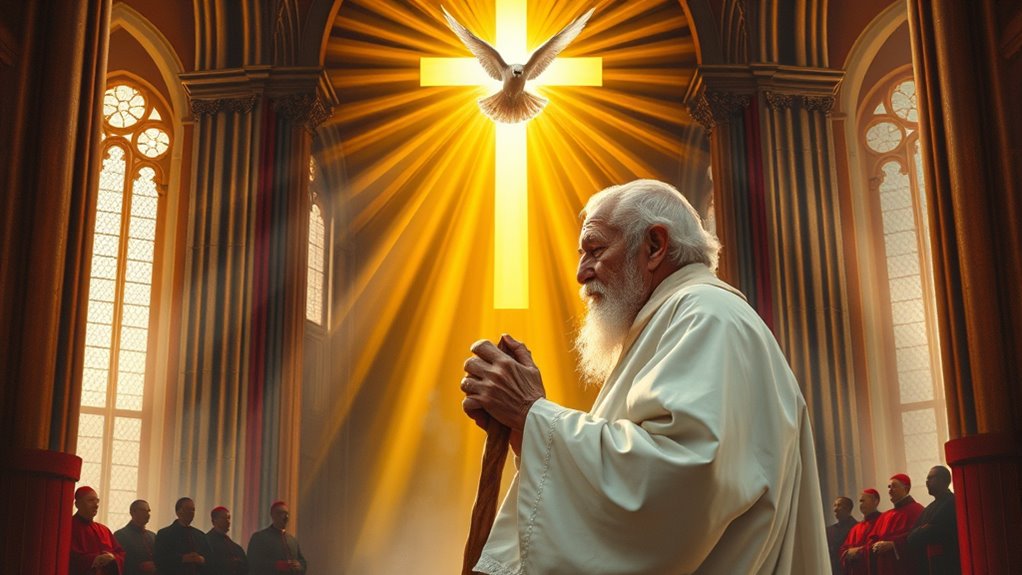
At 88 years old, Pope Francis continues leading the Catholic Church despite recovering from double pneumonia that required high-flow oxygen treatment in early 2025. Vatican officials and Cardinal Fernández confirm he has no plans to retire, though he has hinted at slowing down after demanding trips. His condition is stable with slight improvements, and he remains active in religious rites. While the pontiff has established mandatory retirement ages for Vatican officials through an April 2024 reform, his own future remains guided by faith and duty, with ongoing considerations shaped by health realities and institutional challenges.
How much longer will Pope Francis continue to lead the Catholic Church? At 88 years old and recovering from double pneumonia in early 2025, the question weighs on many minds. Many Christians consider principles like stewardship when evaluating such decisions. Yet despite his health struggles and previous hints about slowing down, Vatican officials and Cardinal Víctor Manuel Fernández have made clear there are no current plans for papal retirement.
Despite health challenges and age, Pope Francis remains committed to his role with no immediate retirement planned.
The pope’s recent hospitalization revealed the physical toll of his office. High-flow oxygen treatment left his throat dry, requiring him to adjust how he speaks. Still, the Vatican released photos and audio recordings showing Francis actively participating in religious rites during recovery. His condition has been described as stable, with slight improvements in breathing and movement, though no official return date has been announced.
Francis has acknowledged his limitations. After a demanding trip to Canada, he publicly suggested the need to slow down and hinted at possible retirement in the future. These remarks sparked widespread speculation, though he maintains his commitment to service. The balance between health and the demands of papal duties remains an ongoing challenge.
Interestingly, while Francis considers his own pace, he has moved to formalize retirement structures for others in Vatican leadership. On April 19, 2024, he issued a motu proprio establishing mandatory retirement ages for Vatican magistrates at 75 and cardinal judges at 80, unless extended by the pope himself.
The reforms even allow him to appoint a successor as assistant to a court president in the final year before retirement to ensure smooth transitions. These amendments were designed to improve economic treatment for magistrates and strengthen the integrity of Vatican justice.
Meanwhile, Francis faces another pressing challenge that may influence his tenure. The Vatican pension system requires urgent structural reforms due to a severe imbalance. Investigations revealed a deficit reaching at least $800 million to $900 million, which had grown beyond $1.6 billion by 2016.
The pope appointed Cardinal Kevin Farrell as sole administrator to address the crisis, calling for difficult decisions requiring sensitivity, generosity, and sacrifice from all Vatican personnel. These financial pressures add weight to questions about leadership and succession, even as Francis chooses duty over stepping down. Despite spending five weeks in Gemelli Hospital, the pope has gradually regained strength and his overall physical condition has returned to its previous state.