Saint John of the Cross endured nine months of imprisonment in a windowless 10×6 foot cell in Toledo, Spain, where Calced Carmelites opposed to his reform efforts subjected him to darkness, extreme temperatures, weekly public lashings, and near-starvation. Rather than breaking him, this brutal confinement sparked what he called the “dark night of the soul,” a profound spiritual experience that he transformed into revolutionary mystical poetry, including the “Spiritual Canticle.” His writings demonstrated how extreme suffering could catalyze divine insight rather than destruction, establishing a new paradigm for understanding spiritual transformation that continues to shape Christian mysticism today.
How does a man endure nine months in a narrow, unheated cell, subjected to weekly public lashings and near-starvation, yet emerge to write some of Christianity’s most profound spiritual poetry? This transformation of suffering into spiritual growth reflects the Christian call to rely on grace. Saint John of the Cross transformed extreme suffering into spiritual insight, making him one of history’s most revolutionary religious figures.
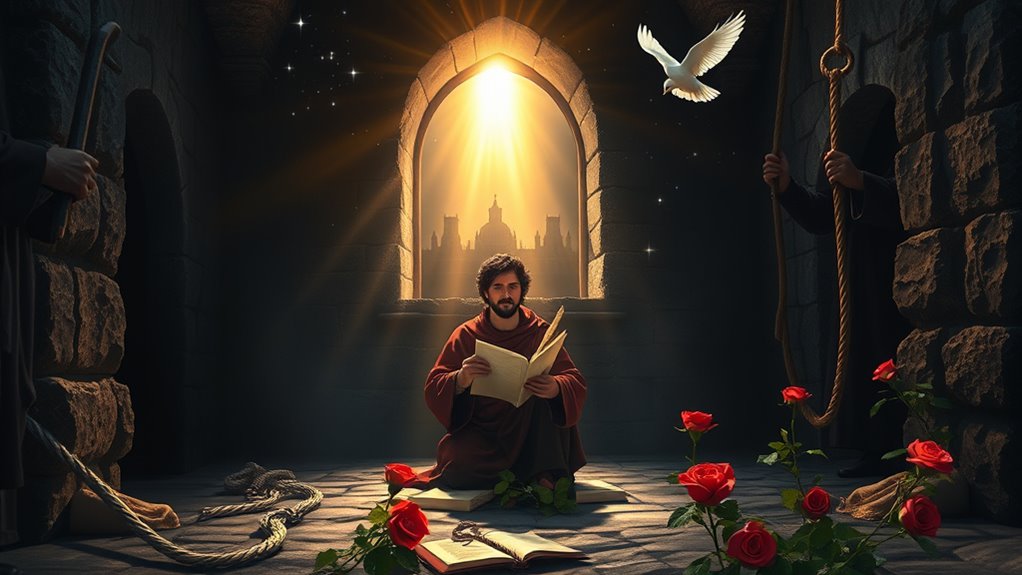
On the night of December 2-3, 1577, Calced Carmelites opposed to reform captured John and imprisoned him in a Toledo monastery. His cell measured only ten by six feet, formerly a closet with no windows and no heat. He experienced extreme temperatures, little light, and complete isolation while wearing the same Calced habit without changes.
A ten-by-six-foot windowless closet became his prison—no heat, no light, no escape from the reformers who sought to silence him.
Three nights weekly, he ate bread, water, and occasional sardines while kneeling on the floor. After supper, friars whipped him publicly in the refectory as supposed discipline.
The imprisonment stemmed from resistance to his reform efforts. Church authorities had ordered him to leave Ávila, but he refused, citing papal approval. The General Chapter of 1575 banned Discalced friars outside Castile and prohibited reform practices. When removed as confessor at Encarnación convent in 1576, opponents began gathering materials across monasteries to build expulsion charges against him.
During seven months confined in darkness within a narrow tower room, John experienced what he termed the “dark night of the soul,” a profound spiritual dryness where God seemed absent. Yet this isolation produced his most enduring writings on mystical spirituality. Despite his suffering, he received heavenly consolations that sustained him through his imprisonment. He passed paper through a guard to write, composing much of his famous Spiritual Canticle during this brutal confinement.
He escaped mid-night by forcing open his cell door and using a homemade rope to descend from a balcony, then jumped the monastery wall. Teresa’s nuns found him wandering Toledo’s streets and nursed him to health over six weeks.
Even after recovery, suffering continued. In 1591, he chose assignment to Ubeda monastery despite knowing the prior’s hatred, fulfilling his prayer “to suffer and be despised.” Fever and leg inflammation led to painful surgery without anesthesia.
He died December 13-14, 1591, during morning prayers. His adversaries, witnessing his peaceful death, acknowledged his sanctity with unexpected enthusiasm, recognizing how radical acceptance of suffering had produced revolutionary spiritual wisdom.