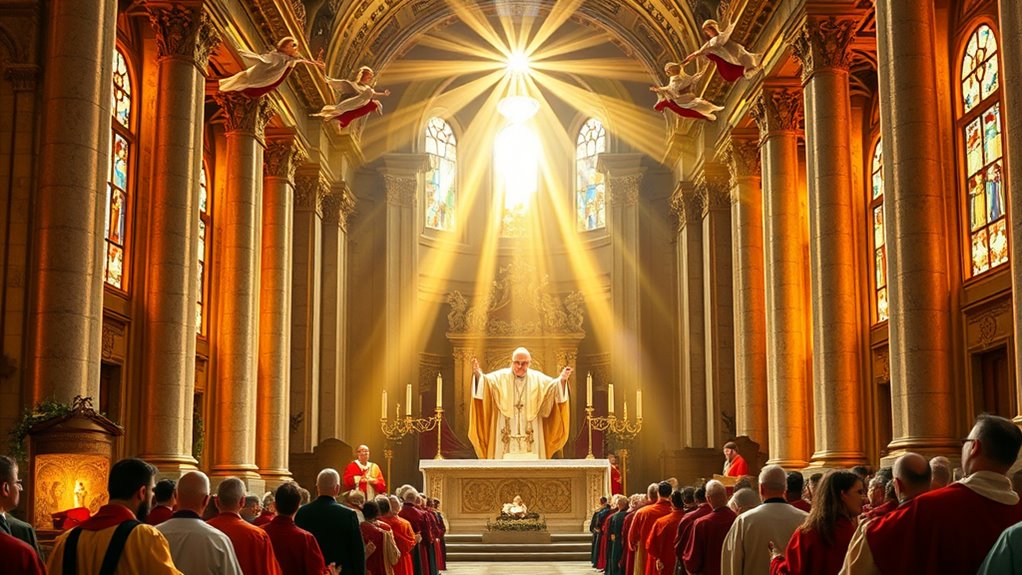
Pope Leo XIV’s celebration of Christmas Mass During the Day at St. Peter’s Basilica on December 25, 2025, marked the first time a pontiff presided over this particular daytime liturgy in over three decades, not since John Paul II in 1994. For thirty years, cardinals led the celebration instead of the pope himself. The restoration of this tradition reconnects the Church with historical customs and signals a renewed emphasis on traditional papal liturgical practices, while the event’s global broadcast underscored its significance for Catholics worldwide and invited deeper exploration of its broader implications.
On December 25, 2025, Pope Leo XIV celebrated Christmas Mass During the Day at St. Peter’s Basilica, marking the first time a pope had publicly presided over this particular liturgy in more than three decades. The last pontiff to lead the morning Mass was John Paul II in 1994, creating a gap that spanned over 30 years. During the intervening decades, cardinals assumed responsibility for the daytime celebration while popes focused on other Christmas liturgies.
Pope Leo XIV restored a three-decade-old papal tradition by personally celebrating the Christmas Day Mass at St. Peter’s Basilica.
The Mass, observing the Solemnity of the Nativity of the Lord, took place inside St. Peter’s Basilica and lasted approximately one hour and 46 minutes. Shalom World broadcast the event live from the Vatican, allowing global audiences to witness the historic return to papal-led daytime liturgy. The Pope was referred to as “Holy Father” throughout the coverage, emphasizing the significance of his participation in this traditional celebration.
Following the Mass, Pope Leo XIV continued the customary “Urbi et Orbi” blessing, which extends to the city of Rome and the entire world. He delivered this blessing from the Central Loggia of St. Peter’s Basilica, preceded by his Christmas Message. The blessing video itself ran 46 minutes and 57 seconds, while the combined events spanned nearly two hours during the morning of December 25.
St. Peter’s Basilica served as the central venue for these primary papal Christmas liturgies, with its interior featured prominently in live broadcasts. The Central Loggia provided the platform for the public blessing, maintaining the Vatican tradition of addressing the faithful from this historic location.
Media coverage extended across multiple platforms. In addition to Shalom World’s English stream, 11Alive reported on Pope Leo XIV leading the Mass, while Vatican News covered both the Message and Urbi et Orbi blessing. YouTube platforms hosted full recordings of the events, and mobile apps promoted viewing access for those unable to attend in person.
The resumption of this papal tradition after three decades represents a quiet restoration of liturgical precedent, reconnecting contemporary Catholic practice with customs that had lapsed during recent pontificates. This return to an older papal practice also aligns with the Church’s emphasis on responsible stewardship and generosity toward those in need.