




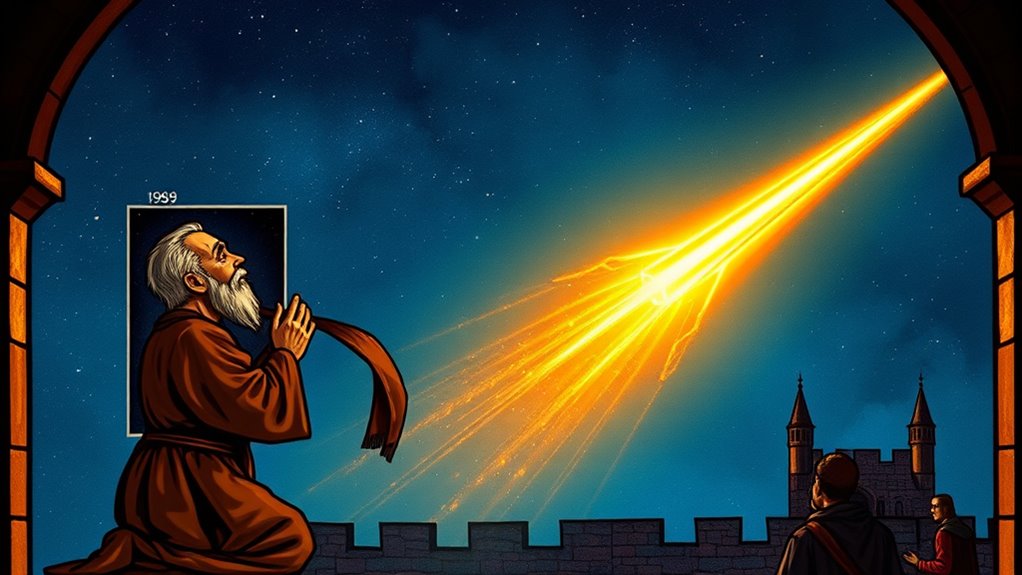
A new study by researchers from Leiden University and the British Museum suggests that Eilmer, an 11th-century English monk, may have recognized Halley’s Comet’s periodic return roughly 600 years before Edmond Halley. Eilmer observed the comet in 989 as a youth and again in 1066, reportedly exclaiming upon the second sighting, “You’ve come, have you?” His recognition, preserved in William of Malmesbury’s 12th-century chronicle, implies he linked the two appearances separated by 77 years. The findings, published in an arXiv preprint, invite reconsideration of early observational astronomy’s achievements.
Edmond Halley has long been credited with recognizing that comets follow periodic orbits, a breakthrough he announced in 1705 after linking the appearances of a bright comet in 1531, 1607, and 1682. He predicted its return in 1758, a forecast confirmed posthumously, and the comet was named in his honor. Now, however, a study by astronomer Simon Portegies Zwart of Leiden University and Michael Lewis of the British Museum suggests that an 11th-century monk named Eilmer may have understood the same principle more than 600 years earlier.
Eilmer observed a comet as a youth in 989 and witnessed it again in 1066 as an elderly man. According to the 12th-century chronicler William of Malmesbury, who recorded the account in Gesta regum Anglorum, Eilmer exclaimed upon the 1066 sighting, “You’ve come, have you?… much more terrible.” This recognition demonstrates that he linked the two appearances, separated by roughly 77 years, indicating an understanding of periodic return. Eilmer was also known for an early attempt at flight, reportedly gliding approximately 660 feet.
The 1066 appearance was widely noted. Chinese records show the comet visible for over two months, brightest on April 22, while observers in Brittany and the British Isles spotted it on April 24. It was famously depicted on the Bayeux Tapestry and interpreted as an omen during the succession crisis surrounding Harold Godwinson and the Battle of Hastings. Comets were commonly viewed as portents of disaster, death, war, and famine across cultures. Five comet sightings were identified over the period surrounding 1066, with comets construed as portents.
The study, published in an arXiv preprint and the book “Dorestad and Everything After,” analyzed medieval chronicles and records to reassess Eilmer’s contribution. While Halley demonstrated the comet’s roughly 76-year orbit through mathematical analysis, Eilmer’s memory-based pattern recognition challenges the traditional narrative of who first identified its periodicity. The research highlights medieval observational practices and the continuity of astronomical records across cultures, especially in Chinese astronomical records, encouraging a broader appreciation of observational science before the modern era.