


The Bible mentions dragons dozens of times across both Covenants. The King James Version uses the word 35 times, with 22 appearances in the Old Covenant and 13 in the New Covenant. Hebrew and Greek source texts use terms like *tanniyn* and *drakon* to describe creatures symbolizing chaos, evil, and opposition to God. Revelation 12:9 directly identifies the dragon as Satan. The specific symbolism behind each appearance, and what it meant to original readers, runs deeper than the surface language suggests.
Key Takeaways
- The King James Bible mentions “dragon” or “dragons” 35 times, with 22 appearances in the Old Testament and 13 in the New Testament.
- The Hebrew word *tanniyn* underlies many Old Testament dragon references, inconsistently translated as “dragon,” “serpent,” “sea-monster,” or “whale.”
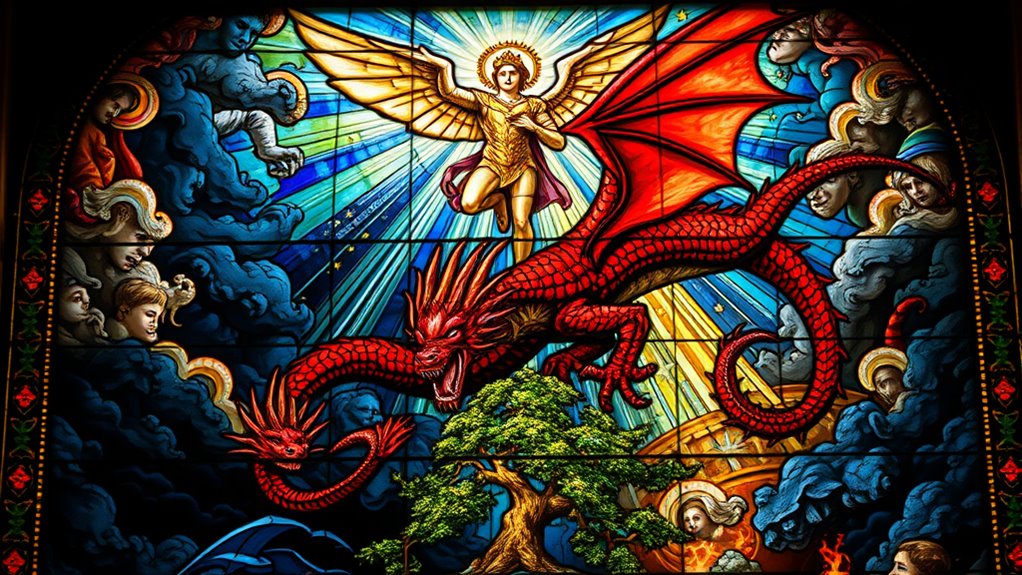
- Revelation explicitly identifies the dragon as Satan, stacking titles like “ancient serpent,” “the devil,” and “deceiver of the whole world.”
- Biblical dragon imagery consistently symbolizes chaos, evil, and opposition to God, with God ultimately defeating whatever the dragon represents.
- Dragon language also describes oppressive human rulers, as seen in Ezekiel 29:3, where it is applied to Pharaoh.
Where Do Dragons Actually Appear in the Bible?

Dragon language appears throughout the Bible more often than many readers expect, spread across both writings and several different literary genres. The King James Version uses “dragon” or “dragons” 35 times total, with 22 appearances in the Old Testament and 13 in the New Testament.
Old Testament examples include Psalm 74:13-14, Isaiah 27:1, and Ezekiel 29:3, where dragon figures appear in poetry, prophecy, and symbolic speech.
The New Testament concentrates its dragon language entirely within Revelation, particularly in chapters 12 and 20.
Genesis establishes early serpent and sea-creature imagery that scholars connect to later dragon passages. The underlying Hebrew word behind many of these passages is tanniyn, which Strong’s Concordance defines as a marine or land monster and is inconsistently rendered across different translations as “dragon,” “sea-monster,” “serpent,” and even “whale.”
The Bible Project notes this symbolic thread begins in Genesis and runs forward through the text, gradually building toward the explicit dragon imagery found in Revelation. Revelation 20:2 directly identifies the dragon as Satan and the Devil, connecting the final defeat of this figure back to the serpent judgment first announced in Genesis 3:15.
What Do Biblical Dragons Represent?

Knowing where dragons appear in the Bible is only part of the picture. What these figures represent matters just as much.
Biblical dragon imagery isn’t just about location — what these figures symbolize matters just as much.
Biblical scholars identify several consistent meanings attached to dragon imagery throughout Scripture. Most commonly, dragons symbolize chaos opposing God’s created order. The sea-dragon language connects directly to dark, disordered waters threatening stability. Dragons also represent evil in direct conflict with God, a meaning made explicit in Revelation, where the dragon is identified as Satan himself. Beyond spiritual forces, dragon imagery describes oppressive human rulers. Ezekiel applies dragon language to Pharaoh, linking the symbol to imperial domination and enslavement. Additionally, some passages use dragon terms for genuinely dangerous creatures inhabiting wilderness or sea environments. Observations like lunar eclipses and star visibility changes in ancient astronomy have been used alongside biblical imagery to argue for broader cosmic symbolism, reflecting how ancient peoples understood the world as ordered and measurable by astronomical evidence. Across all these uses, one theme remains steady: God ultimately defeats whatever the dragon represents. The Greek word δρᾱ́κων (drakon), used exclusively in Revelation, appears thirteen times and consistently functions as a metaphor for Satan. The Hebrew word behind many dragon references is tannin, which can mean serpent or dragon, though its root is associated with jackal, which is why modern translations frequently render the term as jackal in contexts describing desolate or destroyed landscapes.
Why Does Revelation Identify the Dragon as Satan?

Revelation 12:9 does not leave the dragon’s identity open to interpretation. The verse names the figure directly as “that ancient serpent,” “the devil,” and “Satan,” stacking three titles in a single declaration.
The phrase “deceiver of the whole world” adds a fourth layer of description, removing any symbolic ambiguity.
The title “ancient serpent” deliberately echoes Genesis 3, connecting the Eden tempter to the dragon in one continuous biblical narrative. This continuity reflects how early Christians understood Christ’s victory over evil as involving both human and divine agency, seen in doctrines like the Incarnation.
Revelation supplies what Genesis withheld, explicitly naming the serpent’s identity centuries later.
The identification carries theological weight beyond symbolism. It frames Satan as the consistent adversary across Scripture, from the garden to final judgment. Early Christian writers such as Irenaeus and Tertullian identified the serpent of Eden with Satan, affirming that this connection was recognized long before modern interpretation.
Revelation presents this not as mythic decoration but as a direct portrait of a real spiritual enemy who is, ultimately, defeated. Scripture further describes the dragon as possessing seven heads and ten horns, a detail that connects to Daniel’s vision of terrifying beasts and Revelation’s own imagery of kings wielding earthly power against God’s people.