
The Bible treats eating as a gift from God, beginning in Genesis 1:29 where humanity receives seed-bearing plants and fruit trees for food. Gratitude shapes how Scripture approaches meals, with Jesus giving thanks before feeding crowds and Paul instructing thanksgiving “in every thing” in 1 Thessalonians 5:18. Dietary rules and generosity toward others also receive significant attention. Those curious about how these themes connect will find much more ahead.
Key Takeaways
- God designed food as a generous gift, with Genesis portraying eating as receiving divine provision rather than human achievement.
- Jesus and Paul modeled giving thanks before eating, establishing gratitude as a core biblical response to meals.
- According to 1 Timothy 4:4–5, food is sanctified through the word of God and prayer before eating.
- Old Testament dietary laws were covenant markers for Israel; the New Testament broadly affirms freedom in what Christians may eat.
- Scripture consistently calls believers to share food generously with the poor, strangers, and even enemies.
What the Bible Says About Food as God’s Gift

From the very first chapter of Genesis, the Bible frames food not as something humans discovered or invented but as something God deliberately provided.
Genesis 1:29 records God directing humanity toward seed-bearing plants and fruit-bearing trees specifically “for food,” establishing eating as an act of receiving rather than achieving.
Eating, according to Genesis, is an act of receiving — not achieving.
Creation language in Genesis 1 emphasizes abundance, suggesting that meals begin as expressions of divine generosity rather than simple biological necessity. This theme of provision is echoed throughout Scripture, including in the Old Testament historical records that document God’s care for his people.
Food appears before sin enters the world, which shapes how Scripture treats it throughout: not as a burden or neutral fuel, but as a good gift from a good God.
This early framing carries forward into the Bible’s broader understanding that ordinary nourishment points toward the character and care of its source.
Genesis 2 further reinforces this provision by granting permission to eat freely from every tree in the garden, with only a single exception named.
1 Timothy 4:4 affirms that no food is to be rejected if received with thanksgiving, grounding the act of eating in gratitude toward the God who provides it.
Why Christians Give Thanks Before Eating

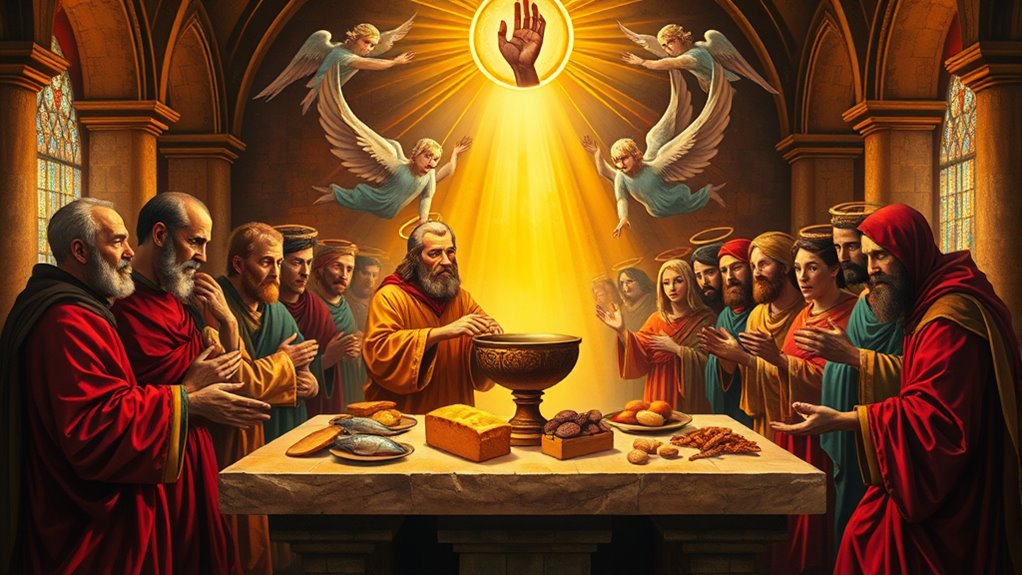
When Christians bow their heads before a meal, the practice traces back to specific moments recorded in Scripture rather than to vague tradition. Jesus gave thanks before distributing food to crowds and before the Last Supper, establishing a consistent pattern.
Paul did the same aboard a ship traveling to Rome. These examples, combined with direct commands, form a clear biblical framework.
First Thessalonians 5:18 instructs thanksgiving “in every thing,” while Romans 14:6 connects eating with worship.
First Timothy 4:4–5 explains that food is “sanctified by the word of God and prayer,” meaning pre-meal prayer sets the meal apart as a gift from God. Regular practice and honest expression help prayer evolve naturally, teaching believers to offer thanks even in ordinary moments and to rely on the Holy Spirit when words feel inadequate.
Early Christians also inherited this habit from Jewish blessing customs, giving the practice roots stretching well before the New Covenant era. Paul gave thanks openly even before non-Christian onlookers, demonstrating that gratitude to God was never treated as a private or shameful act.
In Luke 24:30, Jesus “took bread, gave thanks” before breaking it at the table in Emmaus, and his followers recognized him in that very moment, showing how deeply the act of giving thanks was tied to his identity.
Does the Bible Restrict What Christians Can Eat?

Whether Christians face any meaningful restrictions on what they eat is a question the Bible addresses across both scriptures, though without a single, unified answer.
The Old testament, particularly Leviticus 11 and Deuteronomy 14, restricted Israel from eating pork, shellfish, and other animals. Those laws functioned as covenant markers specific to Israel rather than universal rules. Catholicism also recognizes these texts as part of the Old Covenant while interpreting their application differently for Christians.
The New Testament shifts the framework considerably. The Jerusalem Council in Acts 15:20 identified three main restrictions for Gentile believers: food sacrificed to idols, blood, and strangled animals.
Jesus, in Mark 7:19, is widely read as declaring all foods clean. Paul reinforced broad food freedom in 1 Timothy 4:4-5, grounding Christian eating in thankfulness rather than restriction.
Romans 14 adds a relational dimension to Christian food freedom, cautioning believers to avoid actions that cause a brother to stumble in faith.
Most major Christian traditions today reflect that freedom. Seventh-day Adventists are a notable exception, applying Mosaic dietary restrictions that prohibit shellfish, pork, and other animals classified as unclean.
What the Bible Says About Sharing Food With Others

How a community treats its most vulnerable members often says more about its values than its stated beliefs, and the Bible connects that treatment directly to the act of sharing food.
Proverbs 22:9 says the generous are blessed for sharing bread with the poor.
Deuteronomy 15:11 commands open-handed giving to the needy.
Matthew 25:35 lists feeding the hungry among the acts that mark faithful service.
The early church took this seriously.
Acts 2:42–47 describes believers breaking bread together and distributing resources according to need.
Romans 12:20 extends that generosity further, instructing people to feed even an enemy who is hungry.
Across both testaments, food-sharing functions less as social custom and more as a concrete expression of belonging, responsibility, and care. Shared meals also serve as a gateway to deeper relationships, dismantling barriers and building unity among those gathered.
Proverbs 19:17 teaches that showing kindness to the poor is like lending to the LORD, with God himself repaying what was given.
Regular communal practices like shared meals and giving correlate with spiritual growth and help move communities beyond spiritual infancy.