
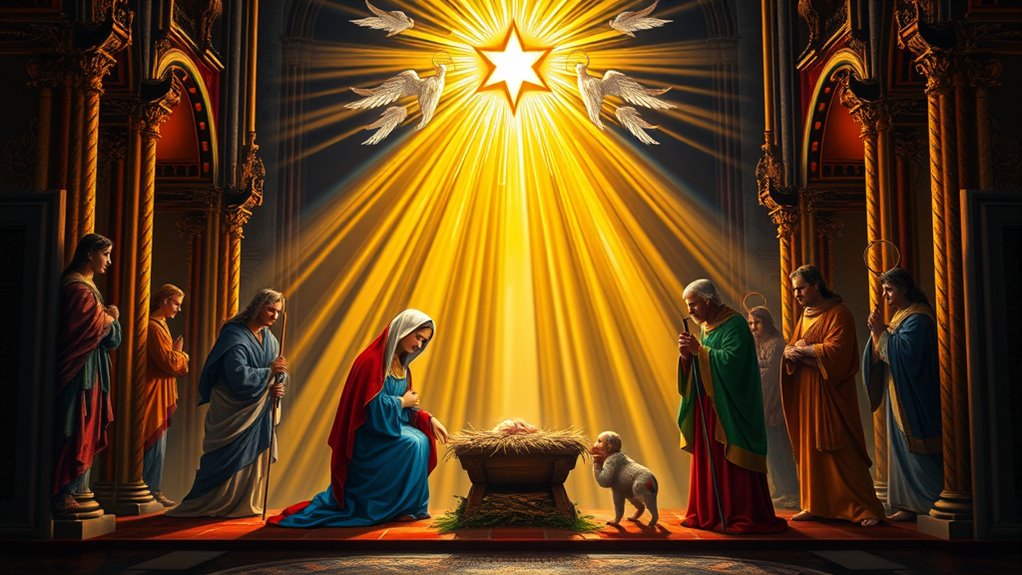

The Bible contains no direct teaching about Christmas as a holiday, but it does record the birth of Jesus in the Gospels of Matthew and Luke. Luke describes a census under Caesar Augustus, a manger in Bethlehem, and shepherds summoned by angels. Matthew emphasizes Mary’s virginity and Joseph’s divine instruction. Neither Gospel mentions December 25, a stable, an innkeeper, or three wise men — details the full account addresses further.
Key Takeaways
- The Bible never mentions Christmas or commands an annual celebration of Jesus’ birth.
- Jesus’ birth is described in Matthew and Luke, placing it in Bethlehem during Herod the Great’s reign.
- Common traditions like December 25, wise men at the manger, a stable, and a Christmas tree lack direct biblical support.
- Jeremiah 10:2–6 warns against heathen customs like cutting and decorating trees, which some apply to Christmas traditions.
- Romans 14:5–6 permits believers flexibility in observing special days, guided by personal conscience honoring the Lord.
What the Bible Actually Says About Jesus’ Birth
The Bible contains two primary accounts of Jesus’ birth, found in the Gospels of Matthew and Luke. Together, they provide complementary details about a singular event.
Luke describes a Bethlehem census under Caesar Augustus, which brought Joseph and Mary to the city of David. There, Mary gave birth, placing the infant in a manger. A nearby angel announcement drew shepherds from their fields, and shepherd worship followed as they praised God after seeing the child. Scholars generally date Jesus’ birth to the last years of the first century BC, during Herod the Great‘s reign.
Matthew, meanwhile, emphasizes Mary’s virginity and records the angel’s instruction to Joseph, confirming the child was conceived by the Holy Spirit. Both accounts present the birth not as coincidence, but as deliberate divine action, carefully documented across two distinct but connected Gospel narratives. On the eighth day after birth, Jesus was circumcised and formally given the name that the angel had declared before his conception.
What the Bible Does Not Say About Christmas
Alongside what the Bible does say about Jesus’ birth, there is also much it does not say—and the gap between scripture and popular tradition is wider than many people realize.
Scriptural silence surrounds several familiar details. The Bible does not specify three wise men, place the magi at the manger on the birth night, or mention a stable, an innkeeper, or animals present at the scene.
December 25 carries no biblical origin; tradition origins trace to later church history, not scripture.
Christmas trees, gift-giving rituals, and nativity scenes also appear nowhere in the biblical text.
The Bible neither commands an annual observance of Christ’s birth nor defines which customs should accompany one, leaving those decisions outside direct scriptural authority. Jeremiah 10:2–6 warns against learning the way of the heathen, describing the cutting and decorating of trees from the forest as a vain custom.
Romans 14:5–6 permits flexibility in observing special days, provided each person is fully convinced in their own conscience that they are doing so to honor the Lord.
Modern scholarship also notes that many traditional Christmas elements developed from later church history and cultural practices rather than direct biblical mandate.
What the Bible’s Christmas Story Means for Believers Today
For believers who read the Christmas story in Matthew and Luke, the birth of Jesus carries meaning that extends well beyond historical record. The narratives present Jesus as Savior, Messiah, and Immanuel, establishing his identity as central to Christian faith.
The birth of Jesus carries meaning that extends well beyond historical record, placing his identity at the center of Christian faith.
Matthew connects the birth to fulfilled prophecy, offering evidence that God’s word remains trustworthy. Luke frames the event as God’s initiative in human history, not a moment produced by human effort.
Figures like Joseph, Mary, and the shepherds model trusting God’s timing by responding with obedience despite uncertainty. Simeon and Anna demonstrate patient expectation rewarded by Christ’s arrival.
The manger setting and the shepherds’ inclusion reinforce humble worship as the appropriate response. Together, these accounts invite believers to receive Christmas as the beginning of the gospel.
The angels announced the birth to shepherds rather than kings or religious leaders, declaring it good news of great joy for all people. The name Jesus carries a specific redemptive purpose declared before his birth, as Matthew records the angel’s announcement that he would save his people from their sins. Additionally, the gospel accounts were written in contexts where Aramaic usage would have shaped the spoken words and expressions recorded.