
Paul’s letter treats spiritual death, described in Ephesians 2:1, as complete incapacity rather than mere weakness. Dead hearts produce no natural appetite for God or the gospel, meaning faith cannot arise independently. John 6:44 reinforces this: no one comes to Christ unless the Father draws them. The cross itself appears as shameful defeat to Roman, Jewish, and Greek audiences alike, yet Paul names it “the power of God” in 1 Corinthians 1:18. Those who continue exploring this passage will find the deeper pattern becoming clearer.
Why Dead Hearts Cannot Respond on Their Own?
Spiritual death, as described in Ephesians 2:1, marks more than a weakened condition—it points to a complete incapacity. Paul’s language describes unregenerate people as genuinely dead, not merely struggling.
Ephesians 2:1 describes no partial disability—spiritual death means complete incapacity, not a soul merely weakened and struggling.
Dead hearts produce no natural appetite for God, holiness, or the gospel.
John 6:44 reinforces this, stating that no one comes to Christ unless the Father draws them. Multiple translations, including the NIV, ESV, NLT, and CSB, consistently render this verse to confirm that the Father draws every individual who ultimately comes to Christ.
Spiritual blindness prevents recognition of Christ’s worth, and human wisdom, as 1 Corinthians 1:18 notes, finds the cross foolish.
The problem is not insufficient information.
Those who do come to Christ are promised resurrection, as the verse concludes with Christ’s commitment to raise him up at the last day.
Without divine intervention, the dead heart remains unresponsive—incapable of generating the faith and repentance salvation requires.
This incapacity highlights the necessity of prayer and Scripture alongside community and obedience for awakening faith.
Why the Cross Looks Weak but Changes Everything?
The dead heart’s inability to respond on its own points toward a deeper question: what kind of message could ever reach it? Paul’s answer in 1 Corinthians 1:18–25 is striking.
The cross looks weak because:
- Crucifixion carried public shame, not honor
- Roman audiences saw it as disgraceful defeat
- It satisfied neither Jewish signs nor Greek wisdom
- It reversed every human standard of strength
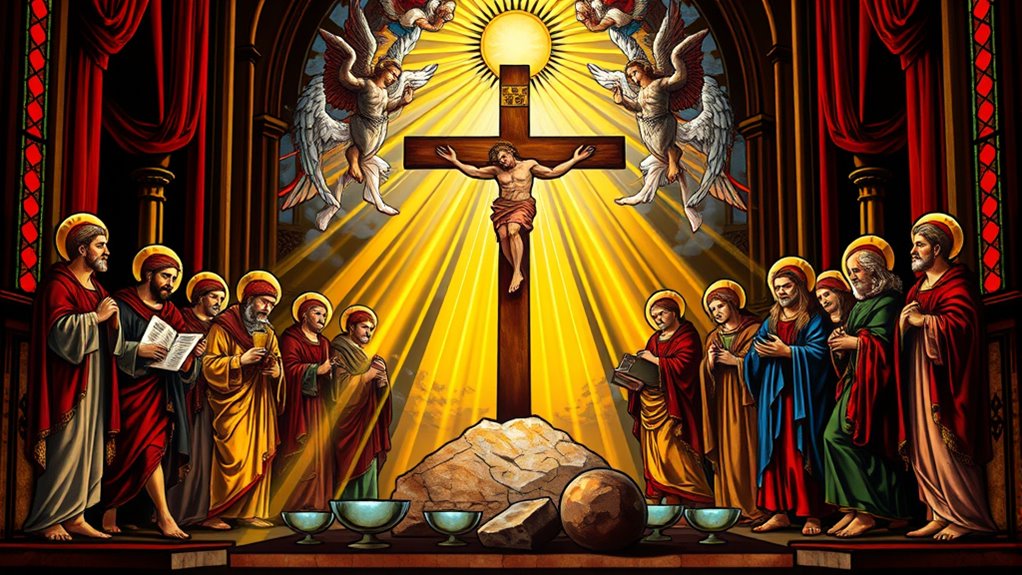
Yet Paul calls it “the power of God” (1:18). The same event divides audiences entirely. For the called, the cross reveals God rescuing people through what human judgment routinely rejects. Crucifixion was reserved for slaves, barbarians, and those considered the scum of society — making it the last place anyone would look for divine power. Roman authorities also used crucifixion as a deliberate tool of humiliation, disrobing victims publicly and encouraging crowds to mock the dying as a demonstration of imperial dominance over any perceived threat. The cross thus foregrounds circumcision of the heart as the transformative marker God accomplishes apart from human signs.
How God Saves Through a Mocked Message?
A message that looked absurd to its first hearers sits at the center of Paul’s argument in 1 Corinthians 1:18–25. Paul records that God chose the “foolishness of preaching” to save those who believe, meaning the proclamation itself carries the saving event. Worldly wisdom, whether Jewish sign-seeking or Greek philosophical reasoning, could not arrive at this salvation independently. The cross offended both groups precisely because it refused their standards. Yet Paul identifies Christ crucified as God’s actual power and wisdom. The mocked message remained effective not despite its humiliation, but because God deliberately chose that form to accomplish rescue. The natural mind cannot receive this, since without the Spirit a person finds the things of God to be foolishness and lacks the capacity to understand them. Each generation confronts the same failure, cycling through the same unsolved problems because human wisdom excludes God and therefore cannot locate the source of actual knowledge or rescue. This pattern shows how faith functions as trust demonstrated in belief, obedience, perseverance across Scripture.
Why Some People See the Cross Completely Differently?
Paul established that God chose a mocked, humiliating message as the actual vehicle of salvation, and that choice raises an immediate question: why do people hear the same message and reach opposite conclusions? Paul identifies four factors shaping that divide:
- Spiritual condition determines perception — the perishing call it foolishness; the saved recognize power.
- Cultural expectations create filters — Jews wanted signs; Greeks wanted logic.
- Human wisdom resists what it cannot control or categorize.
- Divine calling explains genuine understanding — insight becomes a gift, not an achievement.
The cross itself never changes. The hearer’s relationship to God does. To Jews, the crucified Christ became a stumbling block, directly contradicting their expectation of a triumphant Messiah who would arrive with power and signs rather than die under a Roman sentence. To Greeks and the self-described wise, the gospel was dismissed outright, because worldly wisdom — which James 3:15 identifies as earthly, unspiritual, demonic — lacked any framework for a salvation achieved through apparent weakness and shame. Leaders shaped by servant leadership are called to embody the paradox of the cross in posture and practice.
Why the Cross Outlasts Every Human Attempt to Find God?
Every philosophical system, moral framework, and religious tradition ever constructed shares one common limitation: none of them can produce what the cross claims to deliver.
Paul’s argument in 1 Corinthians 1:18–25 is straightforward: human wisdom can examine religion, but it cannot generate reconciliation with God.
Human wisdom can diagnose the problem. It cannot cure it. Only the cross reaches that far.
Philosophy fades when cultures shift.
Morality shifts when standards change.
Religious endeavor exhausts itself against human inability.
The cross, however, addresses what those systems cannot reach—sin, pride, and spiritual deadness.
Its staying power, Paul suggests, comes not from cultural relevance but from divine initiative.
God acts where human effort stops.
Paul makes this contrast explicit by asking where the wise person, the teacher of the law, and the philosopher of this age have gone—God made foolish the wisdom of the world.
The cross accomplishes what no human system can because God chose it as the specific means by which saving purposes are fulfilled, bypassing every expectation of what power and wisdom should look like.
This purpose is consistent with Scripture’s claim that its message is inspired authority for teaching, correction, and guidance.