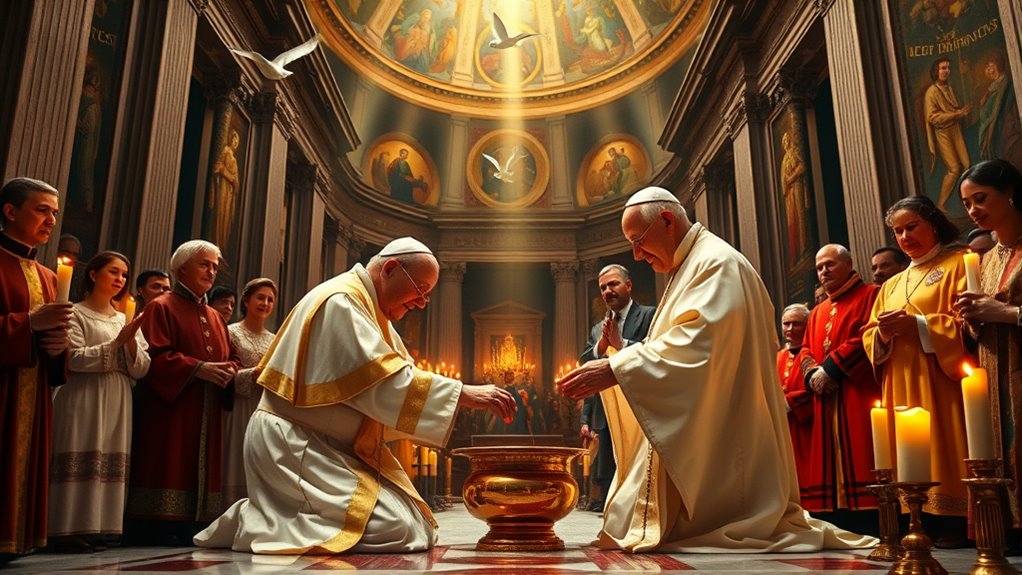
On December 14, 1975, Pope Paul VI knelt before Orthodox Metropolitan Meliton of Chalcedon in the Sistine Chapel and washed his feet, a gesture performed secretly with only his secretary informed beforehand. The act marked the tenth anniversary of lifting mutual excommunications between Rome and Constantinople, symbolizing reconciliation after nearly a millennium of division. Metropolitan Meliton declared “only a saint could do such a thing,” while Patriarch Dimitrios praised the unprecedented humility. The gesture particularly contrasted with 1439’s Council of Florence, where Orthodox leaders refused to kiss the Pope’s feet, suggesting symbolic actions might overcome centuries of separation.
On the eve of the 1975 Holy Year’s conclusion, Pope Paul VI knelt before Metropolitan Meliton of Heliupolis in the Sistine Chapel and washed the Orthodox prelate’s feet, a gesture that stunned those present and symbolized the Catholic Church’s longing to heal a division nearly a millennium old. This gesture resonated with broader Christian practices, including tithing as an expression of faith and communal responsibility. The act, inspired by Christ’s washing of his disciples’ feet, was performed in secret on December 14, with only the Pope’s personal secretary, Fr. Pasquale Macchi, informed beforehand. Long applause followed as attendees absorbed what they had witnessed.
In the Sistine Chapel, Pope Paul VI knelt to wash an Orthodox Metropolitan’s feet, stunning witnesses to this unprecedented gesture of reconciliation.
The gesture marked the tenth anniversary of another pivotal moment. On December 7, 1965, during Vatican II’s final session, mutual excommunications between Rome and Constantinople had been lifted through a joint declaration read simultaneously in both cities. While this did not end the schism that had divided Christianity since 1054, it represented a significant step toward reconciliation and set the tone for Paul VI’s broader ecumenical efforts.
The 1975 Holy Year, announced by Paul VI on May 9, 1973, emphasized reconciliation and renewal. In his December 8, 1974 World Day of Peace message titled “Reconciliation – The Way to Peace,” the Pope stressed that reconciliation with God was the indispensable first step toward peace and called for unity among Christians according to Vatican II’s Unitatis Redintegratio decree.
Orthodox leaders recognized the foot-washing as extraordinary. Metropolitan Meliton said “only a saint could do such a thing,” while Patriarch Dimitrios praised Paul VI for surpassing himself as a force for reconciliation. The act evoked the 1439 Council of Florence, where Orthodox patriarchs had refused to kiss Pope Eugene IV’s feet, making Paul’s reversal of that dynamic especially meaningful. Cardinal Johannes Willebrands highlighted the gesture’s symbolic power over words in fostering ecumenical relations.
Paul VI’s ecumenical work extended beyond Orthodoxy. In 1973, Coptic Patriarch Shenouda III visited the Vatican and issued a common declaration affirming unity on theological issues disputed since 451. The Pope also supported Protestant cooperation, including approval of a 1967 Bible translation. Paul VI had earlier exchanged letters with Archbishop of Canterbury Geoffrey Fisher, initiating ecumenical dialogue between Rome and the Anglican communion.
A faded photograph remains the primary visual record of the 1975 foot-washing, capturing a moment when symbolic action tested whether centuries of division might finally yield to reconciliation.