During his first Holy Week as pope, Leo XIV restored several traditional liturgical practices that differed conspicuously from those of Pope Francis. He washed the feet of 12 ordained priests at St. John Lateran rather than prisoners or women, personally carried a wooden cross through all 14 Stations at the Colosseum before 30,000 people, and moved the Easter Vigil to 9:00 p.m. Each choice signaled a papacy quietly reshaping its relationship with tradition, encounter, and service.
What Holy Week Traditions Did Pope Leo XIV Revive?
During his first Holy Week as head of the Catholic Church, Pope Leo XIV revived several traditional liturgical practices that marked a deliberate shift from the customs of his predecessor, Pope Francis.
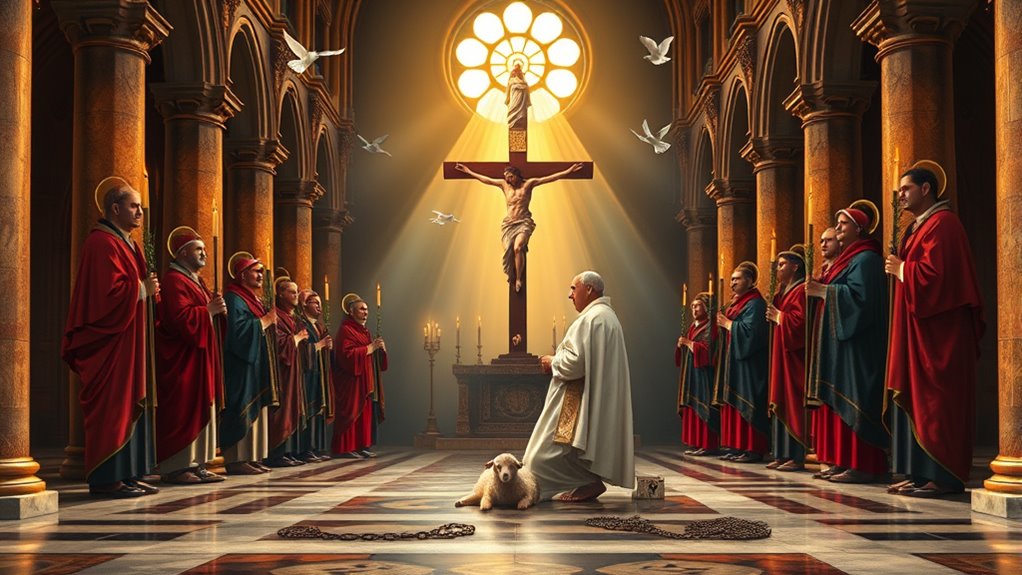
On Holy Thursday, Leo restored the foot-washing ceremony to its traditional form, performing the ritual on 12 Roman Catholic priests at the Basilica of St. John Lateran. Eleven of the 12 priests who participated had been ordained by Leo XIV in the previous year.
On Holy Thursday, Pope Leo XIV washed the feet of 12 priests, restoring the ceremony to its traditional form.
On Good Friday, the 70-year-old pontiff personally carried the cross through the 14 Stations at Rome’s Colosseum.
He also moved the Easter Vigil to 9:00 p.m. and returned major celebrations to formal cathedral settings rather than prisons or alternative venues. This emphasis on restoring longstanding rites echoes discussions about how Christian practices evolve and which traditions are retained or adapted, such as the fact that the Bible does not explicitly mention Christmas trees.
This approach contrasted sharply with Pope Francis, who used the foot-washing ritual to highlight marginalized groups such as immigrants and prisoners.
Why Leo Washed Priests’ Feet Instead of Prisoners’
In a deliberate departure from the approach taken by Pope Francis, Pope Leo XIV washed the feet of 12 Roman Catholic priests during Holy Thursday’s Mass of the Lord’s Supper at the Archbasilica of St. John Lateran. The practice echoed long-standing traditions of communal rites rooted in both Jewish synagogue and early Christian gatherings, emphasizing the value of communal worship. Francis had expanded the ritual after 2013, including prisoners, women, and non-Christians.
Leo returned to the pre-Francis custom, selecting priests ordained within his own diocese. Eleven of the 12 had been ordained by Leo himself the previous year. The choice signaled a clear theological priority: honoring the priesthood specifically, framing the gesture as one of humble, pastoral service toward ordained ministers. In his homily, Leo described the foot-washing as a “gratuitous and humble” gesture revealing the true omnipotence of God.
How Leo XIV Personally Carried the Cross at the Colosseum
On Good Friday, April 3, 2026, Pope Leo XIV carried a wooden cross through all 14 stations of the Via Crucis at Rome’s Colosseum, leading roughly 30,000 people in prayer for those suffering around the world. Prayer served during the ceremony reflected key biblical themes such as intercession for others and thanksgiving to God.
The hourlong procession, flanked by two torchbearers, concluded on Palatine Hill with a final blessing.
Key details from the ceremony:
- Leo held the cross before his face from the condemnation to burial stations
- Vatican archival research confirmed no pope had done this in over three decades
- Meditations, including one by Rev. Francesco Patton, emphasized dignity and reconciliation
- Leo later told reporters: “I carry all of this suffering in my prayer”
The meditations written for the service drew on Scripture, quotations from St. Francis of Assisi, and Father Patton’s experience walking the Way of the Cross through Jerusalem’s Old City. Father Patton, who served as custos of the Holy Land from 2016 to 2025, wrote many of the meditations from Mount Nebo in Jordan.
Where Leo XIV Departed From Pope Francis During Holy Week
While Pope Leo XIV’s decision to carry the cross himself at the Colosseum drew widespread attention, it was not the only way he put his own mark on Holy Week 2026. Two scheduling changes stood out most clearly. The Holy Thursday foot-washing returned to the Basilica of St. John Lateran, ending Pope Francis’s practice of holding the rite in prisons and shelters. The Easter Vigil moved to 9:00pm, two hours later than Francis’s 7:00pm start. Both shifts reflected Leo XIV’s preference for traditional liturgical settings and rhythms, without entirely abandoning the spirit of his predecessor’s outward-facing approach. The Chrism Mass remained anchored to St. Peter’s Basilica, beginning at 9:30am on Holy Thursday morning before the afternoon liturgy at St. John Lateran. At the Lateran, Leo XIV washed the feet of 12 Roman priests, continuing the ceremony’s historic connection to ordained clergy rather than the marginalized groups Francis had honored in recent years. Observers noted that these choices also reopened debates about the role of tradition and context in shaping contemporary liturgical practice.
What Leo’s First Easter Tells Us About the Pope He’s Becoming
Every major decision Pope Leo XIV made during Holy Week 2026 — from carrying the wooden cross at the Colosseum to returning the foot-washing rite to a basilica — pointed toward a papacy shaped by three recurring themes: detachment from institutional comfort, direct encounter with the faithful, and service rooted in humility rather than ceremony.
His choices consistently signaled:
- Peace over political convenience
- Encounter over distance
- Service over ceremony
- Renewal over routine
His Easter address reinforced this direction, linking resurrection hope to real-world suffering — war, inequality, environmental damage — suggesting Leo intends theology to meet reality, not merely decorate it. He directly appealed to those in power, urging that “those with weapons lay them down” in favor of dialogue over domination. The Triduum, which also included the Chrism Mass and Easter Vigil, served as a window into his papal direction, revealing a pontificate defined by detachment, encounter, and a radically different understanding of power. A consistent biblical emphasis on servant leadership undergirded these gestures and words.