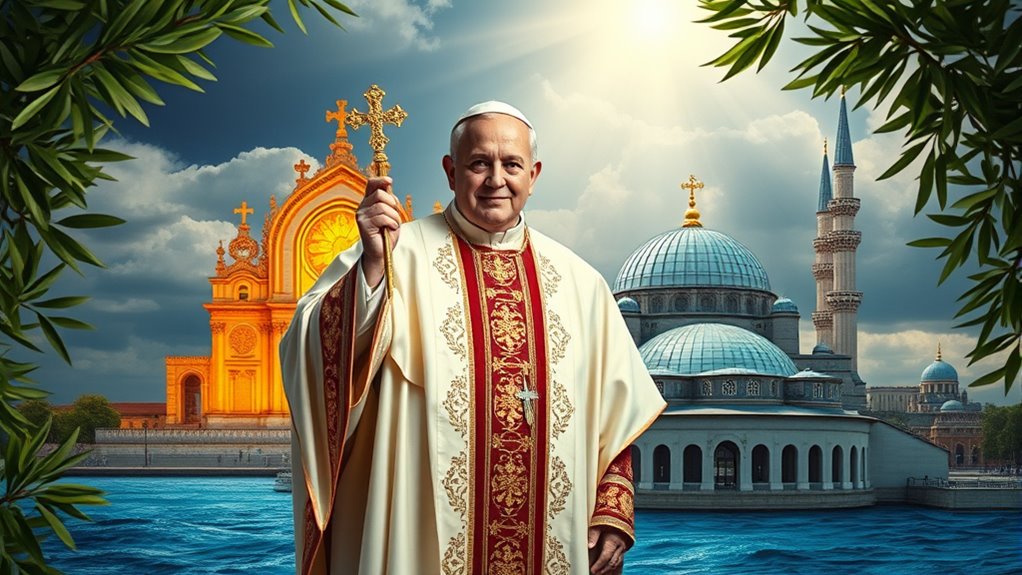
Pope Leo XIV declined to pray inside Istanbul’s Blue Mosque during his November 2025 Turkey visit, citing Catholic doctrine that distinguishes respectful interfaith visits from shared worship in non-consecrated spaces. The first American-born pontiff emphasized maintaining theological boundaries while honoring Christian-Muslim dialogue, particularly meaningful given Istanbul’s history as Constantinople, an ancient center of Eastern Christianity. His decision reflected careful attention to Canon Law and doctrinal integrity rather than diplomatic rejection, establishing a measured approach that balances religious principles with cultural respect. The full context reveals how historical precedents and theological training shaped this nuanced stance.
When Pope Leo XIV declined to pray inside Istanbul’s Blue Mosque during a 2026 diplomatic visit to Turkey, the decision reflected careful attention to Catholic doctrine rather than rejection of interfaith dialogue. The first American-born pontiff and first Augustinian to lead the Church, Leo XIV navigated a delicate situation where theological principles intersected with diplomatic symbolism.
The Blue Mosque, also known as Sultan Ahmed Mosque, serves as an active Islamic worship space with rituals distinct from Catholic liturgy. Scholars often contrast this with biblical burial practices that emphasize interment. Catholic doctrine traditionally designates churches and consecrated chapels as proper venues for official papal prayer. Participating in prayer at a mosque could suggest endorsement of beliefs contrary to Catholic teaching, a boundary Leo XIV sought to maintain while still honoring Turkey’s religious heritage.
Istanbul carries particular weight in Christian-Muslim relations, having served as Constantinople, the ancient seat of Eastern Christianity. The Vatican’s diplomatic relationship with Turkey requires balancing respect for Islamic tradition with preserving Catholic identity. Leo XIV’s approach signaled theological integrity without dismissing the value of dialogue between faiths.
Recent popes have promoted conversations with Islamic leaders while defining clear limits around shared worship practices. Pope Leo XIV has emphasized doctrinal clarity and the holiness of Church members over architectural grandeur, suggesting his priorities rest firmly on faith principles.
His refusal to pray inside the mosque does not indicate hostility toward Islam but rather reinforces the distinction between respectful visiting and liturgical participation. The pontiff, born September 14, 1955, brought decades of theological formation and Canon Law expertise to this nuanced diplomatic moment.
The pope’s chosen name connects him to predecessors known for defending Church authority, including Leo I and Leo XIII, both remembered for doctrinal assertion and careful leadership during complex periods. This historical lineage appears to influence his decision-making style, which favors cautious engagement over potentially ambiguous gestures. During the trip, which took place from November 27 to December 2, 2025, the pope commemorated the 1,700th anniversary of the Council of Nicaea, further emphasizing the historical significance of Christian presence in the region.
Interfaith dialogue often focuses on shared ethical values and mutual understanding rather than joint worship in sacred spaces. By visiting Turkey while maintaining clear religious boundaries, Pope Leo XIV demonstrated that meaningful dialogue between Catholics and Muslims need not require blurring theological distinctions.
His decision reflected both diplomatic awareness and commitment to Catholic teaching, offering a measured path forward in interfaith relations.