
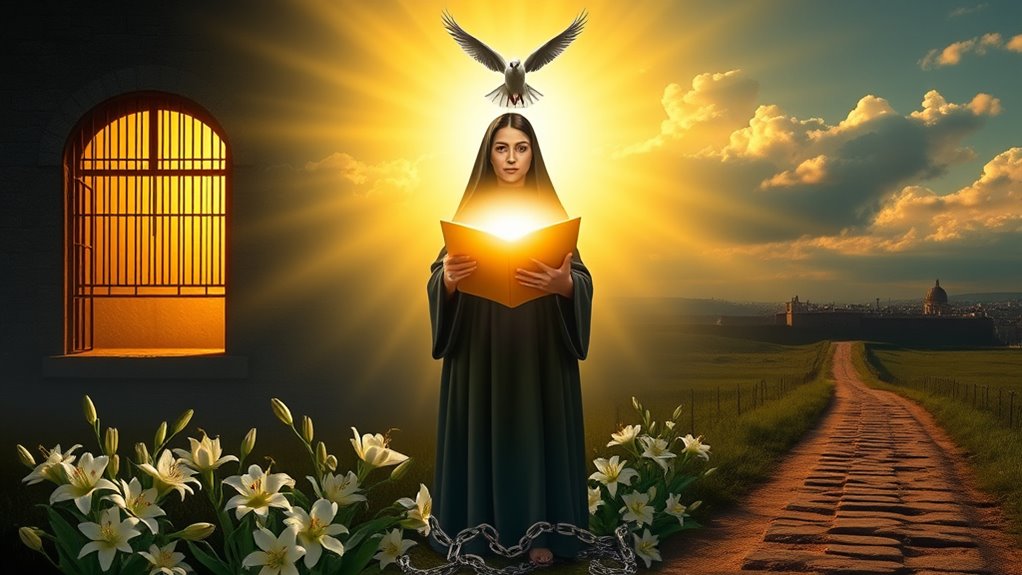
Mary Ward, born in 1585 to a wealthy Yorkshire Catholic family, founded the Institute of the Blessed Virgin Mary in 1609, creating one of the first active religious communities for women. She rejected traditional enclosure, dressing her sisters in simple dark clothing rather than habits and modeling their work on Jesuit mobility to focus on education and ministry. Her innovations drew fierce opposition, leading to papal suppression and imprisonment by the Inquisition, yet her vision eventually prevailed when the institute was restored in 1909, shaping modern approaches to women’s religious life.
In an age when women’s voices were largely confined to the domestic sphere, Mary Ward charted a different course. Born on 23 January 1585 in Yorkshire to a wealthy Catholic noble family, she grew up during a period of intense anti-Catholic persecution under the English Reformation. Her family sheltered persecuted Catholics despite the risks, and Ward herself felt a religious vocation at fifteen, though family expectations delayed her entry into religious life until age twenty-one.
Born into privilege during England’s fierce religious turmoil, Mary Ward defied convention from the start, answering a call that would not be silenced.
Ward traveled to Flanders in 1606 to join the Poor Clares at Saint-Omer, but as an extern sister she found herself excluded from the Divine Office and full prayer life. Within two months she left, using her dowry to found a Poor Clare convent for English women at Gravelines. She also worked underground in London, visiting prisons, caring for the sick, and teaching catechism.
By late 1609, Ward returned to Saint-Omer with companions to establish a new community. Seven women joined her, forming what became the School of the Blessed Mary, later known as the Institute of the Blessed Virgin Mary. Modeled on Jesuit mobility and missionary focus, the institute aimed at sanctification, salvation, and girls’ education. Ward received what she described as a divine vision instructing her to adopt the Jesuit model for women.
Her innovations challenged convention. The women wore simple dark dresses rather than habits, lived vows without formal enclosure, and emphasized active ministry among people. Ward declared in 1612 that no difference between men and women prevented great deeds. Between 1609 and 1615, she established communities and schools, walking from Flanders to Rome twice seeking approval for this active lifestyle.
Opposition mounted. Papal authorities suppressed her congregation for defying enclosure norms, forcing schools and communities to close. Ward faced the Inquisition and traveled to Rome a third time as a prisoner accused of heresy. She was imprisoned in a filthy, rat-infested cell with minimal provisions. Despite these trials, she remained obedient to the Catholic Church while insisting on her God-given mission. Ward died on 30 January 1645 and was later declared Venerable. Her institute was restored in 1909, vindicating her vision of active religious life for women. The institute still exists today with branches such as Loreto where Mother Teresa served for twenty years. Her emphasis on education and formation shaped later Catholic approaches to girls’ schooling and religious life.