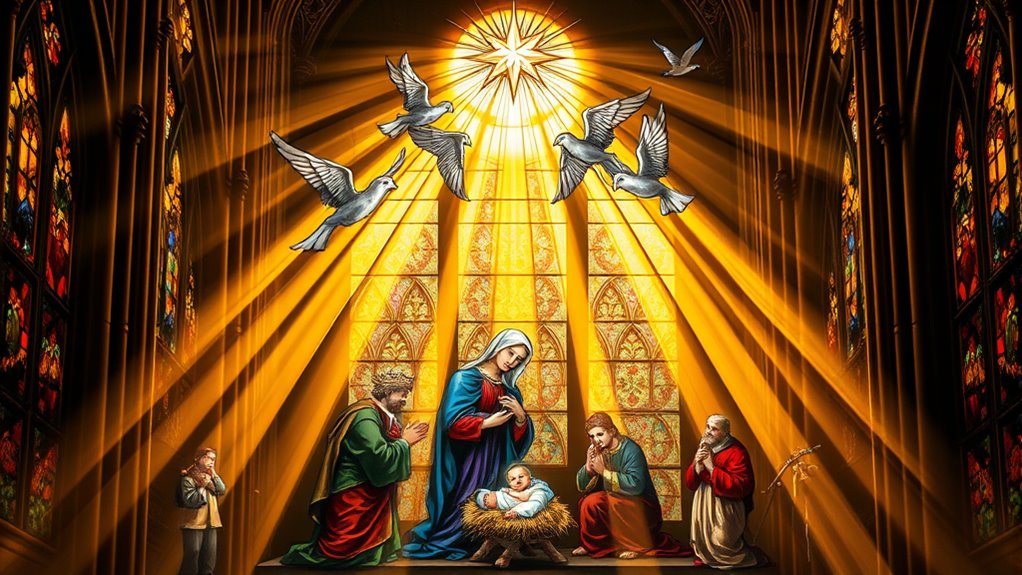
The Bible never mentions Christmas by name, sets no specific date for Jesus’ birth, and gives no instruction to observe an annual celebration. The Gospels of Matthew and Luke record the birth accounts, placing the event in Bethlehem during the reign of King Herod the Great. Scripture neither commands Christmas observance nor prohibits personal gratitude for Christ’s arrival. Those curious about what the biblical record actually says about Jesus’ birth will find the details worth exploring.
Key Takeaways
- The Bible never mentions “Christmas” by name, nor does it command or prohibit observing an annual celebration of Jesus’ birth.
- Scripture provides no specific date for Jesus’ birth, and December 25 receives no biblical confirmation.
- Jesus was born in Bethlehem to the Virgin Mary, fulfilling Old Testament prophecies in Isaiah 7:14 and Micah 5:2.
- Worship should follow God’s approved patterns rather than human tradition, as Exodus 32:5–7 consistently demonstrates throughout Scripture.
- Salvation through Christ, affirmed in Acts 4:12, remains constant regardless of calendar date or seasonal observance.
What the Bible Does: and Doesn’t: Say About Christmas
Many people celebrate Christmas each year without pausing to reflect what the Bible actually says about it — and perhaps more importantly, what it does not say.
Scripture provides no specific date for Jesus’ birth, no instruction for believers to observe it annually, and no mention of the holiday by name.
Scripture names no date, prescribes no annual observance, and never once mentions Christmas by name.
The Gospels and Acts record no celebration of the Nativity.
December 25 receives no biblical confirmation.
Yet the Bible speaks clearly about the event itself.
It affirms that Jesus was born of a virgin, announced by angels, and worshipped by wise men.
It identifies Him as Savior, Messiah, and Lord.
The distinction matters: Christmas as a cultural observance lacks biblical mandate, while the incarnation it loosely commemorates remains central to Christian faith. Devotional writers like Jamie Trunnel have noted that returning to Christmas Bible verses can renew peace and joy during a season filled with distraction.
Historians trace many familiar Christmas customs — including gift-giving, feasting, and the burning of candles — to Roman Saturnalia practices, a mid-December pagan festival that predates Christian observance of the holiday.
Scholars generally place Jesus’ birth in the late 1st century BC, based on historical and astronomical evidence.
What the Bible Actually Records About Jesus’ Birth
While the Gospels of Matthew and Luke offer the most detailed accounts of Jesus’ birth, neither records a specific date, and most biblical scholars estimate the event occurred somewhere between 6 BC and 4 BC, using the reign of King Herod the Great as a primary reference point.
Both gospels agree that Jesus was born in Bethlehem of Judea, to a virgin named Mary, who was engaged to Joseph, a descendant of King David. Bethlehem’s name meaning “house of bread” emphasizes symbolic ties to Jesus as the Bread of Life.
The conception is described as supernatural, caused by the Holy Spirit, with the angel Gabriel announcing the child would be the Son of God.
Following the birth, Jesus was wrapped in swaddling clothes, laid in a manger, and his arrival was announced by angels to nearby shepherds watching their flocks at night. Luke also references a census decreed by Caesar Augustus as the reason Joseph and Mary traveled to Bethlehem at the time of the birth.
The Bible also records that Jesus’ birth was not merely a historical event but one foretold by prophecy, with Old Testament scriptures such as Genesis 3:15, Isaiah 7:14, and Micah 5:2 predicting details of the Messiah’s coming hundreds of years before his birth.
How the Old Testament Predicted the Christmas Story

The Gospels’ account of Jesus’ birth does not stand alone. Several Old Testament scriptures, written centuries earlier, appear to have anticipated the events recorded in Matthew and Luke. Numerous interpreters also connect these prophecies with broader biblical timelines that trace back through Israel’s history and genealogies, sometimes linking messianic expectation to Davidic lineage.
Isaiah 7:14 described a virgin conceiving a son named Immanuel, meaning “God with us.” Micah 5:2 identified Bethlehem as the birthplace of a future ruler over Israel. Genesis traced the Messiah’s lineage through Abraham, Jacob, and the tribe of Judah. Isaiah 11:1 pointed to a descendant of Jesse and David.
Matthew and Luke each reference these texts directly, presenting Jesus’ birth as their fulfillment. His family’s flight to Egypt and later return, along with his upbringing in Nazareth, are also cited as completing specific prophetic details recorded long before his birth.
Matthew uses the phrase “to fulfill what the Lord had spoken by the prophet” in at least a dozen passages throughout his Gospel, underscoring the recurring pattern of prophecy meeting fulfillment in the life of Jesus.
The Old Testament also presents Jesus through his roles as prophet, priest, and king, with Micah 5:2 describing his origins as from of old, everlasting, affirming that the one born in Bethlehem existed long before his birth.
Why the Birth of Jesus Changes Everything Theologically
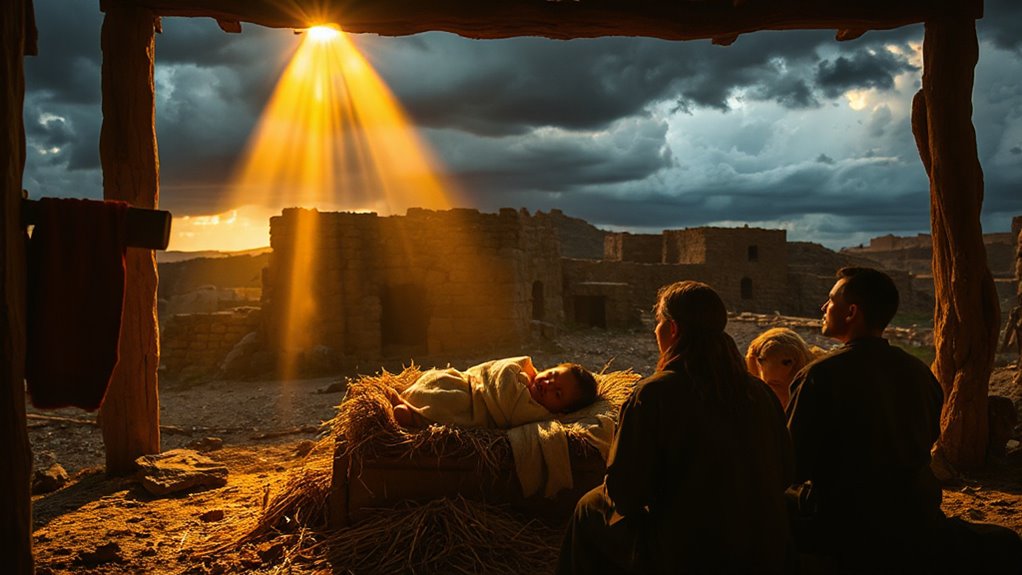
Understanding why Jesus’ birth carries such theological weight requires looking at what Christian teaching says it actually accomplished. Matthew 1:23 and Luke 1:27, 34 describe a conception without a human father, which theologians call the virgin birth.
The virgin birth, described in Matthew and Luke, marks the moment theologians say the divine entered human history.
This event marks what Christians refer to as the Incarnation, the moment the divine took on human flesh.
Christian teaching holds that sin had stripped humanity of its original glory and honor, and that Jesus was born specifically to restore it. Hebrews describes God making the founder of salvation perfect through suffering so that Jesus could bring sons and daughters to glory. The fact that Jesus likely spoke Aramaic grounds these events in a real historical and cultural context.
Through his birth, Jesus also became humanity’s brother, drawing people into the family of God and freeing them from the fear of death. Paul described Jesus as a second Adam whose obedience undid the damage caused by the first man’s disobedience and brought redemption to humanity.
John 1:14 records that the Word became flesh, establishing that Jesus’ arrival in human form was the summit of God’s long-range redemptive purpose rather than a display of power.
What Scripture Permits About Celebrating Christmas
Recognizing why the birth of Jesus holds such theological weight naturally raises a related question: what, if anything, does Scripture actually permit regarding celebrating it? The Bible neither commands Christmas nor prohibits private expressions of gratitude for Christ’s arrival.
McClintock and Strong’s *Cyclopedia* confirms Christmas carries no divine appointment in Scripture. However, verses like John 3:16 and Romans 5:8 encourage believers to reflect on God’s demonstrated love.
Luke 2:10 records the angel describing Christ’s birth as news bringing great joy, suggesting the event itself warrants recognition. Many Christians who celebrate often use approved translations to guide their worship and understanding.
Scripture’s consistent standard, drawn from Exodus 32:5-7, is that worship must align with God’s approved patterns rather than human tradition.
Gratitude for salvation through Christ, as affirmed in Acts 4:12, remains scripturally grounded regardless of calendar date. Isaiah 9:6 announces that a child is born and a son is given, bearing titles such as Wonderful Counselor, Mighty God and Prince of Peace, underscoring the magnitude of what believers have reason to treasure. Jesus, described as completely holy, eternally perfect, incredibly powerful, always forgiving, forever loving, and never failing, gives believers every reason to anchor their reflection in His character rather than seasonal custom.