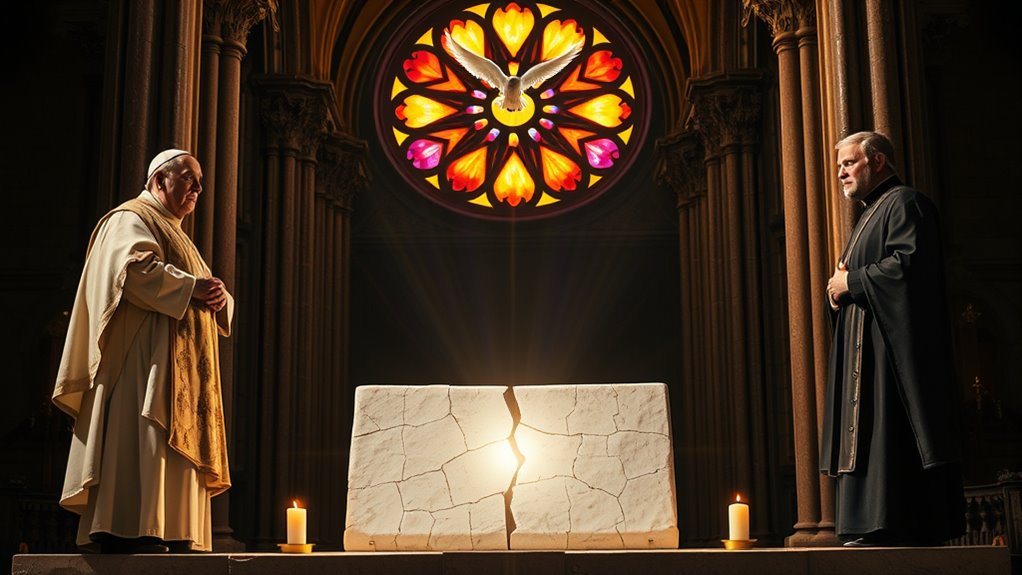
The dispute between Rome and the Society of Saint Pius X is not a blanket rejection of Vatican II. SSPX leaders claim to accept roughly 95% of the Council. The real friction concentrates on three documents: *Dignitatis Humanae*, the Council’s approach to ecumenism, and its teaching on episcopal collegiality. The SSPX argues these texts break from centuries of Catholic tradition. Rome disagrees. In February 2026, the SSPX formally ended dialogue, calling further talks hopeless. The full story behind that rupture runs deeper than most expect.
What the SSPX Really Rejects About Vatican II
When the Society of Saint Pius X lists its objections to the Second Vatican Council, four areas come up repeatedly: the liturgical reform and use of vernacular languages, the Council’s approach to ecumenism, the doctrine of episcopal collegiality, and the declaration on religious liberty known as *Dignitatis Humanae*.
The SSPX argues that each of these represents a break from prior Catholic teaching.
Fraternity leaders have stated these concerns prevent any full doctrinal agreement with Rome.
Bishop Fellay has noted that the Society accepts 95% of Vatican II teachings, meaning its objections are confined to a narrow set of specific texts rather than a wholesale rejection of the Council.
The SSPX was founded in 1970 by Marcel Lefebvre, whose charism centered on priestly formation and whose later decision to ordain bishops without papal approval first brought the Society to the edge of schism.
Understanding what the SSPX actually rejects helps clarify why reconciliation efforts, though ongoing, have not yet produced a lasting resolution between the two sides. A central concern for the Society is the Council’s teaching on liturgical reform and how it altered worship practices.
The Three Vatican II Doctrines Splitting Rome and the SSPX
Among the contested issues between Rome and the Society of Saint Pius X, three doctrines from the Second Vatican Council stand out as the most theologically significant: religious liberty as articulated in *Dignitatis Humanae*, the Council’s approach to ecumenism, and the principle of episcopal collegiality.
Three Vatican II doctrines remain central to the Rome-SSPX dispute: religious liberty, ecumenism, and episcopal collegiality.
*Dignitatis Humanae* grounds religious freedom in human dignity rather than objective truth, which the SSPX views as contradicting centuries of Church teaching.
Ecumenism raises parallel concerns about doctrinal compromise.
Collegiality, meanwhile, challenges the SSPX’s understanding of papal authority.
Rome maintains all three remain consistent with Catholic tradition, though disagreement persists. Paul VI himself acknowledged that the Council deliberately avoided issuing solemn dogmatic definitions with a note of infallibility, a distinction the SSPX argues is routinely overlooked in demands for its unconditional acceptance of conciliar texts.
Archbishop Guido Pozzo has further clarified that some conciliar texts are not doctrinal in character and therefore do not bind the Catholic conscience, a distinction that the SSPX contends must inform any legitimate demand for acceptance of the Council’s disputed formulations. The differing interpretations of these texts have led scholars to map out major conciliar perspectives that inform both supporters’ and critics’ readings.
How Four Illegal Ordinations Tore the SSPX From Rome
On July 1, 2026, the Society of Saint Pius X consecrated four new bishops at its International Seminary in Écône, Switzerland, without a papal mandate — an act that would swiftly end decades of uneasy coexistence between the SSPX and Rome.
Bishop Alfonso de Galarreta led the ceremony, defying explicit instructions from Pope Leo XIV.
The following day, the Dicastery for the Doctrine of the Faith decreed automatic excommunication for all participants under Canon 1382.
The Vatican then declared the SSPX in formal schism. Pope Leo XIV had written personally to Superior General Fr. Davide Pagliarani urging the society to please turn back.
The ceremony drew a congregation of some 15,500 people and their children to the grounds near the Écône seminary.
What had long been a disciplinary tension finally became an official, irreversible break. The episode highlighted ongoing debates within Catholicism over judging others and the balance between doctrinal discipline and pastoral mercy.
Why Benedict’s 2009 Olive Branch Changed Nothing
Pope Benedict XVI’s decision to lift the excommunications of four Society of Saint Pius X bishops on January 21, 2009, was widely seen as a gesture of goodwill — a deliberate effort to reopen dialogue with a traditionalist movement that had been formally severed from Rome since 1988.
However, the Congregation for the Doctrine of the Faith clarified two months later that the SSPX still held no canonical standing.
Priests remained unauthorized to hear confessions, and marriages they performed were considered invalid.
The decree removed a censure — nothing more.
Fundamental disagreements over Vatican II’s doctrinal authority remained completely unresolved. Benedict made clear that Church teaching authority cannot be frozen in the year 1962, and that Vatican II must be accepted alongside the faith professed over the centuries.
Those disagreements persisted well into the following decade, with the Vatican and SSPX exchanging written correspondence between 2017 and 2019 in an effort to clarify outstanding theological issues.
Both leaders and faithful were reminded that rulers and citizens alike are ultimately accountable to God, who calls for justice and mercy in governance and communal life.
Why Rome and the SSPX May Never Reconcile
Despite decades of negotiations, the divide between Rome and the Society of Saint Pius X remains as wide in 2025 as it was when Archbishop Marcel Lefebvre consecrated four bishops without papal approval in 1988.
The core problem is structural.
Rome cannot admit Vatican II contained errors without contradicting its own authority.
The SSPX cannot accept Vatican II without abandoning its founding identity.
The 2019 dialogue collapsed over precisely this impasse.
Neither side holds a position it can reasonably surrender.
Reconciliation may require something neither institution currently offers: a willingness to redefine what agreement actually means.
Rome had insisted for thirty years that the SSPX accept the Second Vatican Council without ever specifying what acceptance means in concrete propositions or content. Without such clarification, any reconciliation based on accepting Vatican II remains chimerical.
In February 2026, the SSPX formally rejected continued talks, sending a letter to Cardinal Victor Fernández declaring the dialogue had no hope of success.
The impasse echoes broader debates about how to respond pastorally to troubled minds and doctrinal dissent within the Church.