
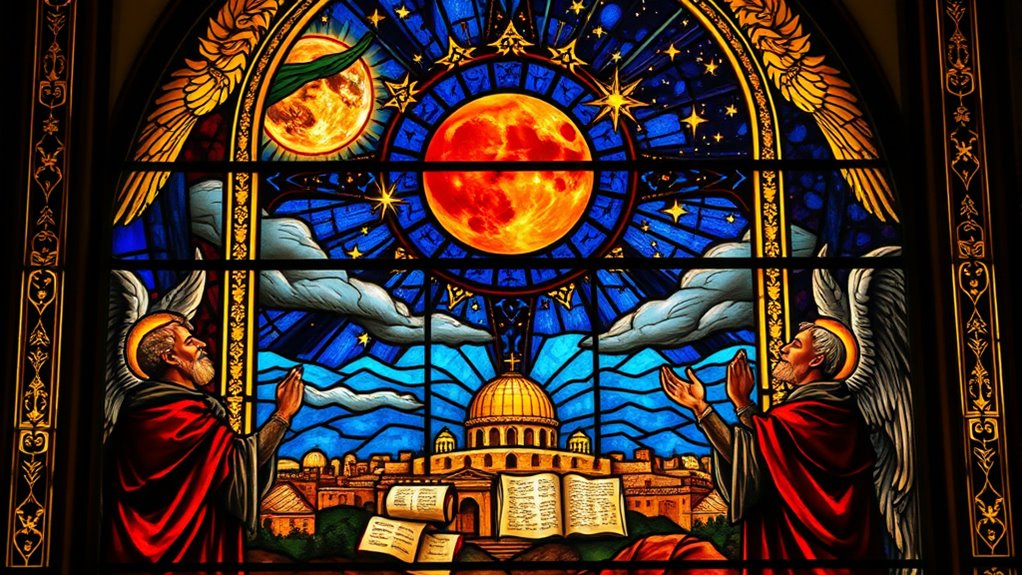
The Bible uses the phrase “moon turned to blood” in Joel 2:31, Acts 2:20, and Revelation 6:12, connecting the image to divine judgment and approaching end-time events. The language functions as symbolic apocalyptic imagery rather than a description of routine astronomy. Scholars across futurist, preterist, and historicist camps debate whether these passages point to past or future fulfillment. The full picture of what Scripture actually teaches on this subject becomes clearer further on.
Key Takeaways
- The Bible uses “moon turned to blood” language in Joel 2:31, Acts 2:20, and Revelation 6:12 within contexts of divine judgment.
- Biblical “blood moon” language functions as symbolic apocalyptic imagery signaling cosmic upheaval, not merely a description of lunar eclipses.
- Joel 2:31 places the moon turning to blood as a sign preceding “the great and dreadful day of the LORD.”
- Revelation 6:12 pairs the blood-red moon with earthquakes, a blackened sun, and falling stars, exceeding what a lunar eclipse produces.
- Matthew 24:36 cautions against precise timing predictions, warning that only the Father knows the day of Christ’s return.
What Does “Blood Moon” Actually Mean in the Bible?
Before examining what the Bible says about the blood moon, it helps to understand what the phrase actually means in two different settings: modern astronomy and ancient scripture.
In modern usage, “blood moon” typically refers to a total lunar eclipse, when sunlight filtered through Earth’s atmosphere casts a reddish glow across the moon’s surface. The term is widely used in both astronomy and popular religious teaching.
The Bible, however, uses different wording: “moon turned to blood,” found in passages such as Joel 2, Acts 2, and Revelation 6. That phrase functions as symbolic apocalyptic language tied to divine judgment and cosmic upheaval.
The two terms overlap in popular conversation but carry distinct meanings, and keeping that distinction clear matters when reading scripture carefully. The scientific explanation for the reddish color involves Rayleigh scattering, a process in which Earth’s atmosphere filters out shorter blue and green wavelengths while bending longer red wavelengths onto the moon’s surface.
The same effect that produces the moon’s red appearance during a lunar eclipse is also responsible for red sunsets, which share an identical atmospheric cause.
Additionally, readers should note that the Bible contains 31,102 verses across 66 books, so phrases like “moon turned to blood” appear within a much larger scriptural context.
Which Bible Verses Actually Mention the Blood Moon?
With the distinction between astronomical and biblical usage established, the actual scriptural record becomes the natural next focus.
Three verses use explicit blood-moon language. Joel 2:31 is the oldest, describing the moon turning to blood “before the great and dreadful day of the LORD.” Acts 2:20 repeats that exact wording inside Peter’s sermon, carrying Joel’s prophecy into the New Testament.
Revelation 6:12 calls the moon “blood red” during a seal judgment sequence.
Several related verses, including Matthew 24:29, Joel 2:10, and Isaiah 13:10, describe the moon losing its light without using blood imagery directly. Researchers typically treat those passages as supporting texts rather than primary references.
Some passages describe the moon darkening without blood imagery, serving as supporting rather than primary references.
The three explicit verses remain the clearest starting point for understanding what Scripture actually records about this sign. Luke 21:25 broadens this picture further, describing signs in celestial bodies accompanied by nations in anguish and the sea roaring, situating the blood moon within a larger tapestry of end-time cosmic activity.
Matthew 24:29 places these celestial disturbances after the tribulation, linking the darkening of the sun and moon to a specific sequence of events that follows a period of intense global suffering. The traditional crucifixion site at Golgotha—outside the ancient city walls—illustrates how biblical events are often anchored to specific historical locations.
What the Bible Actually Says About Blood Moons and Judgment
When the Bible mentions the moon turning to blood, the surrounding context is consistently one of judgment and divine intervention, not astronomical observation.
Joel 2:30–31 places the imagery within “wonders in the heavens” preceding “the great and dreadful day of the LORD.” The passage reflects the prophetic tradition of one God acting through cosmic signs to signal divine judgment.
Revelation 6:12 positions it inside the sixth seal judgment sequence.
Matthew 24:29 uses similar celestial language within an end-times warning.
Across these passages, the emphasis falls on cosmic upheaval signaling God’s decisive action, not on identifying a specific lunar event.
The imagery belongs to a broader Old Testament tradition of darkness, fire, and shaking heavens as markers of divine judgment.
Biblical scholars note the language is highly figurative, making interpretations limited strictly to lunar eclipses incomplete representations of what the text communicates.
Genesis 1:14 establishes that celestial bodies were designated by God as lights for signs, seasons, days, and years, providing the foundational framework within which prophetic celestial imagery is understood.
In 2014 and 2015, prophecy teachers linked a tetrad of eclipses to end-times prophecies found in Joel and Revelation, drawing significant attention to the blood moon theory.
How Futurists, Preterists, and Historicists Read Blood Moon Prophecy
Recognizing that blood moon language belongs to a broader tradition of divine judgment imagery opens a practical question: how do different schools of biblical interpretation apply that imagery?
Blood moon language belongs to a broader tradition of divine judgment imagery — but how do interpreters actually apply it?
Three main approaches exist. Futurists read blood moon passages as pointing to literal future events tied to a coming tribulation and Christ’s return.
Preterists argue these texts were already fulfilled in the first century, particularly during the destruction of Jerusalem in A.D. 70.
Historicists take a middle path, treating prophetic symbols as mapping onto successive periods across church history rather than one single moment.
Each school handles symbolism differently.
Futurists favor more literal readings, while preterists and historicists allow figurative interpretations.
Despite their differences, all three engage the same core texts: Joel 2, Matthew 24, and Revelation 6. Preterism itself is not monolithic, as partial preterists still anticipate a future literal second coming of Christ and bodily resurrection, while full preterists consider all prophecy fulfilled by A.D. 70.
Revelation is notably rich in prophetic content, with nearly one third of its verses containing a prediction spanning roughly fifty-six separate forecast events.
The way interpreters connect signs like lunar disturbances to historical events is influenced by broader traditions about prophetic fulfillment and sites of significance such as Bethlehem.
Do Lunar Eclipses Fulfill Biblical Blood Moon Prophecy?
Whether a total lunar eclipse can fulfill biblical blood moon prophecy is one of the more debated questions in contemporary Christian interpretation.
Supporters connect the reddish appearance of a lunar eclipse with Joel’s and Revelation’s blood imagery, pointing especially to the 2014–2015 tetrad of four total lunar eclipses.
However, many scholars note that Revelation 6:12 places the blood-red moon alongside earthquakes, a blackened sun, and falling stars—details that do not match a routine eclipse. The differing original languages of the Bible, including Hebrew and Koine Greek, shape how such prophetic imagery is interpreted and translated, influencing modern readings of these passages language context.
Additionally, three of the four 2014–2015 eclipses were not visible in Israel, weakening claims tied to biblical geography.
Most careful interpreters conclude that while a lunar eclipse resembles the imagery, resemblance alone does not establish prophetic fulfillment.
The theory remains interpretive rather than something Scripture states explicitly. Genesis 1:14 establishes that lights in the sky were created to serve as signs and seasons, a foundational point that proponents of the blood moon framework cite when connecting eclipse events to prophetic meaning.
Matthew 24:36 serves as an important reminder that only the Father knows the day of the Son of Man’s return, cautioning against treating any celestial event as a precise prophetic timestamp.