




The Bible neither commands nor forbids infant baptism directly, leaving Christians to interpret indirect evidence. Acts 2:38-39 extends the baptism promise to believers “and your children,” while household baptisms in Acts 16 may or may not have included infants. Scripture consistently links baptism to personal faith and repentance, which shapes how different traditions read the silence. The theological reasoning behind each position runs deeper than a single passage can settle.
Key Takeaways
- The Bible contains no direct command requiring infant baptism, nor any explicit prohibition forbidding it.
- Acts 2:38-39 promises baptism to believers “and your children,” though no specific age is mentioned.
- Household baptisms in Acts 16 include entire families, but no infants are specifically named or counted.
- Covenant theology connects infant baptism to Abraham’s covenant in Genesis 17:7, supported by Colossians 2:11-12.
- Scripture consistently links baptism to personal faith and repentance, forming the core Baptist argument against infant baptism.
What the Bible Does and Doesn’t Say About Infant Baptism

When searching the Bible for guidance on infant baptism, readers encounter neither a clear command requiring it nor a direct prohibition forbidding it.
The New Covenant consistently emphasizes baptism following personal belief, yet no verse explicitly forbids extending it to infants. The name Jesus itself, meaning “Yahweh saves,” underscores why some link baptism to the promise of divine salvation.
No infant is named as being baptized in any biblical account.
At the same time, Acts 2:38-39 records Peter declaring the promise of baptism belongs to believers “and your children,” without specifying age.
Household baptisms in Acts 16:15 and Acts 16:33 include entire families, though children are not individually listed.
Household baptisms swept entire families into the covenant, yet Scripture leaves children unnamed and uncounted.
This combination of silence and indirect evidence has fueled centuries of theological debate, leaving Christians to navigate the question through careful interpretation rather than straightforward biblical instruction. Jesus himself declared that the kingdom of God belongs to little children, as recorded in Mark 10:14.
Paul’s letter to the Romans teaches that sin entered through one man and death spread to all, providing a biblical basis for why some theologians argue even infants require the new birth that baptism represents.
How Covenant Theology Justifies Baptizing Infants
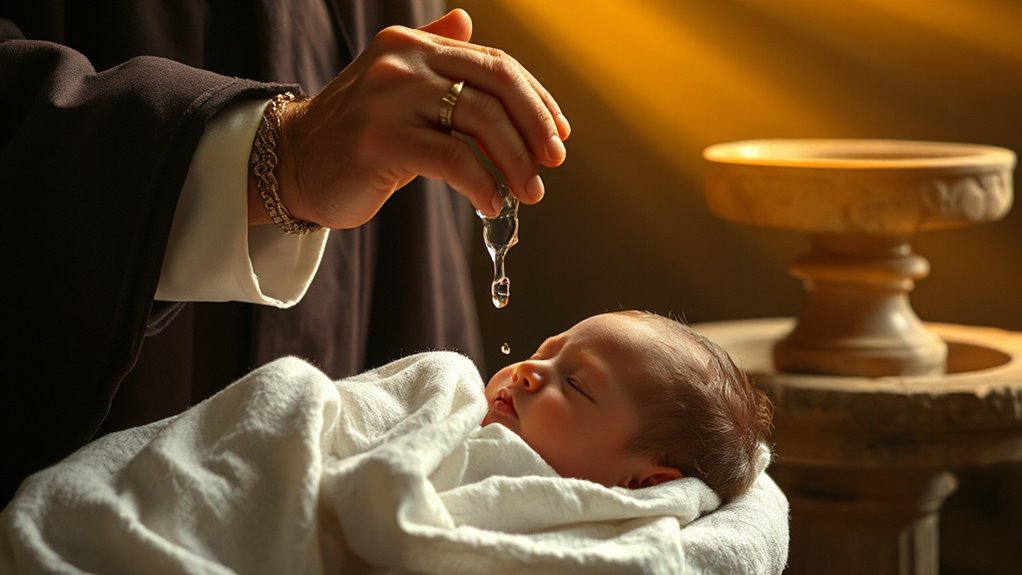
Among the theological frameworks Christians use to evaluate infant baptism, covenant theology stands out as the most developed and historically influential. This framework argues that God’s covenant of grace runs continuously from Abraham through the New testament, uniting both eras under one divine promise.
In Genesis 17:7, God established his covenant with Abraham and his offspring. Reformed theologians contend that just as circumcision marked infant males as covenant members under Abraham, baptism now serves the same function under Christ.
Colossians 2:11-12 is frequently cited to support this parallel. The Westminster Confession and the Heidelberg Catechism both formally affirm infant baptism on these grounds. The doctrine parallels the broader Christian claim that the Son shares the one divine essence with the Father and Spirit, a point rooted in Trinitarian doctrine.
B.B. Warfield acknowledged no explicit New Testament command exists, yet argued covenant continuity reasonably implies the practice. Critics, however, contend that grounding a New Testament ordinance exclusively in Old Testament Scripture reflects a flawed hermeneutical approach.
Galatians 3:29 teaches that those who belong to Christ are Abraham’s offspring and heirs according to the promise, extending the Abrahamic covenant framework directly into the New Testament church.
Why Baptists and Other Denominations Reject Infant Baptism

For Baptists and many other Protestant denominations, the case against infant baptism begins with a straightforward observation: the New covenant contains no command to baptize infants and no recorded example of it ever happening.
Scripture, they argue, consistently links baptism to a personal profession of faith and repentance — conditions infants cannot meet.
Baptism, in Scripture, follows faith and repentance — responses no infant is capable of making.
Baptist theologians describe this silence as total, classifying infant baptism as a human tradition rather than a divinely appointed ordinance.
Beyond the absence of biblical warrant, Baptists also argue that the New Covenant operates differently from the Old.
Membership, they contend, is defined by conscious faith and personal confession, not family lineage.
The church, in their view, is a body of known believers, making infant baptism fundamentally incompatible with New Testament principles.
Critics further contend that infant baptism erases the boundary between the church and the world, with national churches absorbing entire populations into membership without free consent of members.
Some Baptist writers have gone further in their condemnations, with one source describing infant baptism as no invention more harmful among the errors of paganism and delusion.
They also point out that most Protestant groups limit recognized sacraments to two, such as Baptism and the Lord’s Supper, reinforcing their emphasis on believer’s baptism.