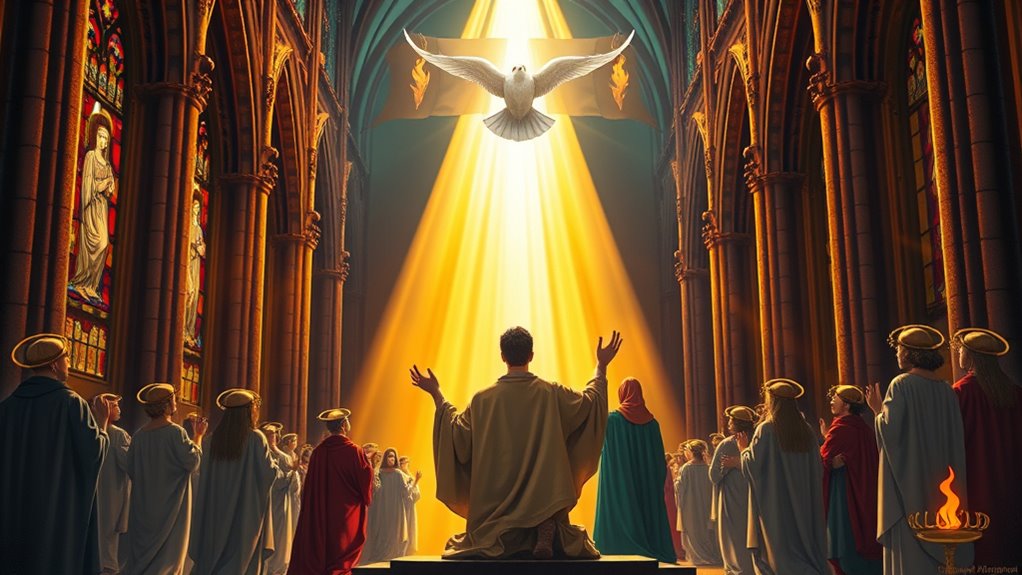
The Bible describes speaking in tongues as a supernatural ability to speak a language unknown to the speaker, given by the Holy Spirit. The Greek word *glossa*, meaning “languages,” appears throughout the New Testament. At Pentecost, roughly 120 disciples spoke in foreign languages heard by crowds from regions including Parthia, Rome, and Cappadocia. Paul later outlined guidelines for its use in church. The sections ahead examine each passage closely.
Key Takeaways
- Speaking in tongues is a supernatural ability to speak languages unknown to the speaker, described as a genuine sign of the Holy Spirit’s power.
- At Pentecost, approximately 120 disciples spoke in real foreign languages, allowing crowds from distant regions to hear the gospel in their native tongues.
- In 1 Corinthians, Paul describes tongues as a private prayer language for communicating spiritual mysteries to God when prayer content feels unclear.
- Paul’s guidelines for public use require no more than three speakers, taking turns, with an interpreter present, prioritizing congregational edification over individual expression.
- Scholars debate whether tongues ceased after the apostolic era or continue today, with no explicit termination date given in 1 Corinthians 12.
What Does Speaking in Tongues Mean in the Bible?

Speaking in tongues, as described in the Bible, refers to the supernatural ability to speak a language unknown to the speaker.
Speaking in tongues describes a supernatural ability granted by God to speak languages completely unknown to the speaker.
The biblical term itself comes from the Greek word *glossa*, which translates directly to “languages.”
This distinction matters, since the gift involves genuine communication rather than random sounds.
Scripture presents tongues as a spiritual miracle, enabling believers to speak human languages, angelic dialects, or heavenly languages without prior study or training.
The gift is identified as a sign of the Holy Spirit’s presence and power among believers.
In Acts 2, international crowds heard the gospel spoken clearly in their own native languages.
Paul later described tongues in 1 Corinthians as a private prayer language used to communicate spiritual mysteries directly to God.
The fulfillment of tongues is rooted in the New Covenant promises, where God foretold pouring out His Spirit and writing His law on the hearts of His people.
The very first occurrence of speaking in tongues took place in Jerusalem on Pentecost, when about 120 disciples were filled with holy spirit and began speaking in different languages.
This phenomenon has been discussed in light of broader Christian doctrines such as the Trinity, which affirms the role of the Holy Spirit in the life of believers.
What Actually Happened on the Day of Pentecost?

The definition of tongues as actual spoken languages finds its clearest demonstration in what happened at Pentecost, roughly fifty days after Passover in approximately AD 30-33.
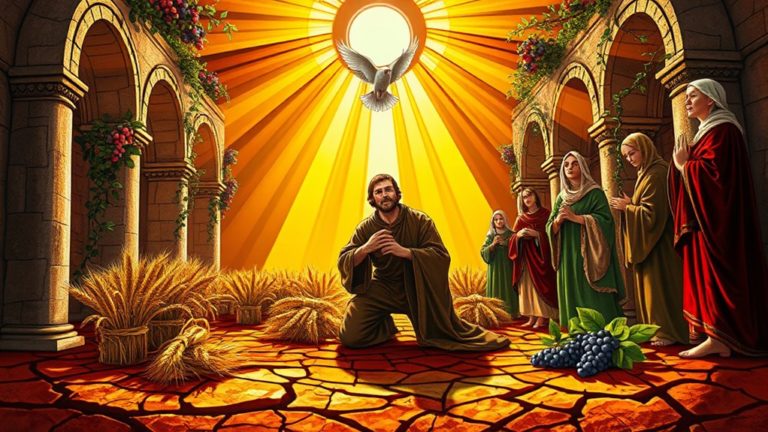
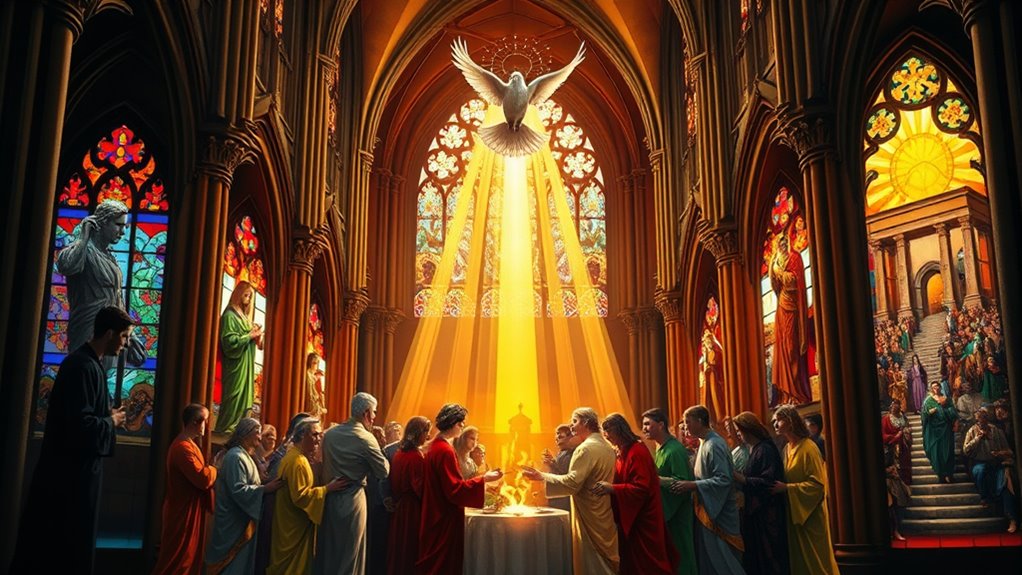
According to Acts 2, believers gathered together when a sound like rushing wind filled the house. Divided tongues of fire appeared and rested on each person present, and all were filled with the Holy Spirit. They then began speaking in languages they had not previously known. Crowds from Parthia, Medea, Cappadocia, and Rome each heard their own native dialects spoken aloud. This event occurred in a world where Koine Greek served as the common language across the Eastern Mediterranean.
Peter addressed the multitude, explaining these events as fulfillment of Joel’s prophecy. Three thousand people responded by believing, repenting, and being baptized that day, marking what many scholars identify as the founding moment of the Christian church. This miraculous event is widely understood as a reversal of Babel, where God had once scattered the nations through language confusion but now gathered them together through the proclamation of Christ.
Before this outpouring, Jesus had specifically promised his disciples that baptized in the Spirit was imminent, a fulfillment they would experience in just a matter of days.
Are the Tongues in Acts 2 and 1 Corinthians the Same Gift?
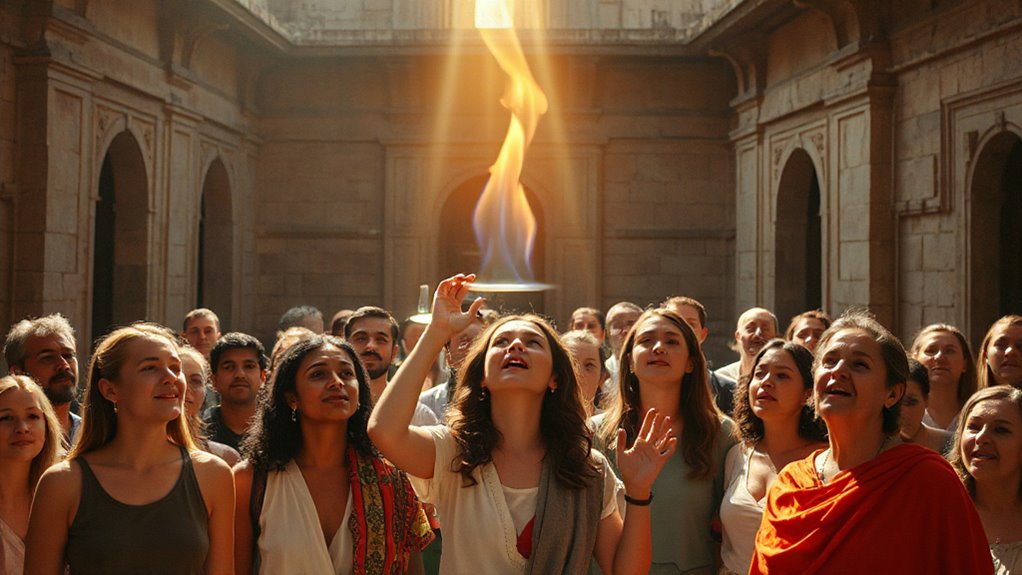
One of the more debated questions in New Testament studies is whether the tongues described in Acts 2 and 1 Corinthians refer to the same gift or two separate phenomena. Both passages use the identical Greek term *glossa*, and no distinct New Testament word separates them.
Acts 2:6–8 confirms the Jerusalem crowd heard their own native languages spoken, while 1 Corinthians 14:10–11 compares tongues to foreign languages requiring comprehension. Some scholars note this aligns with the biblical emphasis on evangelistic signs in the early church.
In Acts 2, native languages were heard and recognized; in 1 Corinthians 14, tongues still required comprehension like foreign speech.
Scholarly sources including Got Questions and Enduring Word explicitly reject the idea of two kinds of tongues.
The purpose shifted contextually — public evangelism in Acts, corporate edification in Corinth — but the gift itself remained consistent: a supernatural ability to speak unlearned, authentic human languages understood by others. Paul explicitly identifies tongues as a sign for unbelievers in 1 Corinthians 14:22, further reinforcing the evangelistic function consistent with what was demonstrated at Pentecost.
How Is Speaking in Tongues Supposed to Be Used in Church?
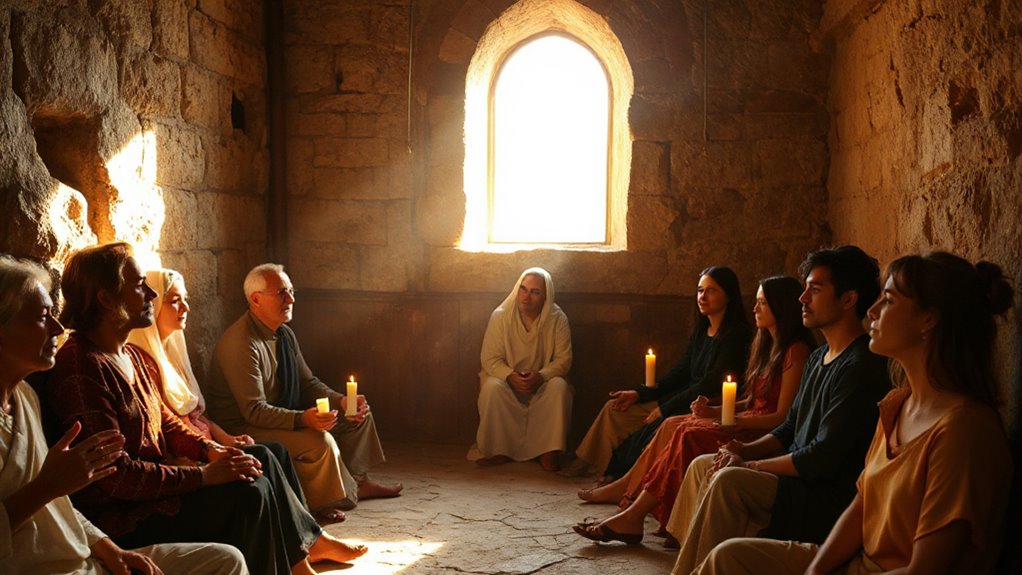
Having established that the tongues in Acts 2 and 1 Corinthians likely describe the same gift expressed in different settings, the natural follow-up question concerns how that gift was meant to function within an organized church gathering. Reading the whole Bible requires only a modest time commitment, with a typical plan taking about 70–80 hours total over a year.
Paul addresses this directly in 1 Corinthians 14, outlining clear rules for public use.
No more than two or three speakers should address a congregation per service, and each must speak in turn.
Most importantly, an interpreter must be present.
If no interpreter is available, the speaker is instructed to remain silent.
Paul’s reasoning centers on edification — the spiritual strengthening of everyone present.
Uninterpreted tongues benefit only the speaker, while interpreted tongues serve the entire body.
Order, he emphasizes, is not optional; chaos is explicitly forbidden in Christian gatherings. Despite these guidelines, Paul is clear that believers should not forbid tongues, preserving the Spirit’s freedom to move as He sees fit.
It is also worth noting that these instructions were originally given in the context of house churches, where gatherings likely consisted of no more than ten to twenty-five people.
Do Christians Still Speak in Tongues Today?

Whether the gift of tongues remains active in the modern church is one of the more genuinely contested questions in Christian theology.
Two main positions shape the debate. Continuationists point to 1 Corinthians 12, noting that no termination date is given for the gift, and observe that many Christians worldwide report practicing it today.
Cessationists counter that 1 Corinthians 13:8 signals the gift ended with the apostolic era, and historical records suggest no verified occurrences between that period and the twentieth century. The debate also intersects with discussions about the number of biblical verses and textual variations, since different translations can affect how passages about spiritual gifts are read and referenced verse counts.
Both sides agree, however, that Paul never treated tongues as universal.
He asked plainly in 1 Corinthians 12:30 whether all speak in tongues, implying the answer is no.
The question remains open, studied carefully by scholars across many traditions. N. T. Wright, for one, has described tongues as a private prayer aid, used when the content of prayer feels unclear rather than as a public demonstration.