




The Bible was originally written in three ancient languages across different historical periods. Most of the Old Testament was composed in Hebrew, the language of ancient Israelites, between the 12th and 2nd centuries BCE. Select portions of the Old Testament, including sections of Ezra and Daniel, were written in Biblical Aramaic. The entire New Testament was composed in Koine Greek, a simplified dialect that served as the common language throughout the Eastern Mediterranean during the Roman Empire. This linguistic diversity reflects the complex cultural interactions that shaped these foundational texts over centuries.
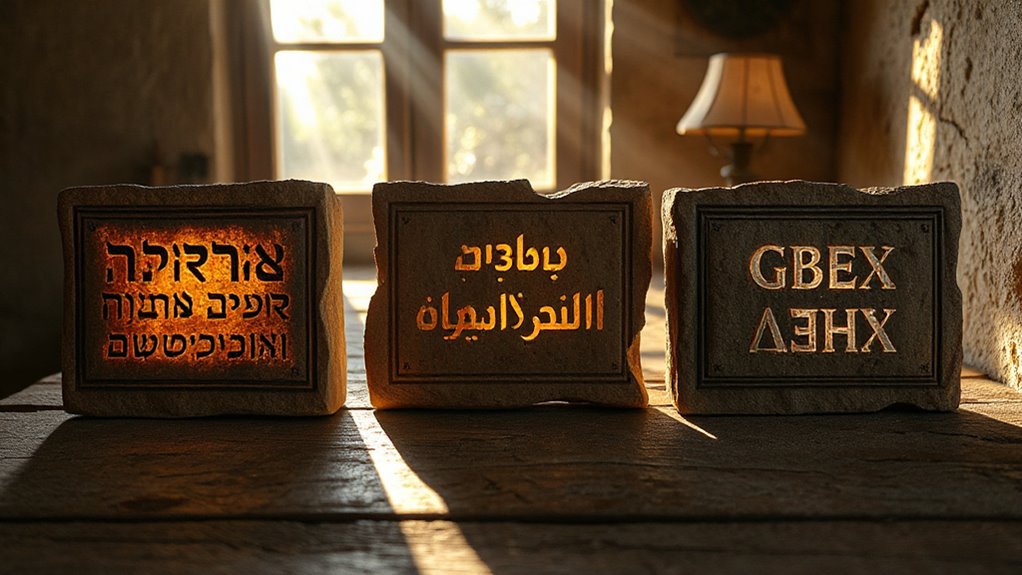
When scholars examine the original languages of biblical texts, they discover a fascinating tapestry of ancient communication that spans over a millennium of human history. The Old Testament was primarily written in Hebrew, the language of ancient Israelites, which belongs to the Semitic language family alongside Aramaic and Arabic. This Biblical Hebrew differs markedly from Modern Hebrew, reflecting centuries of linguistic evolution as scribes composed the various texts. Scholars place much of the Hebrew Bible’s composition between the 12th–2nd centuries BCE.
Hebrew script itself underwent transformation during the biblical period, evolving from early Paleo-Hebrew pictographs to the Aramaic square script that emerged during the Babylonian exile. Certain portions of the Old Testament appear in Biblical Aramaic, particularly in the books of Ezra, Daniel, and small sections of Jeremiah. These Aramaic passages reflect the language’s growing influence as it became the common vernacular in Israel following the Babylonian exile.
The New Testament presents a different linguistic landscape entirely. Scholarly consensus confirms that all New Testament books were originally written in Koine Greek, a simplified dialect that served as the lingua franca throughout the Eastern Mediterranean. This common Greek enabled early Christian teachings to reach diverse populations beyond Hebrew or Aramaic speakers, making it an invaluable missionary tool within the Roman Empire.
Koine Greek served as the strategic lingua franca that enabled early Christian teachings to transcend cultural and linguistic boundaries throughout the Roman Empire.
While Jesus and his disciples likely spoke Aramaic in their daily interactions, the Gospel writers chose Greek to record their accounts. Evidence of this underlying Aramaic influence appears in certain writing styles and preserved phrases like “Talitha koum” within the Greek texts. The choice of Greek proved strategically crucial, as many Jews had lost Hebrew literacy by the New Testament period.
The Dead Sea Scrolls provide manuscript evidence supporting Hebrew and Aramaic origins for Old Testament texts, while the Septuagint demonstrates early Greek translation efforts from the third to first centuries BCE. The Septuagint was created by Jewish scholars who translated the Hebrew scriptures into Greek, including additional Jewish texts like Tobit and Judith beyond the traditional Tanakh. No original Hebrew or Aramaic New Testament manuscripts survive, reinforcing the scholarly position that Greek was the original composition language. Alexander the Great’s conquests established Greek as the dominant language in the civilized world, providing cultural foundation for the widespread adoption of Koine Greek in biblical writings.
This multilingual foundation reflects the complex historical context in which biblical authors wrote, bridging Hebrew religious tradition, Aramaic vernacular speech, and Greek intellectual discourse across centuries of ancient Near Eastern civilization.
Frequently Asked Questions
Why Were Different Languages Used for the Old and New Testaments?
The Old and New Scriptures used different languages because they were written during distinct historical periods with different dominant languages. The Old Testament was composed primarily in Hebrew, reflecting ancient Israelite culture, with some Aramaic sections from exile periods.
The New Testament used Koine Greek, the common language of the Roman Empire, enabling early Christians to spread their message across diverse Mediterranean populations effectively.
How Accurate Are Modern Bible Translations Compared to Original Manuscripts?
Modern Bible translations demonstrate remarkable accuracy compared to original manuscripts, with New Testament texts showing 99.5% textual purity across over 24,000 manuscripts.
While scholars estimate 200,000 to 750,000 textual variants exist, the vast majority involve minor spelling or grammatical differences that don’t affect core meanings.
Translation committees use critical editions like Nestle-Aland, carefully selecting readings closest to original texts through rigorous textual criticism methods.
What Happened to the Original Biblical Manuscripts Written by the Authors?
The original biblical manuscripts written by the authors have been lost to time. These autographs likely disappeared within decades or centuries after composition due to the fragile nature of ancient writing materials like papyrus and parchment.
Despite extensive archaeological efforts, no verified original manuscripts have been discovered. However, thousands of carefully preserved copies remain, allowing scholars to reconstruct the original texts through textual criticism methods.
Did Jesus Speak the Same Language That the Gospels Were Written In?
No, Jesus did not speak the same language the Gospels were written in. Jesus primarily spoke Aramaic, the common language of first-century Galilee.
He likely knew Hebrew and some Greek as well.
The Gospels were originally written in Koine Greek to reach broader Mediterranean audiences.
This linguistic difference reflects early Christianity’s shift from a local Aramaic-speaking Jewish movement to a Greek-speaking international community.
How Do Scholars Determine the Original Language of Disputed Biblical Texts?
Scholars determine original biblical languages through multiple analytical methods. They examine word usage patterns, sentence structures, and linguistic features across manuscripts to identify distinct writing traditions.
Textual critics compare readings from diverse manuscript families, prioritizing older sources while evaluating scribal errors.
The historical-grammatical method investigates grammar, syntax, and historical context to discern authors’ intended meanings, combining archaeological and anthropological evidence with rigorous linguistic analysis.