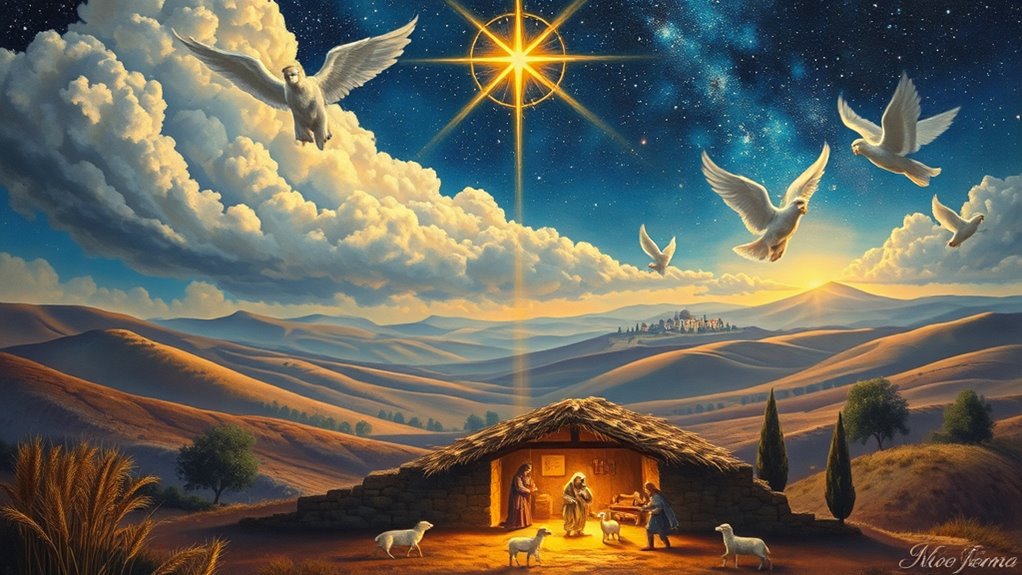
Jesus was born in Bethlehem, a small village in Judea whose name means “house of bread.” The prophet Micah foretold this humble town would produce a ruler over Israel, connecting Jesus to King David’s lineage. During a Roman census under Caesar Augustus, Joseph and Mary traveled to Bethlehem, where Jesus was born in a cave used as a stable. The Church of the Nativity, built over the traditional birthplace in 326 AD, continues drawing pilgrims today, marking where ancient prophecy met divine fulfillment.
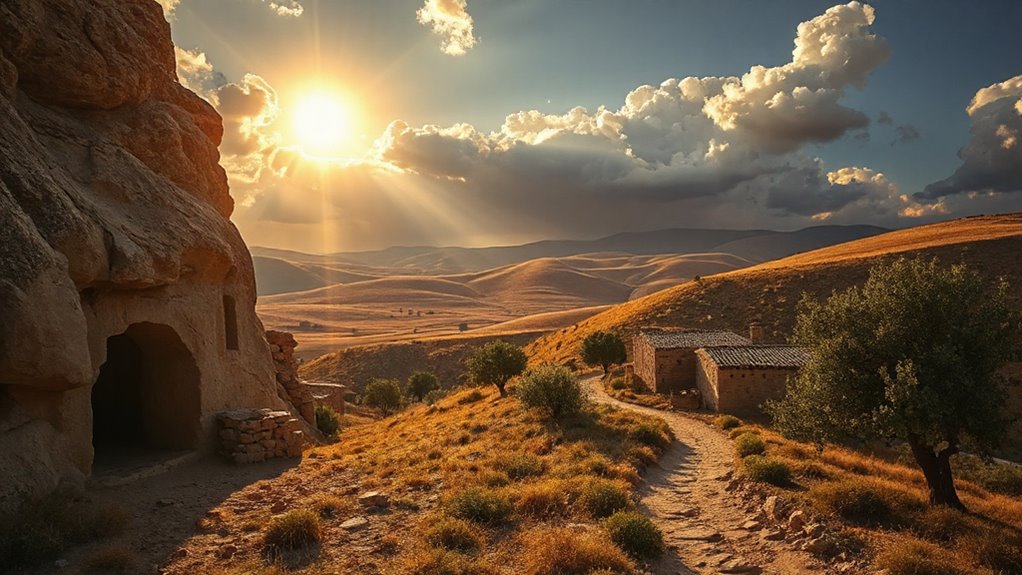
Where would one expect to find the birthplace of a figure who would transform world history? The answer lies in Bethlehem, a small village in Judea that held profound significance long before Jesus’ arrival. The town’s name means “house of bread,” a detail that would later resonate with Jesus’ identification as the Bread of Life, offering spiritual sustenance to humanity. The full Catholic Bible includes deuterocanonical books that are part of its Old Testament canon.
The prophet Micah foretold this momentous event centuries earlier, declaring that though Bethlehem was “small among the clans of Judah,” from it would come “a ruler over Israel.” This prophecy established Bethlehem as the predicted birthplace of the Messiah, connecting Jesus to the lineage of King David, who also called this humble village home.
At the time of Jesus’ birth, Bethlehem remained a modest, rural community in Judea, far from any grand metropolis. Roman Emperor Caesar Augustus‘s census decree required Joseph and Mary to travel from Nazareth to Bethlehem, fulfilling ancient prophecy while setting the stage for the Nativity.
Archaeological evidence and local traditions point to caves used as stables and surrounding shepherds’ fields, providing context for the biblical narratives.
The theological significance of this location extends beyond mere geography. Bethlehem’s historical association with sacrificial lambs from Migdal Eder foreshadowed Jesus’ role as the Lamb of God. This connection reinforced the continuity between Jewish law and Jesus’ mission, demonstrating how his birth fulfilled both prophetic expectations and symbolic traditions. John the Baptist would later identify Jesus as the Lamb of God who takes away the sin of the world, affirming this prophetic fulfillment.
Christian veneration of Bethlehem began early, with the site continuously honored since the second century. Emperor Constantine ordered construction of the Church of the Nativity around 326 AD over a cave traditionally identified as Jesus’ birthplace.
Today, a star marks the spot where tradition places the manger, attracting millions of annual visitors to this sacred location.
The church complex houses multiple Christian denominational chapels, reflecting centuries of religious history and the enduring significance of this small town. Both Matthew and Luke affirmed Bethlehem’s prophetic importance in their Gospel accounts, cementing its place in Christian tradition as the humble beginning of an extraordinary story that would indeed transform world history. King Herod’s slaughter of male infants under two years old in Bethlehem forced Mary, Joseph, and Jesus to flee to Egypt for safety.
Frequently Asked Questions
What Language Did Jesus Speak When He Was Born?
Jesus spoke Aramaic as his primary language from birth, the common tongue of Roman Judaea and Galilean villages like Bethlehem and Nazareth. This Northwest Semitic language had replaced Hebrew in daily conversation following the Babylonian captivity.
He later learned Biblical Hebrew for religious studies and likely acquired functional Greek for broader communication, creating the multilingual environment typical of first-century Palestinian Jews.
How Long Did Mary and Joseph Stay in Bethlehem After Jesus’ Birth?
Mary and Joseph likely remained in Bethlehem for several weeks to nearly two years after Jesus’ birth.
Luke’s Gospel indicates they stayed at least 40 days to fulfill Jewish purification requirements before presenting Jesus at the Jerusalem temple.
Matthew’s account suggests a longer period, possibly up to two years, before the wise men’s visit and the family’s subsequent flight to Egypt to escape King Herod’s persecution.
What Happened to the Stable Where Jesus Was Allegedly Born?
The cave-stable where Jesus was allegedly born became the foundation for one of Christianity’s most enduring sacred sites. Constantine the Great built the first Church of the Nativity directly above the grotto in AD 339, preserving the cave beneath.
After fire destroyed the original structure, a replacement church was constructed in the sixth century, incorporating elements from Constantine’s building and maintaining continuous veneration of the birthplace for nearly two millennia.
Why Do Some Scholars Question the Traditional Bethlehem Birthplace Story?
Scholars question the traditional Bethlehem birthplace for several reasons. Archaeological evidence shows Nazareth was inhabited during Jesus’ time, while direct evidence linking Jesus to Bethlehem remains absent.
Some researchers suggest the Gospel accounts were shaped by theological motivations to fulfill messianic prophecies rather than historical accuracy. The lack of contemporaneous records and potential influence from earlier mythologies also contribute to scholarly skepticism about the traditional narrative.
Are There Any Archaeological Findings That Prove Jesus Was Born in Bethlehem?
No archaeological findings definitively prove Jesus was born in Bethlehem. Excavations have uncovered first-century Jewish homes, storage areas, and natural caves used as animal shelters near Bethlehem, supporting the plausibility of Gospel accounts.
The Church of the Nativity was built over a cave traditionally identified as Jesus’ birthplace since the fourth century. However, no artifacts or inscriptions directly link Jesus’ birth to any specific location in Bethlehem.