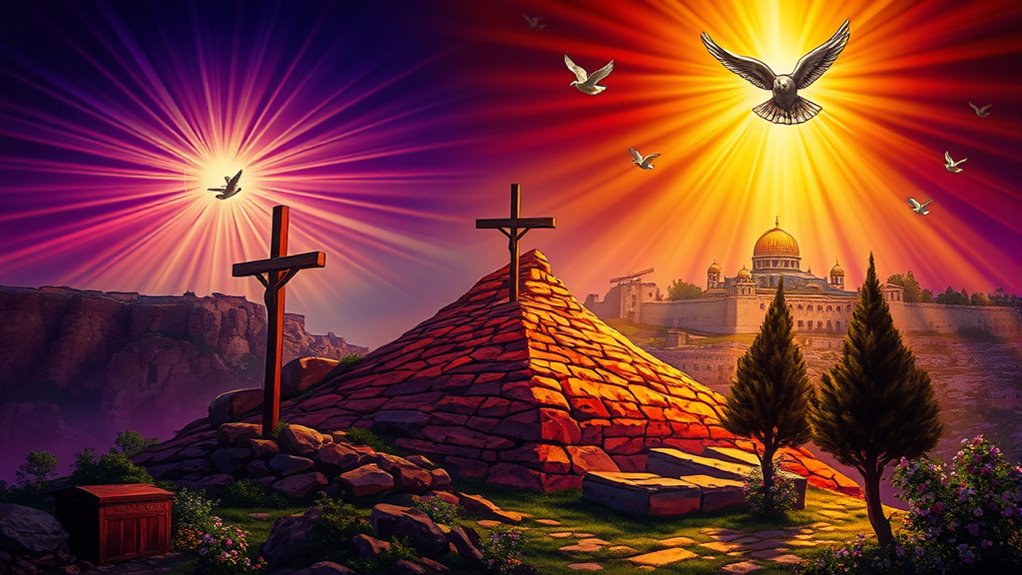
Jesus was crucified at Golgotha, meaning “place of the skull,” located outside Jerusalem’s ancient city walls approximately one-third mile west of the Temple Mount. Archaeological evidence strongly supports this site, now covered by the Church of the Holy Sepulchre, as the authentic location where Jesus died around 30-33 CE. The elevated limestone outcrop resembled a skull and sat along major roads, allowing Romans to display executions publicly. This placement outside the city fulfilled Jewish law prohibiting executions within holy boundaries while symbolizing the removal of sin from the sacred community, marking a pivotal shift from Old to New Covenant theology that continues to shape Christian understanding today.

Where exactly did Jesus of Nazareth meet his death on a Roman cross nearly two thousand years ago? The traditional answer points to Golgotha, an Aramaic word meaning “place of the skull,” also known by its Latin name, Calvary. This site has been identified by Christians for centuries as the location where Jesus was crucified, and archaeological evidence suggests this identification may well be accurate. Many scholars place his birth 6–4 BCE, based on Gospel and historical clues.
The Church of the Holy Sepulchre, constructed in the fourth century under Emperor Constantine, now stands over what was believed to be Golgotha and Jesus’ tomb. Early Christian testimonies, including those from church father Origen, linked this location to ancient traditions about Adam’s burial, creating powerful symbolism about sin and redemption occurring in the same place. While some Protestant scholars have questioned this site’s authenticity since the nineteenth century, it remains the most probable location according to historical evidence.
The fourth-century Church of the Holy Sepulchre marks the historically probable site where Jesus died and was buried.
Scripture confirms that Jesus was crucified outside Jerusalem’s city walls, as Jewish law prohibited executions within the holy city. Golgotha sat approximately one-third of a mile west of the Temple Mount, positioned near major roads where the public execution would be clearly visible. This proximity to thoroughfares aligned with Roman practices of using crucifixion as public punishment and deterrent.
Archaeological investigations reveal that Golgotha was part of an abandoned limestone quarry that had been converted into a garden area during the early first century. The elevated terrain resembled a skull’s shape, possibly explaining the site’s name. Nearby stood Joseph of Arimathea’s tomb, matching Gospel descriptions of Jesus’ burial location within a garden close to the crucifixion site.
The location outside the city walls carried deep theological significance. It fulfilled Mosaic Law requirements that sin offerings be removed from the holy camp, as referenced in Leviticus and later explained in Hebrews. This separation from the Temple Mount emphasized Jesus’ role as a distinct sacrifice, while the public nature of the execution represented the shame and disgrace associated with crucifixion. The geographical separation between Golgotha and Mount Moriah underscores the transition from Old to New Covenant. Archaeological digs continue to reveal clues about Jerusalem’s ancient city boundaries, helping scholars understand the precise relationship between the crucifixion site and the walls of Jesus’ time.
The site therefore embodied both the removal of sin from the holy community and the completion of God’s redemptive plan.
Frequently Asked Questions
What Time of Day Was Jesus Crucified?
According to the Synoptic Gospels, Jesus was crucified at the third hour, corresponding to 9 a.m. in Jewish timekeeping.
Mark’s Gospel specifically records this timing, counting hours from sunrise around 6 a.m.
Some scholars note apparent discrepancies with John’s Gospel, suggesting different timekeeping systems were used.
The crucifixion occurred mid-morning, allowing approximately six hours on the cross before Jesus’ death at 3 p.m.
How Long Did Jesus Hang on the Cross Before Dying?
According to Gospel accounts, Jesus hung on the cross for approximately six hours before dying.
Mark records his crucifixion at the third hour (9 AM) and death at the ninth hour (3 PM).
Matthew and Luke confirm this timeline, noting darkness from noon until his death at 3 PM.
This duration aligns with typical crucifixion timelines and Jewish requirements for body removal before sunset.
Who Else Was Crucified Alongside Jesus?
Two men were crucified alongside Jesus, one on his right and one on his left, according to all four Gospels. The Greek term *lestai* describes them as bandits or insurgents rather than common thieves, suggesting they were political rebels against Roman rule.
Apocryphal sources name them Gestas and Dismas, with Dismas becoming known as the “good thief” who repented and received Jesus’ promise of paradise.
What Happened to Jesus’ Cross After the Crucifixion?
The physical cross likely remained at Golgotha after Jesus’ crucifixion, as Roman soldiers typically reused or discarded crucifixion apparatus. No biblical accounts specify what happened to the wooden structure itself.
Early Christians focused on the cross’s spiritual significance rather than preserving the physical object. Centuries later, traditions emerged about the “True Cross,” though these claims lack contemporary evidence from the time of crucifixion.
Why Was Crucifixion Chosen as the Method of Execution?
Crucifixion served multiple Roman purposes beyond simple execution. The method functioned as a powerful deterrent through its prolonged, public suffering, displaying Rome’s absolute authority to potential rebels.
Practically, it proved cost-effective since vertical posts remained permanently installed while only crossbeams required transport.
Romans reserved this shameful death primarily for slaves, foreigners, and political dissidents, maximizing psychological control over occupied populations through visible terror.
Related Posts