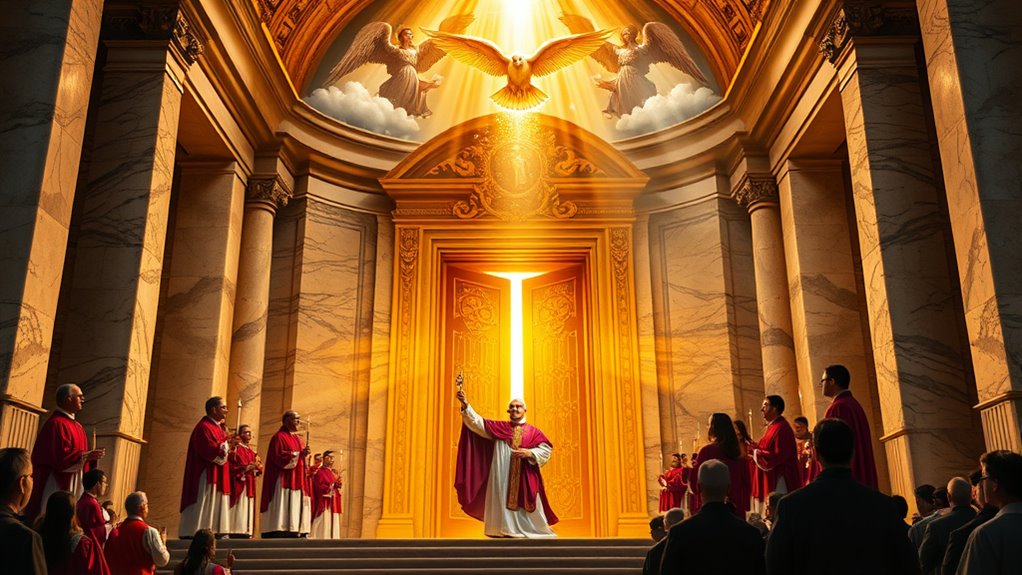
Pope Francis’s successor will seal Rome’s Holy Doors at the conclusion of the 2025 Jubilee Year, a responsibility carrying unusual weight after Francis died April 21, 2025, midway through the celebration he began by opening the doors on December 24, 2024. Nearly 30 million pilgrims have passed through these portals since their opening. The ceremony begins Christmas Day 2025 at St. Mary Major before proceeding through Rome’s major basilicas to St. Peter’s, where bronze panels will close the sacred threshold until the next Jubilee, preserving a metal box containing the key, parchment, and papal medals inside.
As the Jubilee Year of 2025 draws to a close, Vatican officials will gather in the coming days to perform a centuries-old ritual that marks both an ending and a promise of renewal. Many pilgrims also engaged in fasting and prayer as part of their spiritual preparation for passing through the doors. The sealing of Rome’s Holy Doors, which began opening on December 24, 2024, will conclude on January 6, 2026, when Pope Leo XIV closes the final door at St. Peter’s Basilica. Nearly 30 million pilgrims have passed through these sacred portals since they first opened.
A centuries-old Vatican ritual will seal Rome’s Holy Doors on January 6, 2026, ending the Jubilee Year pilgrimage.
The closing ceremony carries unusual significance this year. Pope Francis, who opened the doors in December 2024, died on April 21, 2025, making his successor responsible for sealing them. This unprecedented situation adds historical weight to a ritual already steeped in tradition. The sequence begins Christmas Day 2025 at St. Mary Major and proceeds through Rome’s other major basilicas before reaching St. Peter’s.
The ceremony itself has evolved considerably over centuries. Before 1975, popes used a silver hammer to strike a solid wall blocking the doorway, then laid bricks with a trowel while crowds gathered fragments as relics. Pope Pius XII introduced bronze doors in 1949, and Pope Paul VI simplified the process in 1975, eliminating the masonry work after safety concerns arose. Today, bronze panels close instead of a full wall being constructed.
Inside the wall, workers seal a metal box containing objects essential for the next Jubilee. The current box, placed during the 2016 Jubilee of Mercy closure, holds the key Pope Francis used to open the door, door handles, a closure certification parchment, four golden bricks, and medals from the pontificates of Francis, Benedict XVI, and John Paul II. The box was kept inside the wall since the Jubilee of Mercy in 2016.
Before each new Jubilee begins, the recognitio ceremony verifies the door’s integrity. Cardinal Mauro Gambetti, the basilica’s archpriest, leads prayers while Sampietrini workers demolish the inner wall. The ceremonial norms were established in 1499 by Pope Alexander VI and refined over subsequent centuries.
A procession follows with litanies to the Altar of Confession, then proceeds to the Chapter House where Archbishop Rino Fisichella receives documents and Archbishop Diego Ravelli receives objects. This verification guarantees the seal remained intact, preserving the sacred threshold until pilgrims return.