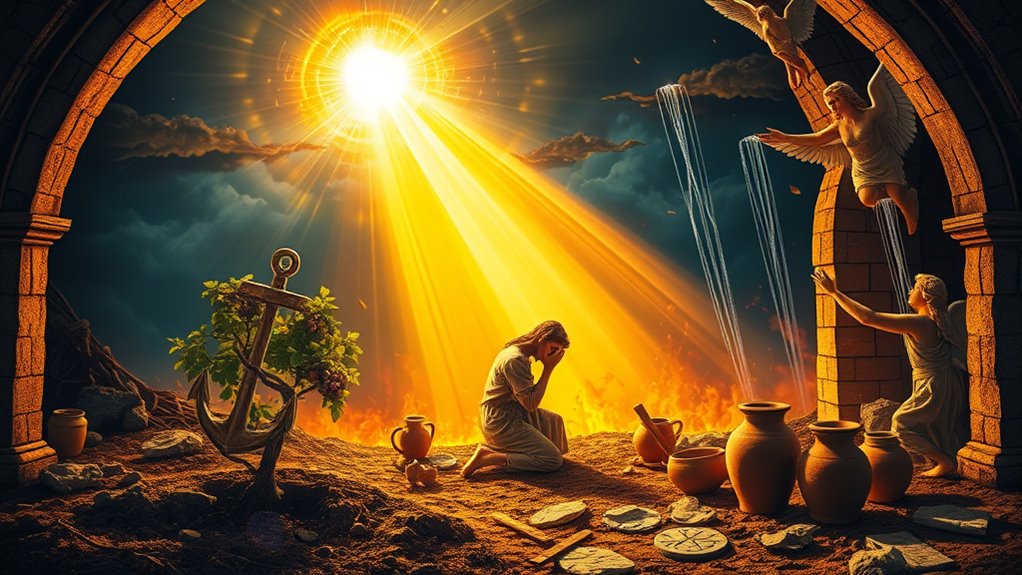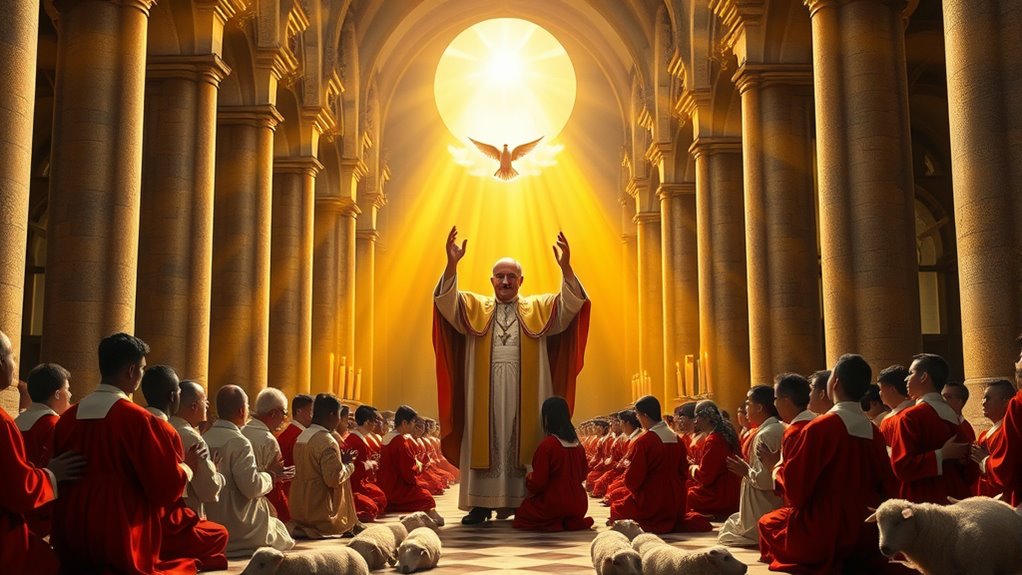
Hebrews transforms Psalm 110 from a royal coronation hymn into a theological framework explaining Christ’s dual role as eternal priest and waiting king. The book quotes Psalm 110:1 and 110:4 repeatedly across its chapters, using rabbinic-style interpretation to demonstrate how Jesus surpasses the Levitical priesthood through his Melchizedek order. Christ now sits at God’s right hand after completing his sacrifice, awaiting the moment when all enemies become his footstool. This reinterpretation reveals the tension between Christ’s present exaltation and future earthly reign, a distinction the original psalm only hints at but Hebrews carefully elaborates for those willing to explore further.
The book of Hebrews stands as one of the New Testament’s most sophisticated theological works, and at its foundation lies a single Old Testament passage: Psalm 110. The letter also assumes a familiarity with Jewish interpretive practices that sometimes repurpose cultural symbols like wine into theological argument. This ancient coronation psalm, originally celebrating the anointing of a Davidic king, becomes the organizing framework for the entire letter.
The author quotes Psalm 110:1 directly in chapters 1, 8, 10, and 12, while Psalm 110:4 appears throughout chapters 5 through 7, creating a structural backbone that guides both exposition and exhortation.
The letter functions as a verse-by-verse commentary on Psalm 110, adapting its themes to Christ’s journey from humiliation to exaltation. This midrashic approach, similar to rabbinic interpretation methods, transforms the psalm into proof of Jesus’s unique status.
In Hebrews 1:13, the author asks which angel God ever invited to sit at his right hand, using Psalm 110:1 to demonstrate that this promise belongs exclusively to Jesus. The resurrection becomes his messianic enthronement, establishing divine sonship superior to any angelic mediator.
The psalm’s declaration that the Messiah serves as “a priest forever after the order of Melchizedek” receives extensive treatment. Hebrews identifies this mysterious priest-king from Genesis who blessed Abraham as a foreshadowing of Christ’s dual role.
Unlike the Levitical priesthood, which could not solve humanity’s fundamental problem, this superior priest accomplishes salvation through his own death, combining royal authority with priestly sacrifice in ways the old covenant never could. The argument demonstrates that Jesus’s superiority stems from becoming the enthroned Messiah, not merely from his inherent divine nature.
Psalm 110:1’s command to “sit at my right hand until I make your enemies your footstool” shapes Hebrews’s understanding of Christ’s current activity. Hebrews 10:12 emphasizes that after offering his sacrifice, Jesus sat down to wait, a posture contrasting sharply with the standing Levitical priests who could never finish their work. This waiting period anticipates the day when Messiah’s enemies will be fully conquered and his rule from Zion will be complete. Hebrews clarifies that His exaltation at God’s right hand does not equate to His present enthronement on David’s throne.