
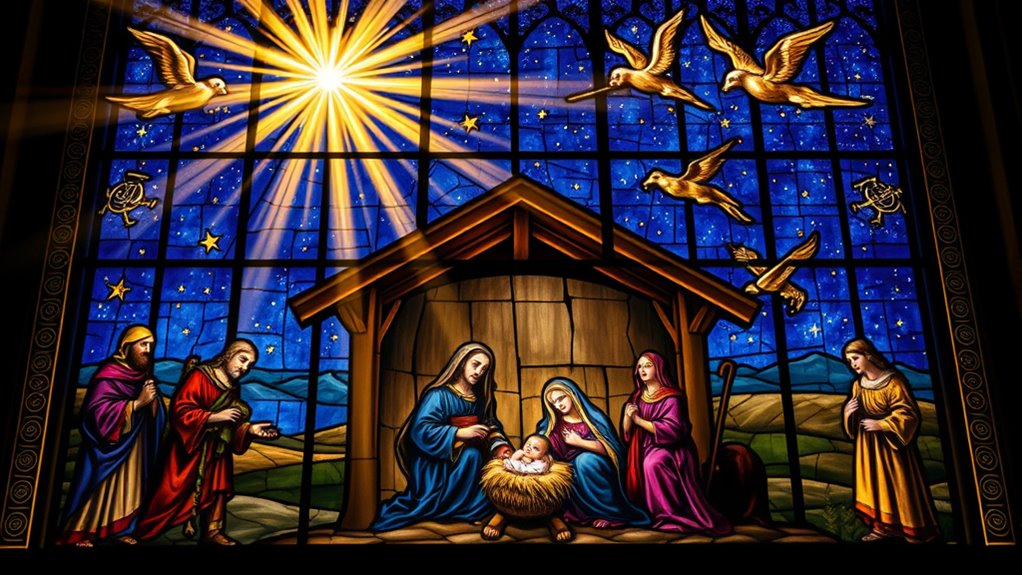
Most biblical scholars place Jesus’ birth between 6 BC and 2 BC, during the final years of Herod the Great’s reign. While Matthew’s Gospel connects the birth to Herod’s time, Luke references a census under Quirinius that occurred later, creating chronological challenges. Early Christian writers like Irenaeus and Tertullian supported a 3-2 BC timeframe. Astronomical evidence, including lunar eclipses and the timing of Jesus’ ministry around AD 28-29, helps narrow estimates, though exploring these complex historical threads reveals additional fascinating insights.
When was Jesus of Nazareth actually born? This question has puzzled historians and biblical scholars for centuries, as neither the Bible nor contemporaneous historical documents record an exact birth date. The search for answers requires piecing together indirect clues from ancient sources, astronomical data, and archaeological evidence.
Most historians believe Jesus was born between 6 BC and 4 BC, based primarily on the reign of King Herod the Great, who died in 4 BC according to traditional dating. However, some evidence suggests Herod may have died closer to 1 BC, which complicates these calculations. Early Christian writers including Irenaeus, Clement of Alexandria, and Tertullian supported a birth date around 3 to 2 BC, providing additional weight to this timeframe.
Historical consensus places Jesus’ birth between 6 BC and 4 BC, though uncertainty about Herod’s exact death date complicates precise dating.
The Gospel accounts present their own challenges. Matthew places Jesus’ birth during Herod’s reign and mentions the ruler’s order to kill children under two years old in Bethlehem. Luke connects the birth to a census under Quirinius, but this census occurred in 6-7 AD, creating chronological conflict. These Gospels were written decades after Jesus’ life, with Matthew possibly composed forty years after the Crucifixion, contributing to historical uncertainty. Scholars also rely on methods such as textual criticism and linguistic analysis to estimate when biblical books were composed.
Roman records and the historian Josephus provide valuable context through their documentation of rulers like Quirinius and Quintilius Varus. Archaeological and astronomical data, including lunar eclipses in 4 BC and 1 BC, help frame the possible timeframe for both Herod’s death and Jesus’ birth somewhere between 8 BC and 2 BC. Scholars often work backward from Jesus’ ministry, using his age of about thirty when he began preaching after baptism by John the Baptist around AD 28-29. Jesus could not have been born in year 0 because this numerical concept was not introduced to Europe until the 13th century.
Interestingly, December 25 as Jesus’ birth date appears relatively late in Christian tradition. The earliest written record associating this date with Jesus’ birth emerges around 336 AD in the Roman “Chronograph of 354.” Some researchers have proposed alternative dates based on astronomical phenomena, including a notable celestial event on September 11, 3 BC.
While the exact date remains elusive, the convergence of historical, biblical, and astronomical evidence points to Jesus’ birth occurring in the final years of the first century BC, offering a reasonable foundation for understanding this pivotal moment in history.
Frequently Asked Questions
Why Do Christians Celebrate Christmas on December 25TH if That’s Not Jesus’ Birthday?
Christians celebrate Christmas on December 25th because early church leaders chose this symbolic date in the 4th century, despite the Bible providing no specific birth date for Jesus.
The Roman almanac Chronograph of 354 first recorded December 25 as Christ’s birthday around AD 336.
Church authorities selected this date to align with existing winter solstice celebrations and unify diverse Christian communities around a shared feast day.
What Calendar System Was Used During Jesus’ Time?
During Jesus’ time, the Jewish community used a lunar-based calendar system inherited from ancient Israel, with months beginning at new moon sightings and lasting 29 or 30 days.
The religious year started in Nisan during spring, while the civil year began in Tishri during fall.
Babylonian month names had replaced earlier Canaanite names following the exile, and an extra month was periodically added to align with agricultural seasons.
How Did Early Christians Determine When to Celebrate Jesus’ Birth?
Early Christians initially focused more on Jesus’ death and resurrection than his birth, with no specific date mentioned in the Gospels.
The earliest recorded celebration occurred in Rome on December 25, 336 CE.
Church leaders chose this date partly through theological calculation—adding nine months to the March 25 Annunciation—and to provide a Christian alternative to popular Roman festivals like Sol Invictus, gradually replacing pagan winter celebrations.
What Role Did Roman Festivals Play in Choosing December 25TH?
Roman festivals profoundly influenced the December 25 date for Christmas. Early Christians chose this date to provide an alternative to the popular *Dies Natalis Solis Invicti*, Emperor Aurelian’s “Birthday of the Unconquered Sun” festival established in 274 CE.
Saturnalia, which ended December 23, contributed customs like gift-giving, feasting, and home decorations with greenery. The winter solstice period was already festive, making it strategically suitable for Christian celebration.
Did Jesus’ Birth Year Affect How We Count Years Today?
Jesus’ birth year fundamentally shaped modern year counting through the Anno Domini system created by monk Dionysius Exiguus in the 6th century.
Though Jesus was likely born between 6-2 BC rather than AD 1, this Christian-based calendar became the global standard through European influence.
Today’s Gregorian calendar maintains this framework, splitting history into BC and AD periods, demonstrating how one historical figure’s birth continues influencing worldwide timekeeping.