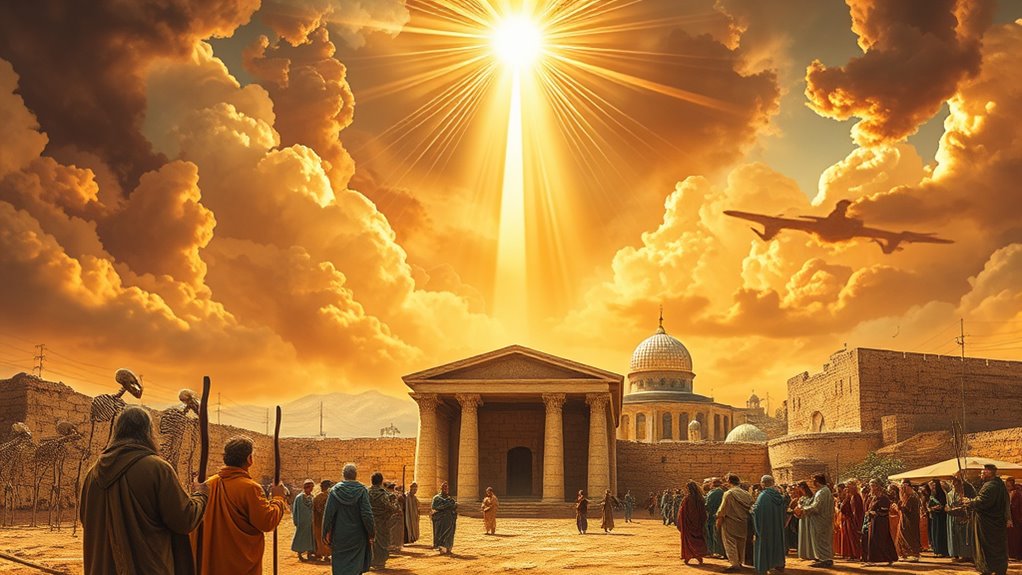
The Bible describes Israel as a nation established through God’s covenant with Abraham around 1500–1400 BC, promising to make his descendants a great nation with specific territorial boundaries from Egypt to the Euphrates. The covenant, confirmed throughout Scripture including Psalm 105:8-10, carries both promises and conditional requirements of faithfulness. Prophets like Ezekiel, Jeremiah, and Zechariah foretold Israel’s restoration in stages—physical regathering followed by spiritual renewal and recognition of the Messiah. The biblical narrative positions Israel as God’s chosen instrument in salvation history, with prophetic visions extending to a future Messianic kingdom that will establish righteousness and make Israel a light to nations.
Key Takeaways
- God established an everlasting covenant with Abraham, promising to make his descendants a great nation with specific territorial boundaries.
- Israel is described as God’s chosen people, called to be a holy nation and instrument of blessing to the world.
- The prophets foretold Israel’s physical regathering to their land after exile, followed by spiritual renewal and Messianic recognition.
- The covenant requires faithfulness from Israel, with disobedience resulting in consequences including exile and restoration cycles throughout biblical history.
- Biblical prophecy envisions Israel’s ultimate restoration under Messianic rule, establishing righteousness and serving as a light to nations.
Israel’s Divine Calling and Covenant Promise

According to the biblical narrative, God’s relationship with Israel began with a divine initiative toward one man, Abraham, who received promises that would shape the identity and destiny of an entire nation. This covenant is reflected in early Israelite legal and narrative texts such as the Pentateuch, which began forming around 1500–1400 BC.
In Genesis 12:1-3, God pledged to make Abraham into a great nation and bless his descendants. This covenant, described as everlasting in Genesis 17:7, extended across generations through Isaac and Jacob.
The promises included specific territorial boundaries—from the river of Egypt to the Euphrates—as an eternal possession (Genesis 15:18). Abraham’s very name was changed to reflect this transformed identity (Genesis 17:5). Abraham’s belief in God’s promise was credited as righteousness, marking a pivotal moment in establishing the covenant relationship (Genesis 15:6).
Psalm 105:8-10 confirms that God remembered this covenant throughout Israel’s history, establishing the theological foundation for the Jewish people as chosen instruments in the unfolding biblical story. The covenant carried conditional requirements of faithfulness, as disobedience would later lead to consequences for Abraham’s posterity.
The Prophetic Restoration and Messianic Kingdom

The prophetic vision of Israel’s future extends beyond the establishment of covenant promises to encompass a thorough restoration that involves both physical return to the land and spiritual renewal under Messianic rule. Ezekiel 37:11–14 depicts dry bones coming to life, symbolizing national resurrection after exile. This restoration unfolds in stages: sinews, flesh, skin, and finally breath, representing gradual reanimation. Jesus and his contemporaries likely spoke Aramaic, the common language of first-century Palestine.
Jeremiah 30:3 and Amos 9:11-15 affirm God’s promise to bring Israel back from captivity and repair David’s fallen tabernacle. Isaiah indicates restoration begins with a faithful remnant, progressing through persecution and hardship. The process involves gathering Israel one by one, with the great trumpet calling them to worship at Jerusalem.
Zechariah 12:10 prophesies spiritual awakening follows physical regathering, when Israel recognizes the Messiah. The Messianic kingdom represents restoration’s culmination, establishing righteousness and making Israel a light to nations. Modern aliyah movements demonstrate this prophetic fulfillment, with nearly half of the global Jewish population now residing in Israel.