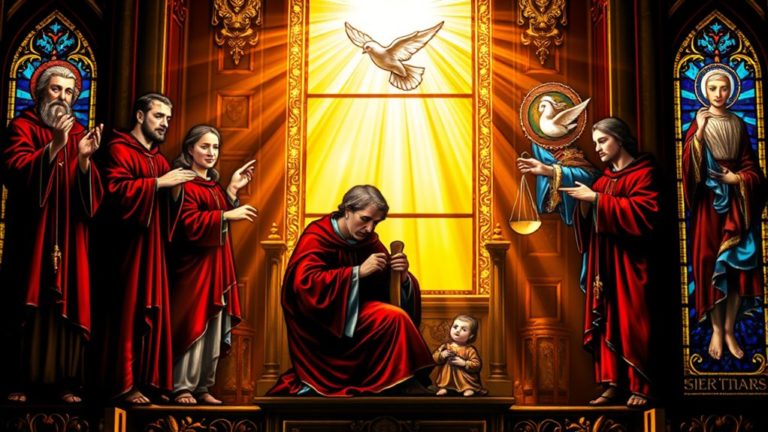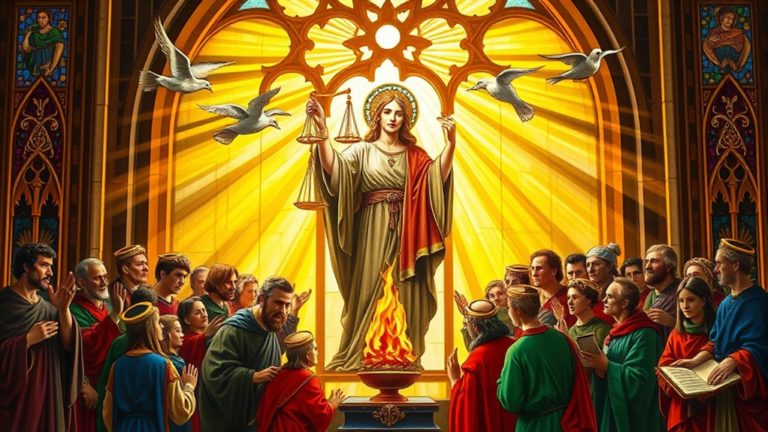
Saints proclaimed Mary’s sinlessness from conception because they recognized her unique role as Mother of God required complete purity to bear Christ without defect. Early Church Fathers like Irenaeus called her the New Eve, while Eastern tradition honored her as Panagia, meaning all holy. Theologians such as Duns Scotus reasoned that God would preserve Mary from original sin as the highest form of redemption. This conviction, supported by Luke’s description of Mary as full of grace and her typological link to the unblemished Ark of the Covenant, grew through centuries of reflection until Pope Pius IX formally defined the doctrine in 1854, drawing on consistent witness that anticipated what deeper exploration reveals.
How did Catholic tradition come to affirm that Mary, the mother of Jesus, was preserved from sin from the very first moment of her existence? The answer lies in centuries of theological reflection, scriptural interpretation, and the witness of saints and scholars who saw this truth as essential to understanding both Christ and his mother.
Mary’s sinlessness emerged through centuries of theological reflection, scriptural study, and the witness of saints who deemed it essential truth.
The doctrine known as the Immaculate Conception holds that Mary was preserved immune from all stain of original sin from the first moment of her conception, through the merits of Jesus Christ applied retroactively. Pope Pius IX defined this as dogma in 1854, declaring it a singular grace and privilege from almighty God. The Catholic Church teaches that Mary remained sinless her entire life, free from both original and personal sin, with grace applied at her conception analogous to how baptism removes sin.
Saints and early Church Fathers recognized this truth long before its formal definition. Irenaeus stated that the knot of Eve’s disobedience was loosed by Mary’s obedience, presenting her as the New Eve. Eastern Fathers called Mary Panagia, meaning all holy, free from any stain of sin. Devotional practices like spiritual fasting often accompanied such Marian veneration as expressions of humility and dependence on God. Augustine and Gregory of Nyssa supported this understanding early on, showing awareness that Mary was redeemed from the moment of conception. Notably, Thomas Aquinas did not initially accept the doctrine of the immaculate conception, though the Church’s understanding of this truth continued to develop through further theological reflection.
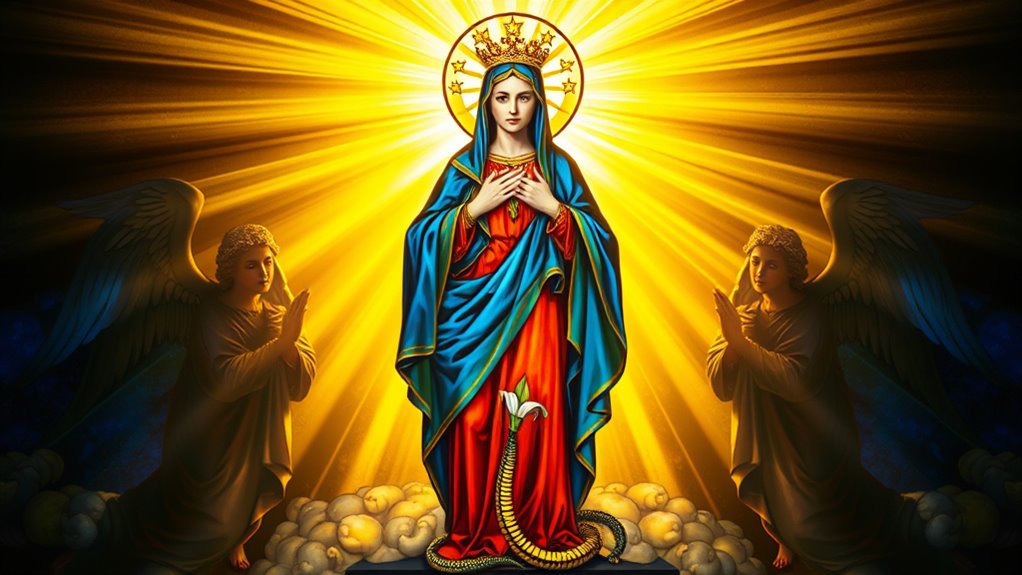
Scripture provided foundations for this belief. Luke’s Gospel calls Mary full of grace, a title suggesting complete freedom from sin. She is linked typologically to the Ark of the Covenant, which had to be pure and without defect. The woman in Revelation 12 was understood as Mary bringing life through obedience, contrasting with Eve who brought death. The Church’s teaching affirms Mary’s complete sinlessness not only in her earthly life but continuing in her heavenly existence.
Theological reasoning supported the doctrine as well. Duns Scotus offered an analogy: salvation can mean being preserved from falling into a ditch after warning, not just being pulled out afterward. Christ required sinless human flesh from his mother to be fully human without sin. The Council of Trent in the sixteenth century excluded Mary from its decrees on original sin, and by 1950, Pope Pius XII affirmed her protection from all sin in his document Munificentissimus Deus.