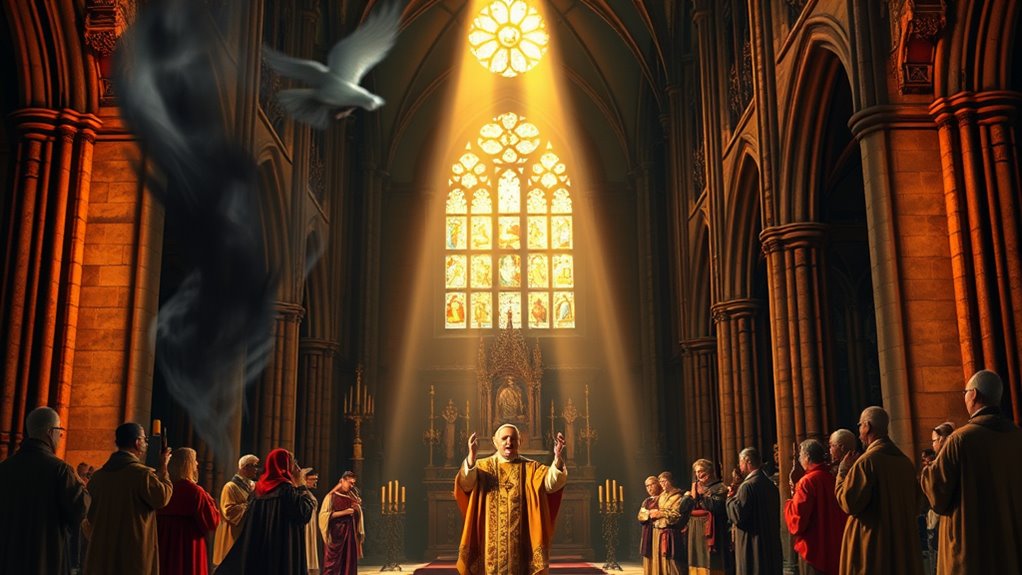
On June 29, 1972, Pope Paul VI warned that “the smoke of Satan has entered the temple of God,” describing a subtle infiltration through a crack rather than an open door. He identified symptoms including doubt, spiritual disquiet, dissatisfaction, and loss of trust in Church authority spreading among the faithful. The Pope characterized this as a preternatural force perverting human freedom and urged humble adherence to God’s word as the response, emphasizing faith over secularization. The warning’s specifics reveal his deeper concerns about the Church’s direction.
On the Feast of Saints Peter and Paul in 1972, Pope Paul VI delivered a homily that would resonate through the decades with a stark warning about spiritual danger facing the Church. Speaking in Italian, he declared that “from some fissure the smoke of Satan has entered the temple of God,” a phrase describing infiltration through a crack rather than an open door. The full text did not appear in the Vatican’s official Insegnamenti volume for that year, though a summary with direct quotes was preserved, and the complete Spanish translation remains available. This warning has often been contrasted with biblical warnings about deception and false teachers, highlighting the need for spiritual discernment.
Through some fissure, the smoke of Satan has entered the temple of God—infiltration through a crack, not an open door.
The Pope identified a preternatural force disturbing the fruits of the Second Vatican Council, blocking what should have been the Church’s hymn of joy and renewed self-awareness. He catalogued specific symptoms of crisis: doubt, incertitude, problematic thinking, disquiet, dissatisfaction, and confrontation within the Church itself. He observed a loss of trust in Church authority and a preference for what he called profane prophets found in journals and social movements, accompanied by waves of worldliness, desacralization, and secularization.
Paul VI defined Satan’s role with theological precision. He described the Devil as a principal adversary, a living spiritual being actively perverting human work and freedom, accompanied by many fallen creatures. This preternatural element, he explained, sowed doubt, uncertainty, unrest, and anger, suffocating the hoped-for outcomes of the Council. He connected this interference directly to sin as a perversion of human freedom. He referenced Christ’s triple temptation and Gospel episodes where the Devil figures prominently in teaching about spiritual warfare. Notes and translations were later provided by R. Fastiggi to clarify the original Italian text.
Five months later, on November 15, 1972, the Pope returned to this theme in a general audience, addressing the Devil’s reality in detail. He emphasized that the Church needed defense against the Devil as its greatest priority, describing evil not as mere absence of good but as a perverse and frightening reality.
Paul VI called the faithful to a specific response: exercise Peter’s function to strengthen brothers’ faith through humble, sincere adherence to God’s word. He urged conscious commitment expressed as “Lord, I believe in Your word,” restraining secularization and proclaiming virtues that lead from darkness to marvelous light.