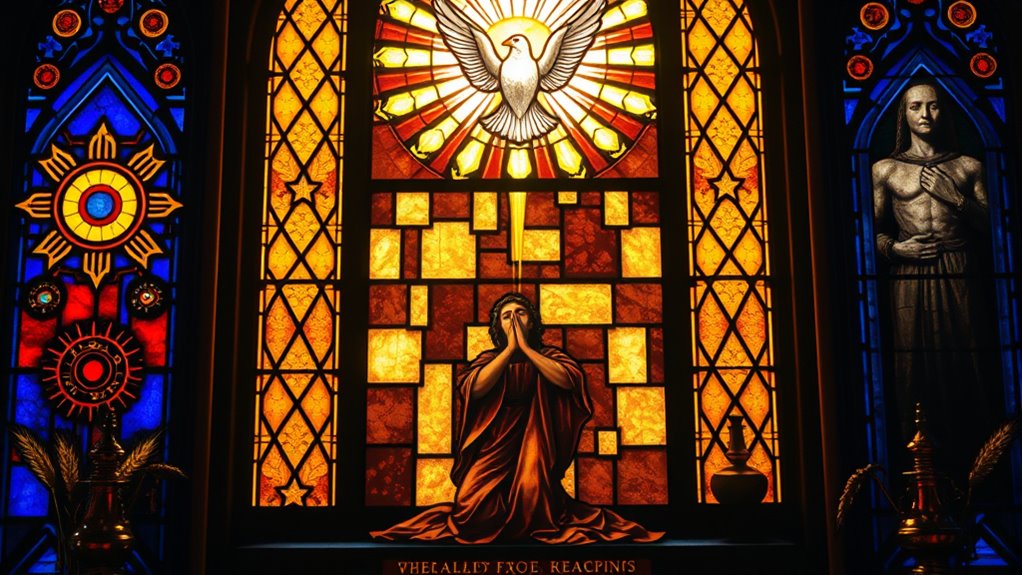
Some theologians now challenge the classical view that God exists outside time while humans move through it moment by moment. Thinkers like William Craig propose instead that God experiences time alongside creation, allowing genuine relationship and responsiveness to prayer. This temporal view contrasts with Augustine and Aquinas, who linked God’s perfection to timelessness. Hybrid positions suggest God may have entered time at creation’s first moment. The debate carries significant implications for understanding how prayer works and whether divine-human connection can be truly mutual. The following exploration examines both perspectives more thoroughly.
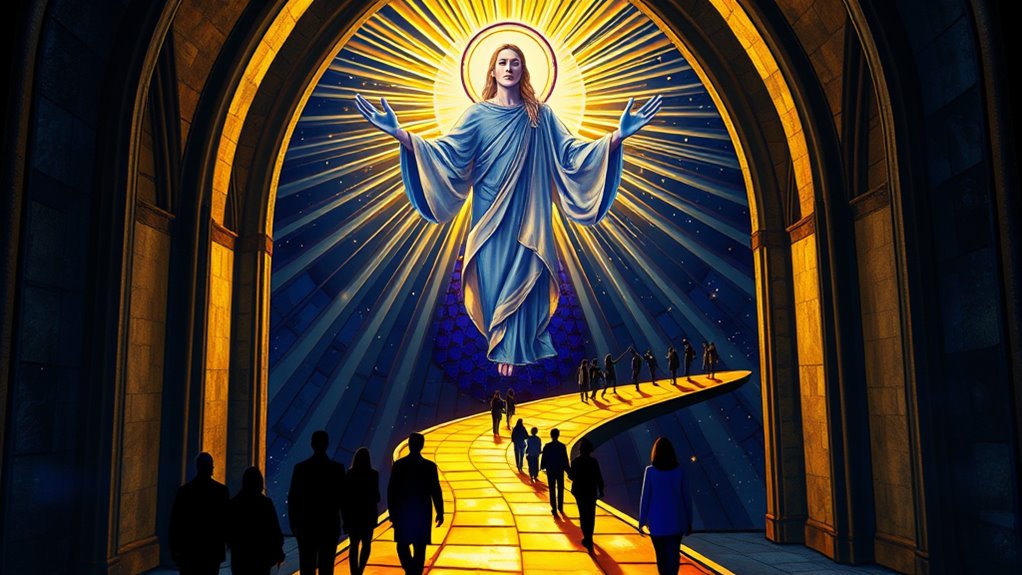
How eternal is God, and does that eternity differ fundamentally from human experience of time? For centuries, classical theologians like Augustine and Aquinas maintained that God exists outside time entirely, experiencing all moments simultaneously rather than successively. This view, called divine timelessness, describes God’s existence as lacking temporal extension and location, seeing past, present, and future in one instantaneous whole. Augustine affirmed that God created time itself and experiences no succession, while Aquinas connected timelessness to divine simplicity. Under this framework, God views all time at once, much like someone seeing an entire road from above rather than walking it step by step.
God’s timeless existence means viewing all moments simultaneously, like observing an entire road from above rather than walking it step by step.
This classical position offered theological advantages. Defenders argued that timelessness represents a superior form of existence for a perfect being, one that solves puzzles about divine foreknowledge of free human actions. They suggested that temporal life, available only moment by moment, seems incompatible with perfection. Some proposed that a timeless God would experience greater pleasure since all experiences would be fully available simultaneously, rather than scattered across moments.
Yet recent theologians have challenged this view, arguing that a timeless God cannot engage in genuine personal relationships or undergo real change. Philosopher William Craig and others contend that a temporal God, existing everlastingly within time without beginning or end, better fits the biblical portrayal of a relational, responsive deity. This temporal view allows God to have successive thoughts and novel experiences without being trapped in endless, dulling repetition. Publications on divine eternity and God’s relationship to time have grown exponentially over the past two decades.
Some thinkers propose hybrid positions. One suggests God existed timelessly before creation but entered time when the first event occurred. Another maintains God experiences successive mental states without relating to any particular present moment. These in-between views attempt to preserve divine perfection while allowing dynamic interaction. Whether an unchanging God can genuinely respond to petitionary prayer remains a central puzzle for defenders of divine immutability.
The debate hinges partly on whether the present moment holds special metaphysical status, a question tied to competing theories of time itself. What remains clear is that even if God experiences time differently than humans do, that difference may be less dramatic than classical theology suggested. The possibility of shared temporal existence offers quietly hopeful implications for genuine divine-human relationship. Acknowledging prayer as both communication and an act of worship can reshape how we think about God’s temporal relation to us.