

Scripture portrays mothers as integral to God’s redemptive plan, describing children as a heritage from the Lord formed in the womb (Psalm 139:13). The Fifth Commandment establishes honoring parents as a moral priority alongside prohibitions like murder and adultery (Exodus 20:12). Second Timothy 1:5 traces faith from grandmother Lois through mother Eunice to Timothy, illustrating generational spiritual influence. Proverbs 23:22 warns against despising one’s mother in old age, while Ephesians 6:1-3 links parental honor to promises of blessing. The passages below explore these biblical foundations and practical applications further.
Key Takeaways
- The Bible describes motherhood as part of God’s deliberate design, with children called a heritage from the Lord.
- Scripture commands honoring mothers alongside fathers, linking obedience to blessings and long life in multiple passages.
- Mothers are portrayed as agents of spiritual influence, passing down sincere faith and wisdom across generations.
- Biblical warnings caution against despising mothers, while promises attach joy and blessing to those who honor them.
- Jesus modeled care for mothers by securing provision for his own mother even while dying on the cross.
What Scripture Reveals About Godly Motherhood

Scripture presents motherhood not as a cultural accident but as a deliberate design woven into God’s redemptive plan.
Motherhood is not a cultural accident but a deliberate design woven into God’s redemptive plan.
The Bible describes children as a heritage from the Lord, with each child’s inward parts formed and knitted together in the womb according to Psalm 139:13. Isaiah 66:13 depicts God’s comfort using maternal imagery, while Isaiah 40:11 compares divine care to a shepherd carrying lambs. This foundation establishes motherhood as both privilege and responsibility. The Church recognizes the importance of family and scripture within its canon, which includes books used by early Christians such as the deuterocanonical books.
Second Timothy 1:5 traces sincere faith passing from grandmother Lois to mother Eunice to Timothy, demonstrating generational spiritual impact.
Proverbs 31:28 notes that children rise up and call such mothers blessed. The biblical portrait consistently emphasizes mothers as agents of lasting influence within God’s broader purposes.
The Ten Commandments place the directive to honor father and mother alongside prohibitions against adultery and murder, revealing God’s intentional elevation of parental respect as foundational moral law. Proverbs 1:8-9 instructs children to hear their father’s instruction and not forsake their mother’s teaching, comparing such wisdom to a graceful garland and pendants adorning the neck.
How the Bible Calls Us to Honor Mothers

The Bible’s portrait of motherhood as divinely designed naturally leads to explicit instructions about how children should respond to their mothers throughout life.
Exodus 20:12 establishes honoring father and mother as the fifth commandment, positioned alongside prohibitions against murder and theft, demonstrating God’s prioritization of parental respect.
Deuteronomy 5:16 reinforces this command with promises of blessing and longevity.
Ephesians 6:1-3 directs children to obey parents in the Lord, identifying this as the first commandment with an attached promise.
Proverbs 1:8-9 instructs listeners not to forsake mother’s teaching, describing parental guidance as ornamental gifts that grace and adorn. Many Catholic readers prefer translations like the NABRE when reading these passages for liturgical and devotional use.
Proverbs 23:22 warns against despising your mother when she is old, emphasizing that respect endures throughout her lifetime.
Proverbs 23:25 offers the outcome of such honor: may she who gave you birth be joyful, reflecting the fulfillment a mother experiences when her children walk rightly.
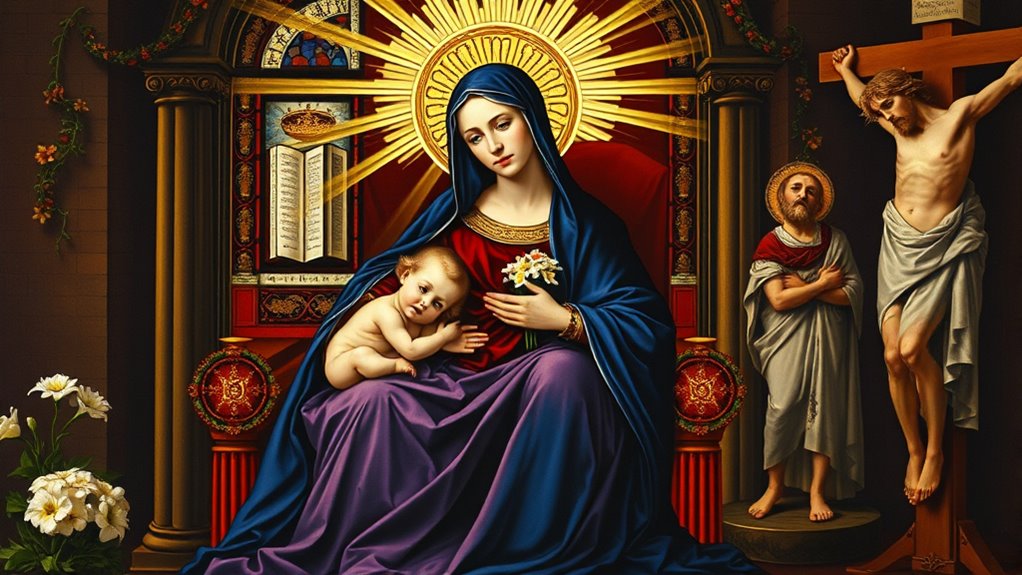
Even at his crucifixion, Jesus secured provision for his mother, establishing a model of children’s enduring obligation toward maternal care.