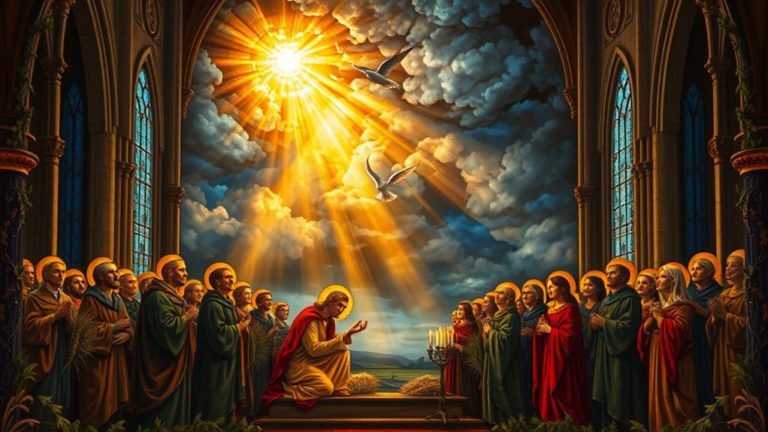
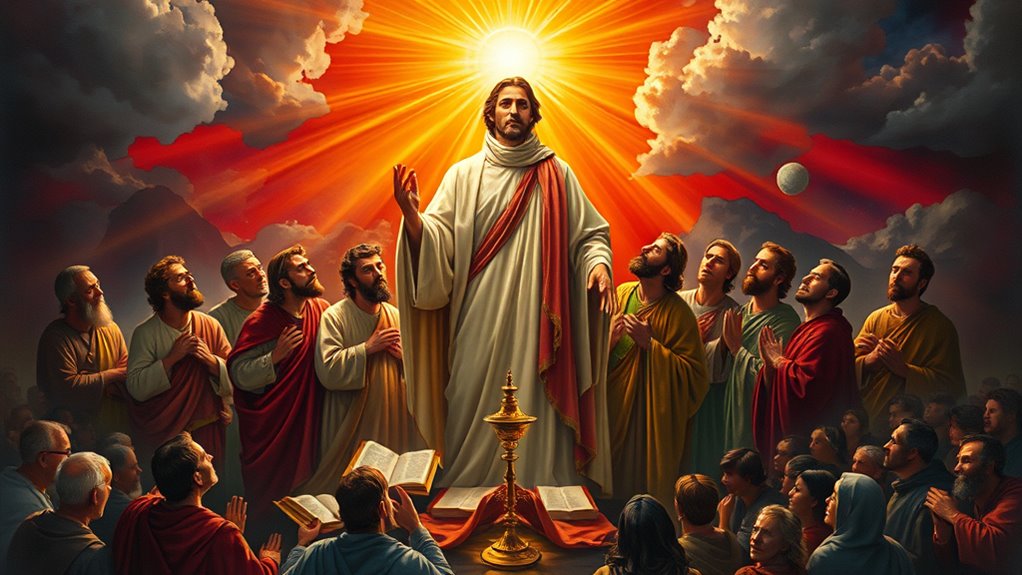
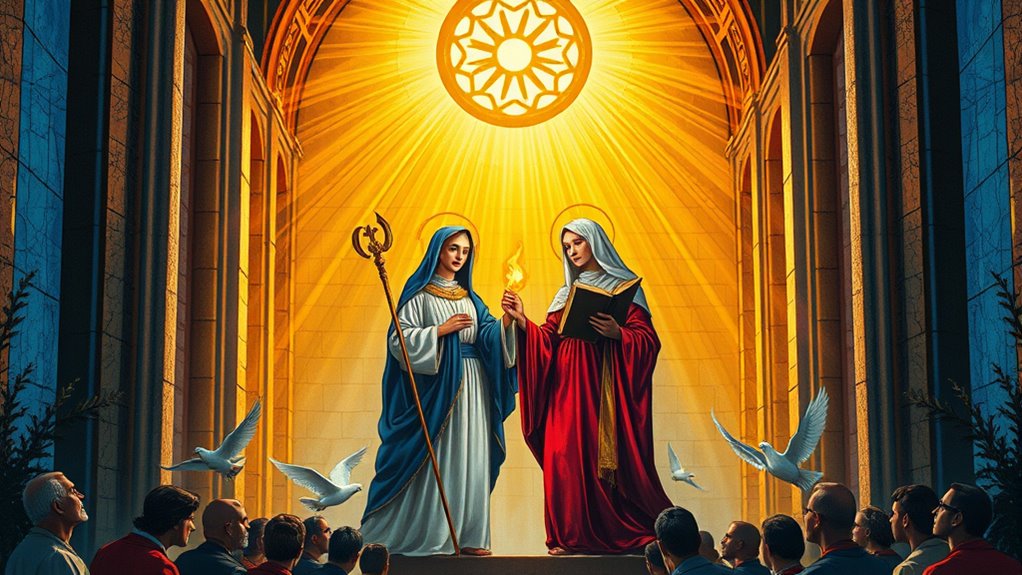
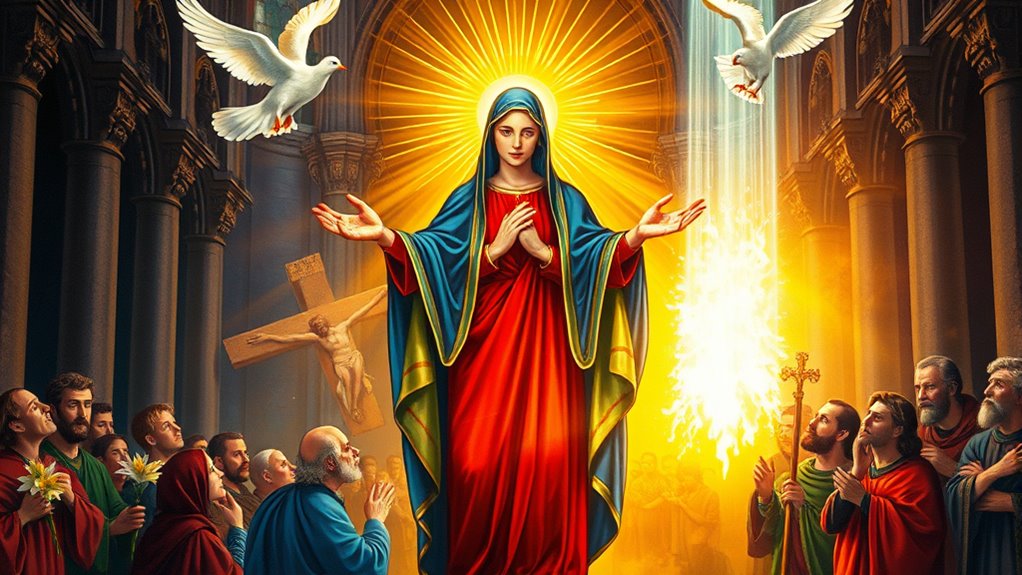
Catholics honor Mary as “Mother of the Church” on the Monday after Pentecost because her maternal role connects directly to the Church’s birth. At the cross, Jesus entrusted Mary to the beloved disciple, whom Catholics understand as representing all believers. Acts 1:14 confirms she prayed with the apostles before Pentecost. Pope Francis established this memorial in 2018 to mark her presence at the Church’s founding. Those who look closer will find the doctrine runs deeper than tradition alone.
The Doctrinal Meaning Behind Mary’s Title “Mother of the Church”
Within Catholic teaching, the title “Mother of the Church” carries a specific doctrinal weight that sets it apart from ordinary expressions of Marian devotion.
The title flows from Mary’s identity as Mother of Christ, who Catholic doctrine identifies as the Head of the Mystical Body.
Because she is mother of the Head, she is also understood as mother of the Body—meaning the Church itself.
The Catechism states that Mary is “clearly the mother of the members of Christ” through her charity.
Her role belongs to the order of grace, not equality with Christ’s unique mediation. Tithing in the Bible is sometimes contrasted with Marian and ecclesial roles that emphasize gratuitous, grace-filled giving rather than legal obligation. Paul VI formally proclaimed this title on November 21, 1964, at the closing of the third session of the Second Vatican Council.
Scripture records that at the foot of the Cross, Christ entrusted Mary to St. John as a sign of her Motherhood to all the faithful.
The Bible Scene Where Jesus Gave Mary to the Church
At the center of the Catholic case for Mary’s maternal role toward the Church stands a single passage from the Gospel of John.
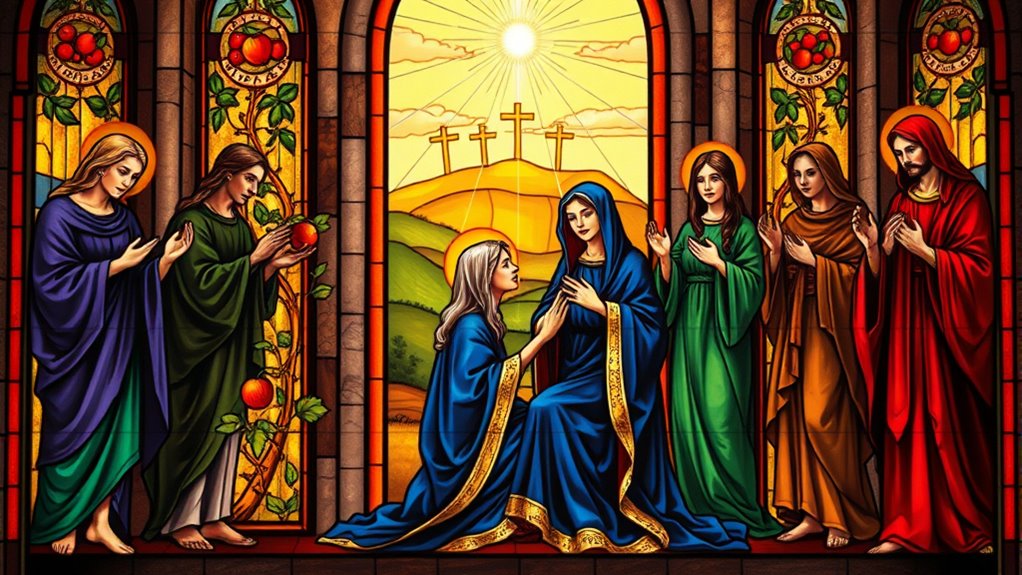
John 19:25–27 records three quiet moments at the crucifixion:
- Jesus addresses Mary as “Woman, behold, your son.”
- Jesus tells the beloved disciple, “Behold, your mother.”
- The disciple immediately takes Mary into his own home.
Catholic teaching reads the beloved disciple not as one individual but as a representative of all believers.
Through him, Jesus entrusted Mary to the whole community of faith, forming a new spiritual family at the cross.
Jesus addresses Mary here with the same formal title, “Woman,” that he used at the wedding in Cana, a deliberate Johannine echo that carries deep symbolic weight across the Gospel.
Standing alongside Mary at the cross were three other women, including Mary of Magdala and Mary the wife of Clopas, whose faithful presence at the crucifixion reflected courageous loyalty when most had fled.
This maternal dimension is seen as part of Christ’s broader establishment of a covenant family in scripture.
Why the Monday After Pentecost Is No Accident
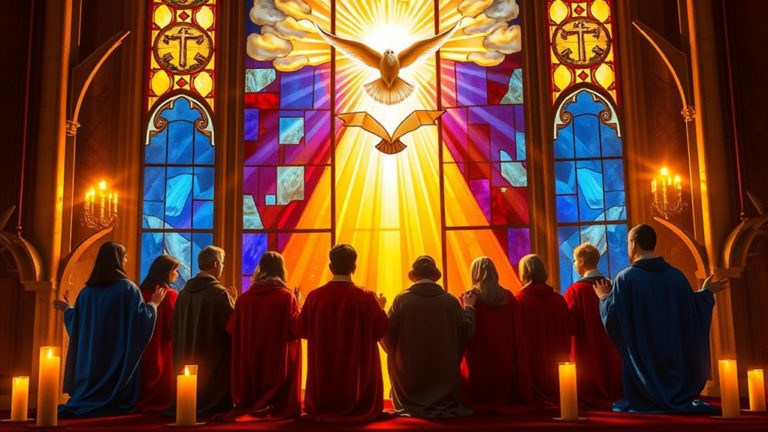
The placement of Mary’s memorial on the Monday after Pentecost carries deliberate theological weight. Pentecost Sunday marks the Holy Spirit’s descent and the Church’s public birth.
Placing Mary’s feast the very next day connects her directly to that founding moment. Acts 1:14 confirms she was present in the Upper Room, praying alongside the apostles before the Spirit arrived.
The Church teaches that her maternity extends beyond Jesus to all believers. Pope Francis formalized this connection in 2018, choosing Whit Monday not arbitrarily, but to remind Catholics that Mary stood at the Church’s beginning as mother, witness, and intercessor. The title itself was formally added to the Litany of Loreto in 1980, marking another deliberate step in the Church’s recognition of this maternal role.
Pope John Paul II was among the most prominent champions of this title, even commissioning a mosaic of Mater Ecclesiae facing St. Peter’s Square following his 1981 assassination attempt, dedicating his pontificate to Mary’s protection in gratitude for his survival. This memorial also echoes biblical themes of the Church as a dwelling place of God and a community shaped by resurrection hope.
How Catholics Honor Mary Without Worshiping Her?
One of the most persistent misunderstandings about Catholic practice is the claim that Catholics worship Mary. Catholic theology draws a firm line between worship, reserved for God alone, and veneration, the honor given to Mary.
Three forms of Marian devotion illustrate this distinction clearly:
- Intercessory prayer — Catholics ask Mary to pray *to* God on their behalf.
- The Rosary — a structured prayer rooted in Scripture and focused on Christ’s life.
- Titles like “Mother of God” — expressions tied to Christology, not independent divinity.
Mary is honored as a creature, never adored as divine. The Church designates this special veneration due to Mary as hyperdulia, a category entirely distinct from the latria, or worship, owed to God alone. Scripture itself anticipates this honor, as Mary’s own Magnificat declares that “all generations shall call me blessed”, a prophecy fulfilled in the Church’s centuries-long tradition of Marian devotion. Many Catholics also emphasize that such devotion should lead to edifying speech and actions that reflect Christ rather than replace him.
How This Memorial Shapes Catholic Devotion and Pastoral Identity
Since Pope Francis added the Memorial of the Blessed Virgin Mary, Mother of the Church to the General Roman Calendar in 2018, the observance has quietly shaped how Catholics understand their relationship to Mary and to the Church itself.
The memorial’s readings—Acts 1:12-14 and John 19:25-34—place Mary within prayer, the Cross, and the apostolic community, giving parishes a framework for Marian preaching rooted in ecclesial identity rather than private devotion.
The feast encourages communal prayer, supports catechesis on Mary’s role in salvation history, and reinforces a pastoral identity built on communion, fidelity, and maternal care for the faithful. The title itself was first formally used during the Second Vatican Council in 1964 by Pope Paul VI, anchoring the memorial in a rich theological tradition that predates its calendrical establishment.
Both St. Augustine and St. Leo the Great referred to Mary as mother of the members of Christ, demonstrating that the theological foundation for this memorial stretches back to the earliest centuries of the Church.
This emphasis also invites believers to balance reverent honor with charitable correction, encouraging mercy and careful discernment in community life.