





Research consistently shows that faith formation is shaped more by daily home habits than by weekly church attendance, with parental religiosity identified as the single strongest predictor of adult faith. One study found a 47% chance of daily prayer in adulthood when parents prayed daily. Researchers describe the family, not the congregation or pastor, as the primary engine of religious formation. There is considerably more to understand about how ordinary household rhythms quietly build lasting belief.
Why Home Shapes Faith More Than Church Ever Will
The home, it turns out, does more to shape a child’s faith than any Sunday service ever will.
Research consistently identifies parental religiosity as the single strongest predictor of whether children adopt and maintain faith into adulthood.
Church attendance matters, but it works best when reinforced at home.
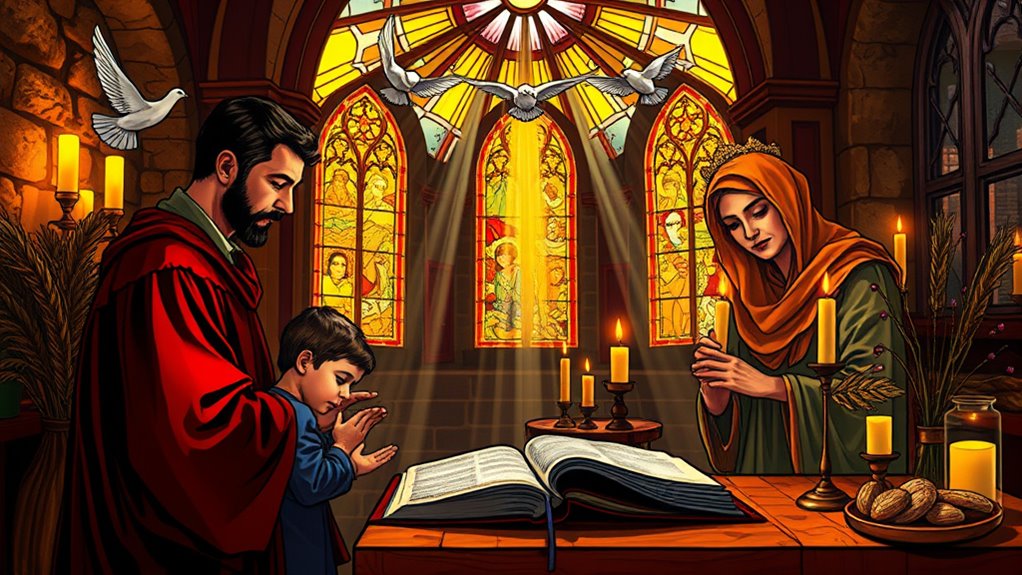
Daily prayer, shared rituals, and open faith conversations all leave lasting impressions.
One study found that children whose parents prayed daily had a 47% chance of praying daily as adults.
The family, researchers note, is the primary engine of religious formation—not the congregation, the curriculum, or the pastor.
Studies spanning Germany, Finland, Italy, Canada, and Hungary found that religious transmission is strongest when families cultivate a shared religious self-image, with mothers consistently identified as playing the most important role in that process.
Parents also shape religious beliefs through everyday social interactions, explanatory conversations, and the home environments they deliberately create for their children. Research confirms that parental scaffolding strategies, including dialogic engagement and corrective feedback, are key mechanisms through which religious traditions are preserved across generations.
Christian teaching also emphasizes that children are blessings and should be nurtured in faith within the home, reflecting their treasured status in Scripture.
Why Everyday Habits Predict Adult Faith More Than Sunday Attendance
Knowing that parents shape faith more than pastors do raises a follow-up question worth examining: which parental behaviors actually matter most?
Research consistently points away from Sunday attendance and toward daily household habits. Children raised in homes where faith appears regularly in routine life show stronger adult religious engagement than those who simply attended church frequently.
Key home practices linked to lasting faith include:
- Praying together at meals and bedtime
- Talking openly about beliefs, doubts, and scripture
- Serving others as a family
- Observing religious rhythms through holidays and rituals
Daily repetition, not weekly attendance, builds durable faith. Parents, siblings, and close family members carry the most significant influence in shaping how children internalize and ultimately live out their Christian values and beliefs. Adults whose parents attended church weekly were more than twice as likely to attend weekly themselves compared to those whose parents did not. Prayer functions as communication with God and serves as worship, confession, thanksgiving, and intercession, highlighting its role as a core spiritual practice.
Why Both Parents Need to Be on the Same Page
Parental agreement on faith may matter as much as any single practice carried out in the home. Research consistently identifies parents as the primary agents of religious socialization, and alignment between them reduces mixed signals about what the household values.
When both parents model, teach, and reinforce the same expectations, children respond to that coherence. Studies link shared parental religiosity to lower stress, greater marital harmony, and more responsive parenting overall.
A unified approach does not guarantee outcomes, but it does create the kind of structured, predictable environment where faith has a clearer opportunity to take hold and grow steadily. Children who attend religious activities with parents are associated with higher psychological well-being throughout adolescence.
Researchers note that the home, not the parish is identified as the crucial location for religious outcomes, with parents bearing primary responsibility for passing on faith while congregations and schools play a secondary, supportive role. The Bible’s emphasis on parental teaching and household faith practices underscores the importance of family religious formation in shaping a child’s beliefs.
How to Make Faith Feel Real, Not Forced, at Home
Faith tends to take root not in the moments families set aside for it, but in the ones they do not. Research consistently shows that ordinary conversation carries more weight than scheduled religious activity.
Children internalize belief more deeply when faith appears in daily life rather than only during structured practice. Authenticity matters more than polish. A parent still working through questions models something more compelling than a finished faith.
Key practices associated with stronger faith formation include:
- Talking openly about doubts and belief during everyday moments
- Sharing regular meals together
- Displaying visible religious artifacts at home
- Discussing faith several times weekly
Among churchgoing children, both parents attend church regularly in nearly seven out of ten families, suggesting that shared household commitment to faith plays a formative role beyond what any single parent or church program can provide alone. This household pattern echoes the biblical emphasis on communal worship as foundational to faith lived out in community.
Daily Practices That Turn Good Intentions Into Real Faith Formation
Good intentions rarely survive without structure. Research on family spirituality ranks shared religious rituals as the highest-rated practice for strengthening family bonds.
Daily anchors help. Bedtime prayers, mealtime grace, and brief morning reflections move faith from occasional events into repeatable habits. Regular rhythms also create space for daily fasting practices to cultivate dependence on God and spiritual focus.
About four-in-ten parents say they pray or read Scripture with at least one child, and among highly religious parents, that figure rises to 81%.
Nearly 25% of parents report talking with children about faith extremely or very often.
Small, consistent practices, not grand gestures, appear to be what quietly shapes belief over time. A sequential exploratory mixed-methods study found that moral and ethical alignment ranked second among family spirituality practices, with a mean importance score of 4.51 out of five.
A survey of 2,397 parents found that those who engaged consistently in family devotions were more likely to report openness to broader conversations with their children, suggesting that regular Bible reading and prayer do more than build faith alone.