

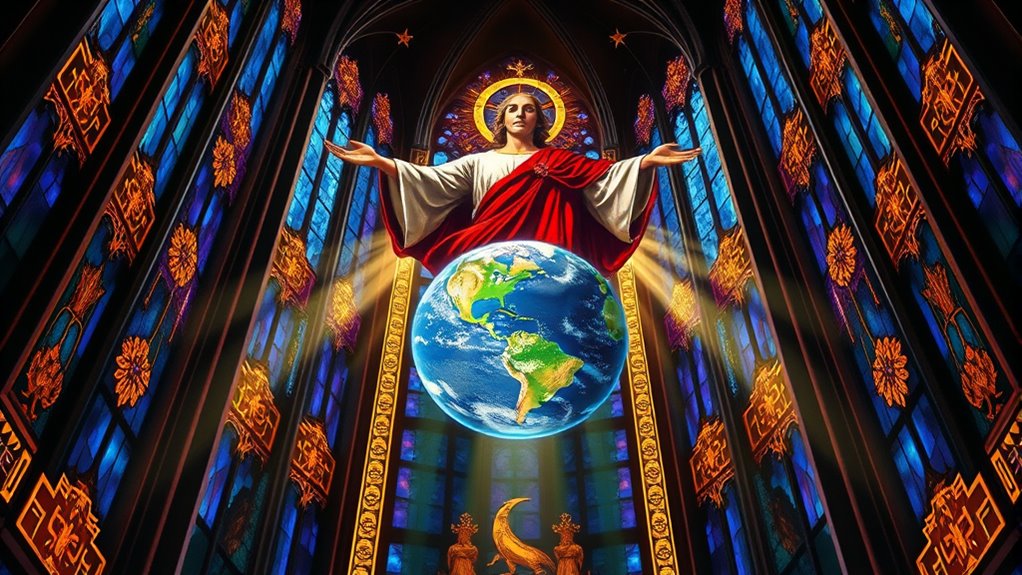
The Bible describes the earth as God’s purposeful creation, introduced in Genesis 1:1 and declared good at each stage of formation. Psalm 104 and Colossians 1:17 present God as actively sustaining what he made. Humans receive delegated responsibility to care for creation, not exploit it. Revelation 21 and Isaiah 65 point toward a renewed earth where God dwells with humanity permanently. The sections ahead explore each of these themes in closer detail.
Key Takeaways
- God created the earth intentionally and purposefully, forming it to be inhabited and declaring each stage of creation good.
- God continuously sustains the earth, governing rainfall, seasons, and all natural systems through His active, ongoing providence.
- Humans bear delegated responsibility over creation, called to rule, work, and preserve the earth accountably before God.
- The earth belongs entirely to God, making human authority derivative rather than absolute or exploitative in nature.
- Scripture promises a future renewal, replacing the current earth with a new creation where God dwells fully with humanity.
How God Created the Earth According to the Bible

According to the Bible, the creation of the earth begins with a single, decisive act: “In the beginning God created the heavens and the earth” (Genesis 1:1). The account presents God as the intentional source of all reality, not a passive observer.
Isaiah 45:18 reinforces this, describing God as the one who formed the earth purposefully, not “in vain,” but to be inhabited.
The process unfolds in stages. Genesis 1:2 describes the earth initially as “without form, and void,” covered in darkness and deep waters.
God then speaks order into existence — separating light from darkness, land from sea, and naming each element. This sequence reflects ancient Near Eastern literary patterns and the use of Hebrew as the original language of much of the Old Testament, especially in Genesis, which shapes how these events are described Biblical Hebrew.
Vegetation follows, designed to reproduce and sustain life.
Each stage is declared good, presenting the earth as a carefully prepared, livable home. On the sixth day, God created human beings in his image and granted them dominion over every living creature on the earth.
The Spirit of God hovered over the waters before any act of creation took place, signaling divine presence from the very first moment.
How God Sustains and Governs the Earth

Where creation ends, sustenance begins. The Bible presents God not only as the earth’s maker but as its ongoing keeper. Psalm 104:5 states He set the earth on its foundations so it would not move, while Colossians 1:17 adds that all things hold together in Christ.
Natural processes, too, fall under divine direction. Psalm 147:8-9 describes God sending clouds, rain, and mountain grass. Job 36:27-28 links rainfall directly to His action. Jesus’ teachings and examples likewise reflect God’s care for creation, often communicated in Aramaic to first-century listeners.
Governance extends further still. Daniel 2:21 says God changes times and seasons and removes and sets up kings. Isaiah 45:7 places light, darkness, peace, and calamity within His authority. Hebrews 1:3 summarizes the idea plainly: the Son sustains all things by His powerful word. Psalm 24:1 declares that the earth is the LORD’s, along with its fullness and all who dwell in it. Nehemiah 9:6 affirms that God made heaven and earth and all that is in them, and that He preserves them all.
Humanity’s God-Given Role on the Earth

God’s ongoing care for the earth, as the previous section outlined, does not operate without human involvement. Genesis 1:26-28 places humanity in a position of delegated authority, tasking both male and female image-bearers together with ruling over creation responsibly.
Genesis 2:15 narrows this further, instructing the first human to “work” and “keep” the garden, pairing productivity with preservation. Scholars frequently cite Psalm 24:1, which declares the earth belongs to God, as evidence that human authority remains derivative and accountable rather than absolute.
Dominion, in this reading, resembles a king’s duty to protect rather than exploit his subjects. The mandate extends to all people equally, framing earth-care not as optional but as a core dimension of shared human vocation under God’s ownership. Colossians 3:23 reinforces this by calling people to approach every task heartily, as for the Lord, situating even ordinary earthly work within a framework of worship and accountability. Many readers find starting with the Gospels helpful to understand how Jesus’ teachings shape Christian approaches to daily life, including care for creation.
Notably, the term “stewardship” itself does not explicitly appear in Genesis 1–2, yet these chapters remain the foundational texts from which later stewardship discussions are most frequently derived.
What the Bible Says About the Earth’s Future
While the Bible addresses humanity’s present responsibilities toward the earth, it also looks forward to the earth’s ultimate future. Revelation 21:1 describes a “new heaven and a new earth” appearing after the present world passes away.
Isaiah 65:17 echoes this, promising that former things will no longer be remembered. Revelation 21:3–4 adds that God will dwell directly with humanity, and death, mourning, and pain will end. The traditional site of Jesus’ death at the Church of the Holy Sepulchre lies outside the ancient city walls, reflecting themes of removal and restoration tied to this hope for a renewed creation and public execution practices.
The progression, according to Christian teaching summaries, follows Christ’s return and final judgment. Second Peter 3:13 is frequently cited as further support for this coming renewal.
The new earth is portrayed not as a temporary arrangement but as a permanent state — a restored world where divine presence replaces separation, and suffering gives way to lasting peace. Acts 3:19–21 connects this future renewal to “times of restitution”, describing a coming restoration of all things from the presence of the Lord.
Daniel’s vision anticipates this transformation as well, describing a divinely appointed end of time when human schemes are replaced by the purposes of God, culminating in judgment of the dead. This expectation of final divine justice forms a foundational thread running through both Old and New Testament visions of the earth’s future.
Why Biblical Writers Used Symbolic Language to Describe the Earth
Ancient Near Eastern culture shaped the way biblical writers described the earth long before modern science offered alternative frameworks. Surrounding civilizations shared cosmological images of a stable landmass beneath a firm sky, and biblical authors worked naturally within that setting. Expressions like “foundations of the earth,” “ends of the earth,” and “corners of the earth” functioned as familiar metaphors rather than literal geographic claims. Poetic and wisdom literature relied on such imagery to communicate stability, vastness, and divine authority. Symbolic language also served a theological purpose, emphasizing God’s sovereignty over creation rather than offering physical explanation. Because the writing reflected ordinary human observation, it described the world as people experienced it. That approach made the message accessible, meaningful, and lasting for its original audience. Understanding such expressions requires knowing enough about the cultural assumptions and shared frame of reference behind them to move beyond words to meaning. The Hebrew word erets appears throughout scripture to refer to the whole earth, specific lands, and the ground beneath one’s feet. Observations like lunar eclipses and changing star visibility informed ancient perspectives on Earth’s shape and are reflected in some biblical descriptions of the world, a point often noted by scholars as evidence of a spherical Earth.