
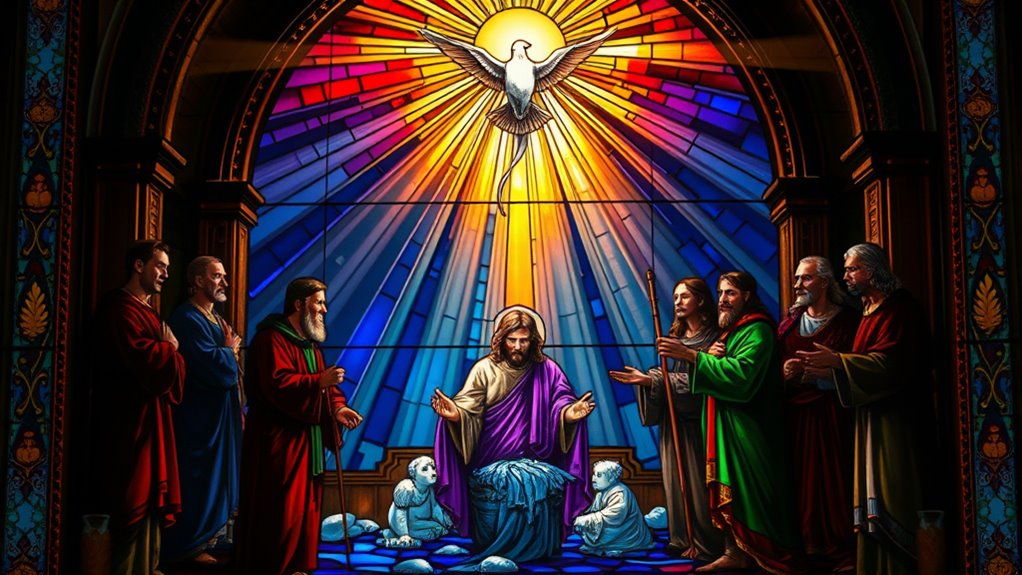
Baptism, across Catholic and Protestant traditions, is understood primarily as God’s action rather than a human achievement. Its meaning rests on Christ’s word of command and promise, not on personal effort or ritual performance. Romans 6:3–4 frames it as burial with Christ and rising into new life — something received, not earned. Acts 2:38 links it directly to forgiveness. For those ready to explore what Scripture actually says about each of these dimensions, more awaits ahead.
Baptism Is God’s Move, Not Yours
Most Christian traditions treat baptism as something a person chooses and performs, but Anglican teaching takes a different starting point.
In this framework, baptism is described as God’s work, not a human achievement. The sacrament draws its meaning not from the faith performance of the candidate but from Christ’s word of command and promise.
Anglican theology frames baptism as something God does for a person, rather than something a person does for God. This distinction shifts the entire weight of the act away from human effort and places it firmly on divine action. Dying and rising with Christ is not a metaphor for personal resolve but a declaration of what God has already accomplished in the believer. By contrast, other approaches emphasize that baptism follows a personal decision to follow Jesus and serves as an outward picture of an inward transformation already completed by faith.
Anglican teaching also locates baptism within the broader biblical themes of union with Christ and entrance into the community of faith.
Why Baptism Is an Act of Faith, Not a Rule to Follow
Receiving baptism is not the same as following a rule. Desiring God describes it as an ordinance meant for those who have already repented and come to faith, placing response before ritual.
Across Baptist and evangelical sources, baptism belongs after belief forms, not before. It expresses what faith has already received rather than earning what faith has not yet found.
Catholic teaching agrees that baptism without faith is not automatic or “magic.” The act, in this framing, is a faith-filled confession — something a person does because trust in Christ already exists, not to manufacture that trust from scratch. Scripture reinforces this in Romans 6:3-4, where baptism is described as being buried with Christ, signifying death to sin and the beginning of a renewed life.
The Greek word for baptize means to dip or immerse, not to sprinkle, a distinction that shapes how the burial and resurrection imagery of Romans 6 is understood and practiced across Baptist and evangelical traditions. The promise of eternal life through Christ, demonstrated by his victory over death, gives baptism its forward-looking hope.
Forgiveness, Cleansing, and What Happens in the Water
Once the nature of baptism as an act of faith is established, the question that follows concerns what the water itself signifies and what God is understood to do through it.
Scripture uses water as a visible picture of spiritual cleansing, since water removes dirt from the body. Ligonier identifies baptism as a sign and seal of forgiveness, while Desiring God clarifies that the water pictures cleansing rather than causing salvation. This visible symbolism points to spiritual cleansing that flows from God’s grace and forgiveness.
First Peter 3:21 describes baptism as an appeal to God for a good conscience. The forgiveness connected to baptism, most sources agree, belongs to those who repent. Acts 2:38 links repentance and baptism directly to the receiving of forgiveness of sins.
The Greek term επερωτημα in First Peter 3:21 is a hapax legomenon, appearing only once in the New Testament, and major lexicons define it as a formal request, appeal, or solemn pledge.
How Baptism Joins You to Christ’s Death and Resurrection
At the center of Romans 6, the apostle Paul connects baptism directly to Christ’s death, burial, and resurrection. Verse 3 states that believers are “baptized into his death,” and verse 4 describes burial “through baptism into death.” The movement is deliberate: death, burial, then resurrection. Paul presents this sequence not as ritual performance but as genuine union with Christ. This union also calls believers to live in ways that reflect biblical teachings about covenantal commitment and holiness, including the Bible’s teachings on marriage and sexual ethics.
The baptized person is described as having the old self buried with Christ, making room for new life. That new life, Paul writes, mirrors Christ’s own resurrection — received, not earned, and already begun in those joined to him. Further study and reflection on this teaching is available through the site’s Episodes, Sermons, Interviews for those seeking deeper understanding.
This is why baptism is fittingly described as a celebration — not merely a formality, but a declaration that the believer has been awakened and empowered by the Spirit to walk in newness of life.
How Baptism Makes You Part of God’s Family
Baptism carries a family-making weight that goes beyond ritual welcome. Catholic teaching describes the baptized person as a true child of God — adopted, claimed, and sealed. Romans 8 frames this as receiving the “Spirit of adoption,” shifting one’s identity from outsider to heir. Belonging comes before achievement; inheritance comes before performance.
- Baptism incorporates a person into a global, cross-generational community of believers
- The baptized become co-heirs with Christ, receiving the promise of eternal life
- Church membership becomes visible, marking entry into a shared covenant community
This family is not earned. It is given. The baptized are made temples of the Holy Spirit, receiving the indwelling presence of God as a direct consequence of their adopted status.
Jesus commanded baptism for all in his family, making it not an optional milestone but a direct expression of belonging. Belief is the sole biblical prerequisite, meaning the moment faith takes root, the invitation to be baptized follows immediately.
This incorporation echoes the biblical call to gather in community, where worship, teaching, and mutual encouragement define the life of the church.