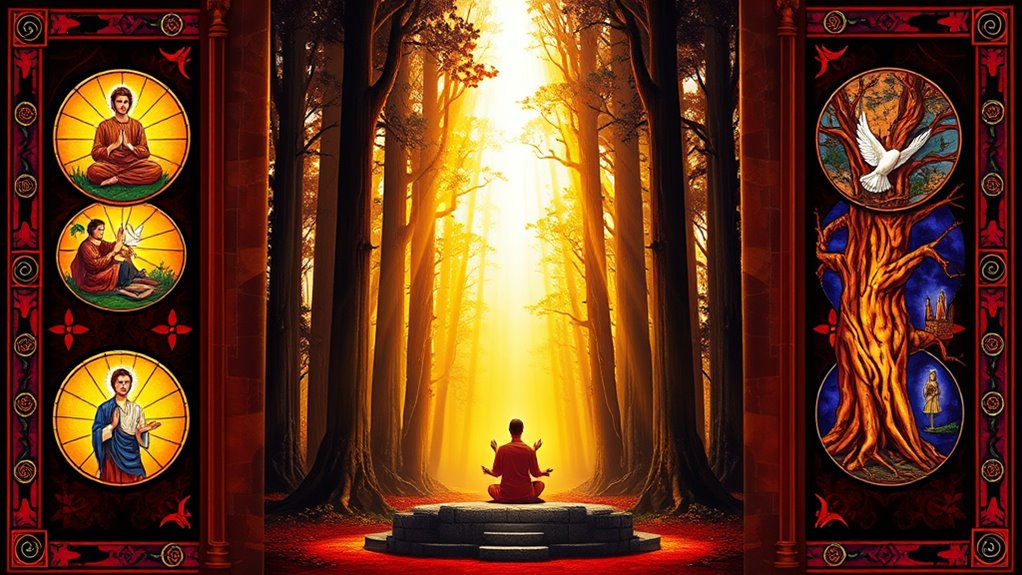
Roughly 29% of U.S. adults now identify as religiously unaffiliated, yet many retain the rituals they grew up practicing. Pew research shows 35% of Americans have left their childhood faith, while PRRI finds 67% stopped believing in their religion’s teachings. Still, weddings, funerals, and naming ceremonies persist because rituals reduce anxiety, mark change, and build belonging without requiring shared belief. The deeper reasons behind this quiet shift, and what it costs, are worth understanding.
Why Americans Are Walking Away From Organized Religion
Something significant is shifting in American religious life. According to Pew Research, 29% of U.S. adults now identify as religiously unaffiliated, up from 21% in 2013. About 35% of Americans have moved away from the faith of their childhood.
The reasons are varied but consistent. PRRI found that 67% of unaffiliated adults stopped believing in their religion’s teachings. Others cite moral conflicts, particularly around LGBTQ inclusion, which rose as a disaffiliation factor from 29% in 2016 to 47% in 2023. Clergy abuse scandals have further eroded trust, with 88% of unaffiliated adults reporting little confidence in religious leaders. Many who leave report shifting priorities toward personal spiritual practices over institutional affiliation.
Among those who have left organized religion, the largest previously affiliated groups were former Catholics and former mainline Protestants, each representing over one-third of the newly unaffiliated.
Research tracking over 1,300 participants from 2003 to 2013 found that while religious affiliation and attendance dropped sharply, belief in God remained stable, suggesting Americans are not abandoning faith itself but rather the institutions that house it.
Why Americans Keep the Rituals After They Drop the Religion
Walking away from a religion does not always mean walking away from its rhythms. Pew’s 2025 follow-up survey found that 35% of Americans had left their childhood religion, yet many retained its rituals. Researchers describe this pattern as religious residue.
Weddings still feature vows, witnesses, and solemn timing even when God goes unmentioned. Funerals and naming ceremonies keep their structure for similar reasons.
Rituals survive because they reduce anxiety, mark permanent change, and create belonging without requiring shared belief. Practice, it turns out, can outlast doctrine, quietly carrying forward what formal faith no longer holds. Among those who did leave, 46% left before age 18, suggesting that ritual habits formed in childhood often persist long after the doctrinal break.
The broader landscape of religion is shifting as people seek new ways to find meaning, connection, and flourishing outside institutional frameworks, with projections suggesting Christianity may no longer hold majority status by 2070. The persistence of communal practices also echoes biblical emphases on corporate worship as a place for encouragement, teaching, and shared rites.
What Rituals Give You That Doctrine Never Can
Beneath the creeds and catechisms, rituals operate on a different register entirely. Doctrine asks for belief; ritual asks for presence.
Research shows that bodily participation makes spiritual realities feel more tangible than abstract teaching alone. Rituals engage the whole person, including body, emotion, and attention, rather than only intellectual assent. They generate feelings of awe, contentment, and gratitude while reducing anxiety by creating a sense of personal control. Many people find that combining ritual with practices like prayer and Scripture meditation brings measurable inner calm in daily life.
Where doctrine explains, ritual enacts. Repeated practice reinforces commitment through physical performance, linking inner conviction to outward action in ways that a theological statement, however precise, rarely can. Rituals also serve to channel emotions in constructive ways during some of life’s most disorienting moments, including dying and funerals, offering structure when people need it most.
In ancient civilizations such as the Greeks, Romans, and Egyptians, communal rites held society together through shared emotions and symbols, suggesting that ritual’s social power long predates any formal system of belief.
The Real Cost of Going It Alone Spiritually
Freedom has a price, and for those who step away from organized religion to pursue spirituality on their own terms, that price often shows up in unexpected places. Research links chronic isolation to higher rates of depression and stress.
Freedom has a price. For solo spiritual seekers, that price often arrives as chronic isolation.
Solo seekers frequently face:
- Loss of shared meaning and guidance
- No communal check on distress or confusion
- Greater financial costs from solo retreats and travel
- Heavier self-management without institutional structure
The burden of interpreting difficult experiences alone can intensify rumination. Solitude, when chosen and time-limited, carries real value. When it becomes chronic, the costs quietly accumulate.
Without community and shared experience, even the most intentional spiritual journey risks losing the encounters with others that researchers and travelers alike describe as essential to the magic of the journey.
Many who walk this path report that teachings and gurus ultimately fall away, leaving them without even the alternative spiritual frameworks they once relied on for stability.
Scripture reminds anxious people to cast their anxieties on God and exchange worry for prayer, offering a pattern of communal and spiritual care that solo seekers may miss.
What’s Replacing Organized Religion in American Life
Leaving organized religion does not necessarily mean leaving spirituality behind. Many Americans are building new belief systems through mindfulness, therapy, art, music, and loosely structured personal practice. Prayer as communication remains central to many people’s personal practices even outside formal institutions.
Psychologists specializing in spiritual reconstruction are helping people create meaningful lives outside traditional frameworks, sometimes using cognitive behavioral therapy to identify distorted thinking and develop new patterns.
Survey Center on American Life data show that 47% of religiously unaffiliated Americans now believe a less religious country would be a positive development, compared to just 25% a decade earlier. The shift suggests not an absence of meaning, but a renegotiation of where meaning is found.
Research tracking young Americans from adolescence into adulthood found that meditation practice grew even as support for proselytism declined by nearly 10% across the same cohort, pointing to a reorientation toward personal spiritual practice rather than outward religious expression.
Among those navigating life outside organized religion, secular social networks have become increasingly central, with a majority of secular Americans now surrounded by secular close contacts and 62% married to nonreligious spouses, reflecting a broader clustering that shapes how this growing population understands community and belonging.