Bishop Heiner Wilmer’s February 2026 election as German Bishops’ Conference president positions him uniquely to navigate the Vatican standoff over the Synodal Path reforms. The 64-year-old multilingual diplomat, who speaks five languages and maintains Vatican connections, supports progressive reforms while respecting Rome’s concerns. His election required three rounds of voting among 56 bishops, suggesting internal divisions mirror the broader tension between German calls for women’s inclusion and traditional papal authority. Whether his bridge-building approach calms or inflames this rift remains uncertain, though his experience offers both factions reason for cautious optimism about what lies ahead.
In the shadow of years-long tensions between Germany’s Catholic bishops and the Vatican, Bishop Heiner Wilmer of Hildesheim was elected president of the German Bishops’ Conference in February 2026, succeeding the controversial Georg Bätzing. The election required three ballot rounds on Tuesday morning, with neither of the first two producing the required two-thirds majority. Progressive Bishop Franz-Josef Overbeck of Essen finished second in the final vote, when a simple majority became sufficient. Fifty-six bishops and auxiliary bishops participated in the spring plenary assembly in Würzburg.
Wilmer’s election signals a potential shift toward reconciliation with Rome compared to previous leadership. The 64-year-old bishop brings unusual qualifications to the role, speaking German, English, French, Spanish, and Italian. As former Superior General of the Sacred Heart of Jesus order, he gained extensive Vatican experience, living in Rome for theological studies and ecclesiastical service. He met privately with Pope Leo XIV in November and has visited the Vatican multiple times during Pope Francis’s papacy. A journalist covering his three predecessors noted unprecedented emphasis on “Christ,” “Jesus,” and “faith” in Wilmer’s inaugural press conference.
Wilmer’s multilingual skills and Vatican experience position him as a bridge-builder between German progressives and Rome’s traditional authority.
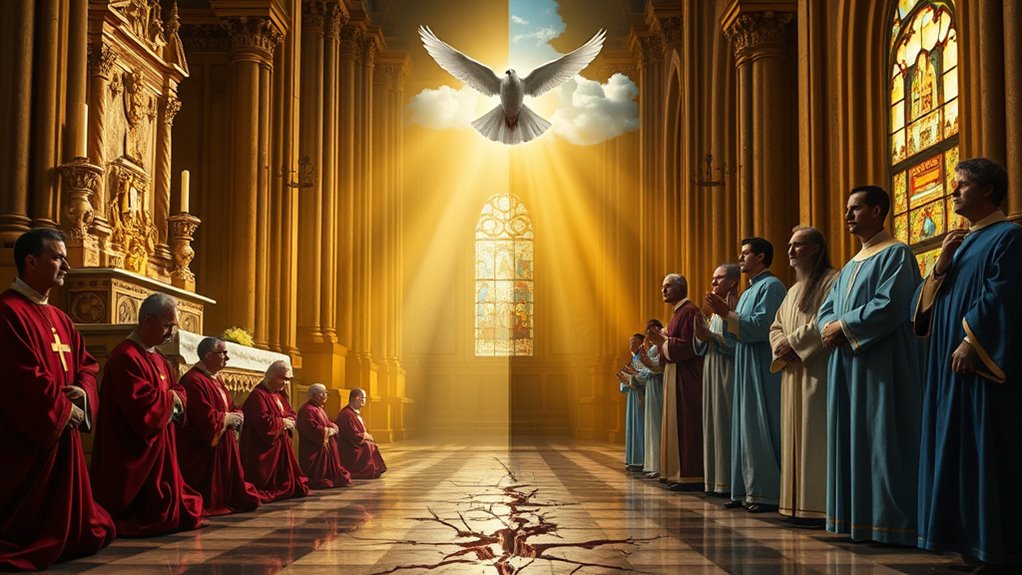
The German church experienced what observers called an “ecclesial earthquake” in 2019 following an abuse report containing thousands of victim testimonies. The subsequent Synodal Path remains contentious between German bishops and Vatican authorities, with progressive factions desiring accelerated reforms on women’s roles and power structures while conservative elements resist departures from traditional doctrine and papal authority.
German Episcopal media describes Wilmer as a bridge between conservative and progressive factions. He supports the Synodal Path while maintaining openness to Vatican concerns, stating that abuse of power exists in the “DNA of the Church.” He welcomes the World Synod’s placement of women in offices and ministries on its agenda, yet emphasized that “Christ stands at the center” in his inaugural address.
Wilmer expressed confidence that both Pope Francis and Pope Leo XIV support synodality as a “fundamental form of the Church.” While the conference president lacks direct governing authority over other bishops, the chairmanship carries significant symbolic weight in representing the direction of German Catholicism.
Leaders and citizens alike are reminded that biblical teaching emphasizes servant leadership as a model for exercising authority and pursuing justice.