
In the summer of 1830, twenty-four-year-old novice Catherine Labouré reported visions of the Blessed Virgin Mary at her Paris convent on Rue du Bac. During the November 27 vision, Mary appeared standing on a globe with rays of light streaming from her hands, instructing Catherine to create a medal bearing this imagery. Despite her spiritual director’s initial doubts, 1,500 medals were produced in 1832, spreading rapidly worldwide and sparking numerous reported miracles. Catherine remained anonymous for over forty years, continuing her humble service until her death in 1876, while the medal she introduced continues inspiring millions globally.
The visions of Saint Catherine Labouré began in the summer of 1830, when a twenty-four-year-old French novice reported a series of mystical encounters that would reshape Catholic devotion for generations. Born May 2, 1806, as the ninth of eleven children to Pierre and Madeleine Louise Labouré, Catherine entered religious life during a period when France was still recovering from the French Revolution’s anti-Church violence.
She began her novitiate on April 21, 1830, at a convent on Rue du Bac in Paris.
Catherine Labouré entered the convent on Rue du Bac in Paris as a novice on April 21, 1830.
On the night of July 18-19, 1830, the eve of Saint Vincent de Paul’s feast day, Catherine reported being awakened by a child’s voice, which she believed was her guardian angel. The child led her to the chapel, where the Blessed Virgin Mary awaited.
Mary told Catherine that God wished to entrust her with a mission during evil times in France and the world, instructing her to inform her spiritual director despite expected contradictions.
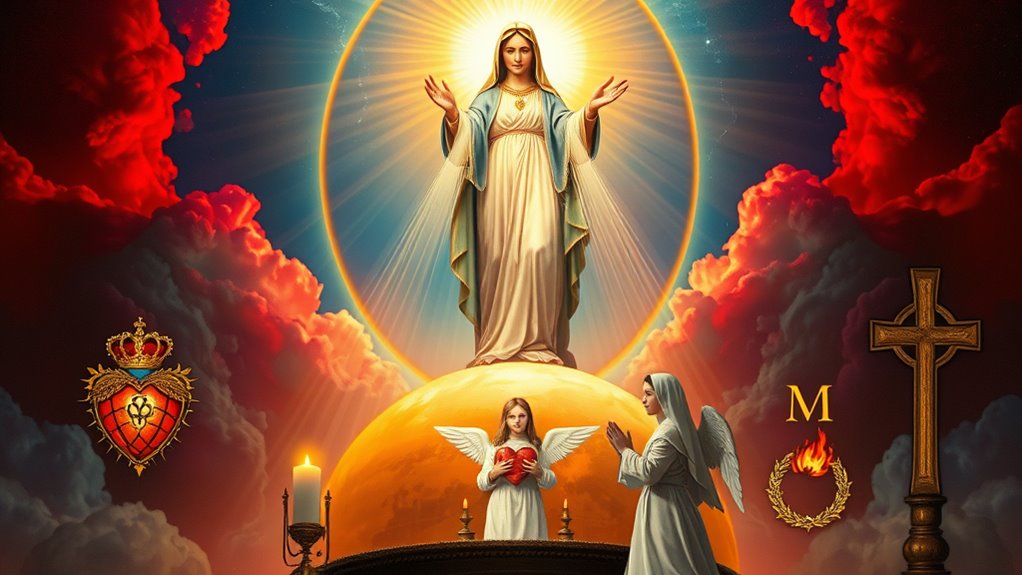
The most significant vision occurred on November 27, 1830. Catherine saw the Blessed Virgin standing atop a globe, hands emanating rays of light.
The reverse side featured a cross with the letter M, the Sacred Heart crowned with thorns, and the Immaculate Heart pierced by a sword.
Mary directed Catherine to create a medal bearing this image, with the inscription “O Mary conceived without sin, pray for us who have recourse to you.” Mary appeared within an oval frame with rays of light streaming from her hands, promising great graces to those who wore the medal.
Catherine immediately shared her visions with her spiritual director, Father Jean Marie Aladel, who doubted her for nearly two years, calling her delusional.
She persisted without altering her account, and in 1832 Aladel produced 1,500 copies of the medal.
The medal spread globally, popularizing the phrase “Immaculate Conception” before Pope Pius IX declared it dogma on December 8, 1854. The Miraculous Medals became associated with numerous miracles, including the conversion of Alphonse Ratisbonne.
Catherine remained anonymous about her visions for over forty years, serving at Hospice d’Enghien near Paris, where she cared for the aged and infirm.
She died December 31, 1876, at age seventy, having lived humbly and avoided prominence throughout her life. Her humble service reflected biblical ideals of stewardship and generosity, emphasizing care for the poor and trusting God for provision.