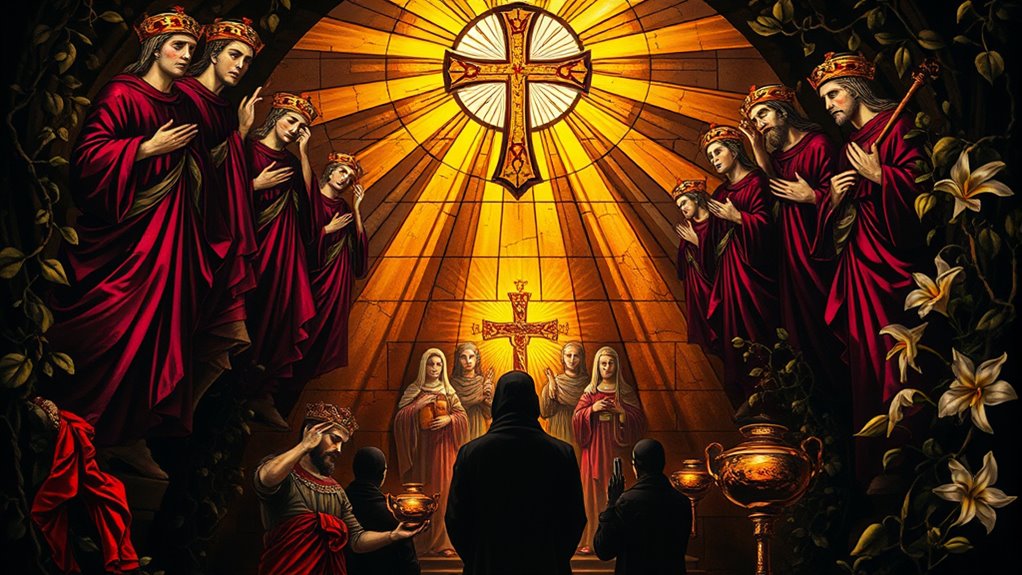
On December 8, 2025, Catholic protesters gathered outside Vienna’s Künstlerhaus Vereinigung to pray the rosary against an exhibition titled “You shall make yourself an image,” which featured a crucified green frog, a transgender Virgin Mary, and other controversial religious artworks. The Austrian Society for Protection of Tradition, Family, and Private Property organized the demonstration and launched an international petition demanding the show’s closure, citing attacks on core Catholic beliefs. Exhibition organizers defended the works as protected artistic expression, while Bishop Hermann Glettler of Innsbruck publicly praised the exhibition on Instagram, revealing divisions within the Catholic community over faith and contemporary art.
On December 8, 2025, the Solemnity of the Immaculate Conception, a group of Catholic faithful gathered outside Vienna’s Künstlerhaus Vereinigung cultural center to pray the rosary in protest of an exhibition they considered blasphemous.
The demonstrators, organized by the Austrian Society for Protection of Tradition, Family, Private Property (TFP), carried placards demanding an immediate end to what they called attacks on their faith. Many of the demonstrators cited scriptural calls to honesty found in the Ten Commandments as part of their moral reasoning.
The exhibition, titled “Du sollst dir ein Bild machen” (“You shall make yourself an image”), featured several controversial pieces. Among them were a crucified green frog, a bearded man dressed as a transgender Virgin Mary holding a child, and a naked parody of Michelangelo’s Pietà.
Protesters described these depictions as abominable mockeries of Christ and the Mother of God that struck at the heart of Catholic beliefs.
The Austrian TFP, supported by its American counterpart, launched an international online petition calling for the exhibition’s closure. The petition gathered signatures from Austria and abroad, with organizers arguing that the artworks constituted direct assaults on core elements of the Catholic faith.
Exhibition management responded by emphasizing that they had no intent to offend religious beliefs. According to organizers Oberhollenzer and Prušnik, provocation remains subjective and lies in the eye of the beholder.
They noted that many visitors, including Christians and Catholic clergy, expressed positive impressions of the works. The organizers also pointed to Austria’s constitutional protection of artistic freedom and described harmonious discussions with attendees. Artistic director Günther Oberhollenzer and president Tanja Prušnik defended the exhibition, citing constitutional protection of artistic expression and democratic culture.
Notably, Bishop Hermann Glettler of Innsbruck praised the exhibition on Instagram, calling it evidence of struggling with God’s mystery in a wounded world. He specifically mentioned the crucified frog among other pieces, representing high-ranking Catholic clergy who found value in the display.
The prayer rally, reported on December 12, highlighted the continuing tension between artistic expression and religious sensibilities. Pope Benedict XVI had previously intervened in 2008 when the crucified frog was exhibited in Italy, sending a letter expressing concern over offending religious sensibilities.
Pope Benedict XVI had previously noted that similar frog crucifix displays offended believers. The protest underscored deep divisions within the Catholic community itself regarding how faith and contemporary art should intersect.