The Basilica of Our Lady of Guadalupe in Mexico City welcomed a record 12.8 million pilgrims in December 2025, surpassing the previous year’s 12.5 million and reinforcing its position among the world’s most visited religious sites. Approximately 5 million arrived on December 12 alone for the feast day, traveling from Mexico and countries including Vietnam, China, and the United States. Thousands of security personnel and over 200 medical staff managed the largely peaceful gathering, treating 2,721 individuals. The celebration reflected enduring faith and devotion despite contemporary challenges, with further details illustrating the event’s spiritual and logistical dimensions.
How many pilgrims can gather in one place to honor a centuries-old devotion? In December 2025, the Basilica of Our Lady of Guadalupe in Mexico City provided a remarkable answer. An estimated 12.8 million pilgrims visited the basilica between December 11 and 12, surpassing the previous record of 12.5 million set just one year earlier.
The Basilica of Our Lady of Guadalupe welcomed a record-breaking 12.8 million pilgrims in December 2025, surpassing all previous gatherings.
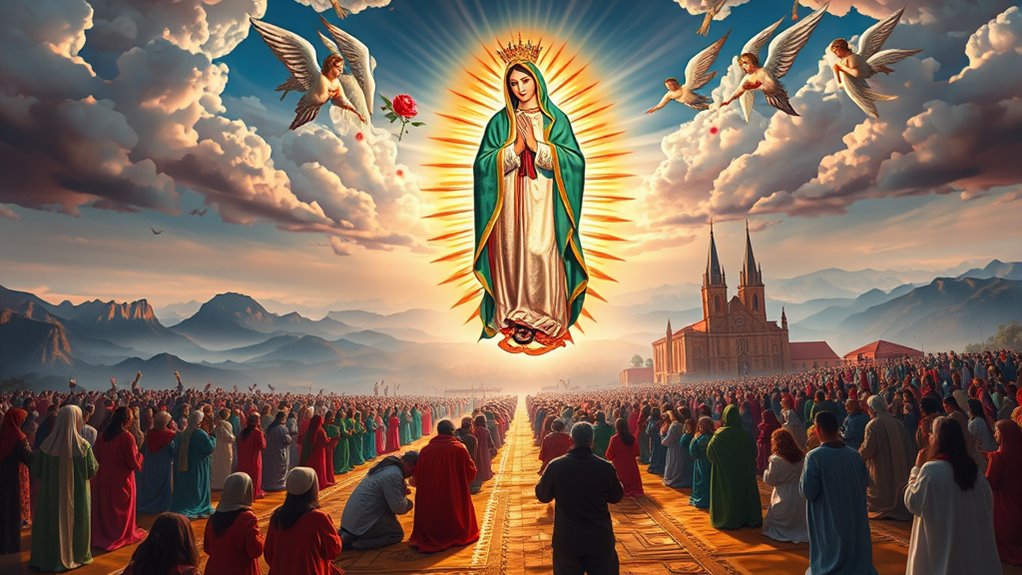
Mexico City Mayor Claudia Sheinbaum reported that approximately 5 million arrivals occurred on December 12 alone, the feast day celebrating the Virgin of Guadalupe’s appearance to Juan Diego in 1531.
The milestone establishes the basilica as one of the most frequented religious sites globally. Throughout a typical year, roughly 20 million pilgrims visit the sanctuary, with about 9 million traditionally arriving during the December 12 feast period. Visitor numbers exceed most well-known Marian sanctuaries by at least double annually.
On the feast day itself, typical flow reaches 95,000 Catholics per hour, though the basilica’s physical capacity stands at only 10,000 people with 5,200 seated spaces.
Pilgrims arrived from across Mexico and beyond, traveling on foot, motorcycle, bicycle, bus, and wheelchair. Tour groups from Vietnam, China, and the United States joined Mexican families, parish groups, dancers, and torch runners.
Festivities commenced at midnight with collective singing of “Las Mañanitas” to the Virgin. The faithful crowded basilica entrances to view the sacred tilma of Juan Diego, protected behind bulletproof glass and accessible via electronic moving sidewalks that prevent crowding. The occasion also prompted reminders from clergy about the importance of guarding one’s speech during celebrations.
Many brought roses and personal objects for blessings, offering prayers regarding health, relationships, and business matters. Some devotees approached the basilica kneeling or crawling as acts of devotion or gratitude.
Authorities deployed extensive resources to manage the unprecedented crowds. Five designated routes into the city featured government-operated food and water distribution centers.
Medical teams treated 2,721 individuals, with over 200 doctors and nurses staffing healthcare stations. Thousands of security officials guaranteed pilgrim safety throughout largely incident-free celebrations.
Officials described the outcome as a “clean slate” with no major disturbances, reporting only minor detentions for public order violations and theft. The working-class La Villa neighborhood hosted encamped pilgrims in its streets, embodying the enduring power of faith. Church leaders observed increased petitions reflecting fears about violence and insecurity, revealing collective anxieties beneath the devotion.