
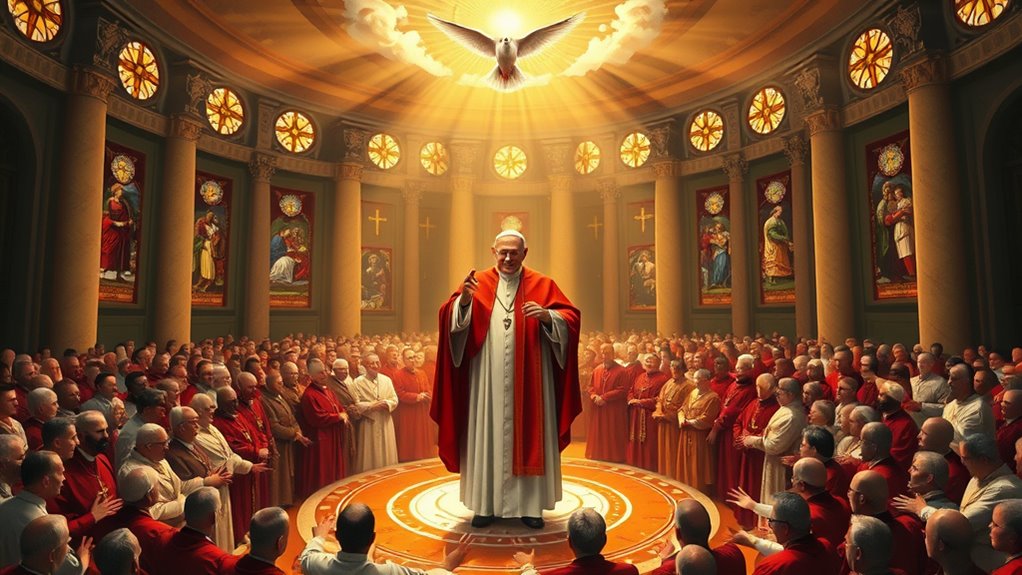
Pope Leo XIV has signaled continuity with his predecessor’s reform agenda while adopting a markedly different style. The 69-year-old Chicago native emphasizes consensus-building shaped by his Augustinian background, leading from the center of conversation rather than the top of a pyramid. His first consistory topics mirror Francis’ priorities: synodality, evangelization, and Curial reform. Yet his reserved demeanor, traditional Latin blessing, and cautious public interactions contrast sharply with Francis’ spontaneous warmth. Catholic scholars note he advances the same initiatives through measured, deliberate engagement that reflects both his temperament and governance philosophy.
While Pope Leo XIV‘s reserved demeanor marks a stark contrast to his predecessor’s spontaneous warmth, the newly elected pontiff appears to be following a path remarkably similar to the one Francis walked in his early days—prioritizing consensus over command and emphasizing the Church as a community rather than a hierarchy.
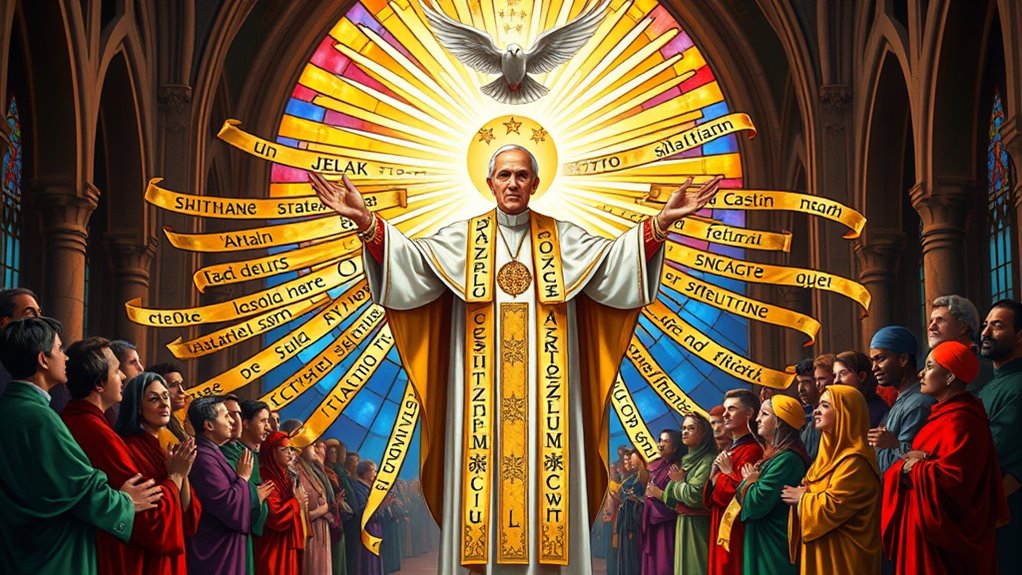
The 69-year-old Chicago native, who dressed in traditional red mozzetta and white cassock for his first public appearance, brings a measured communication approach that differs sharply from Francis’ outgoing personality. Cardinal Prevost was described as holding himself back where Francis might speak his mind immediately. Leo takes a cautious approach to public interactions, blessing babies but not holding them in his arms, contrasting with his predecessor’s spontaneous crowd engagement.
Despite these stylistic differences, Leo’s substantive agenda aligns closely with Franciscan priorities. In his first address, the new pontiff emphasized building a “synodal church” where all Catholics walk together, describing himself as the “successor of Peter” and “bishop of Rome” using St. Augustine’s language. His management of the consistory presented four topics aligned with Francis’ initiatives: synodality, evangelization, reform of the Curia, and the liturgy. The pontiff’s message focused on being a missionary church seeking peace, charity, and closeness to those suffering. He also emphasized the importance of marriage and family life as a foundational covenant instituted by God for Christian witness.
Leo’s consensus-driven approach stems from his background leading the Order of St. Augustine, a global and diverse religious community. This experience, requiring him to build consensus across fractious communities without hierarchical authority, shaped his governance style distinctly from Francis, who came from diocesan leadership. Leo served as superior of his local Augustinian community, formator of novices, and seminary professor before becoming bishop.
Catholic scholars note that Leo has been “mostly continuing the Francis initiatives in a different style.” The pontiff exercises his role not “at the top of the pyramid but as at the center of conversation,” praising his predecessor while invoking Francis’ emphasis on synodality and the message that Christianity should include everyone. Leo concluded his first appearance with the traditional Latin blessing addressed to the city and the world, a ceremonial choice that further signals his approach to papal authority.
Leo chose his regnal name honoring Pope Leo XIII, father of Catholic reflection on culture, politics, and economics, sending a symbolic message emphasizing continuity with tradition rather than departure from it.